
“Wherefore we receiving a kingdom which cannot be moved, let us have grace, whereby we may serve God acceptably with reverence and godly fear: For our God is a consuming fire.” (Hebrews 12:28–29)
The American church has become remarkably good at producing experiences. We know how to entertain, how to market, and how to attract a crowd. But somewhere along the way, we have forgotten something the Scriptures repeatedly emphasize: reverence. We have become so consumed with creating memorable services that we have neglected to remember who the service is actually for.
Church is not primarily about us. It is about Him.
Paul declared Christ to be the One “that in all things he might have the preeminence” (Colossians 1:18). Notice the scope of that statement. If Christ is to have the preeminence in every area of life, surely He must have the preeminence in His own church.
Yet all across America, that preeminence is quietly being surrendered. It is sometimes given to celebrity pastors, sometimes political movements, sometimes to emotional experiences, and sometimes to elaborate productions. Whatever takes center stage while Christ is pushed to the margins has become an idol, no matter how noble it may appear.
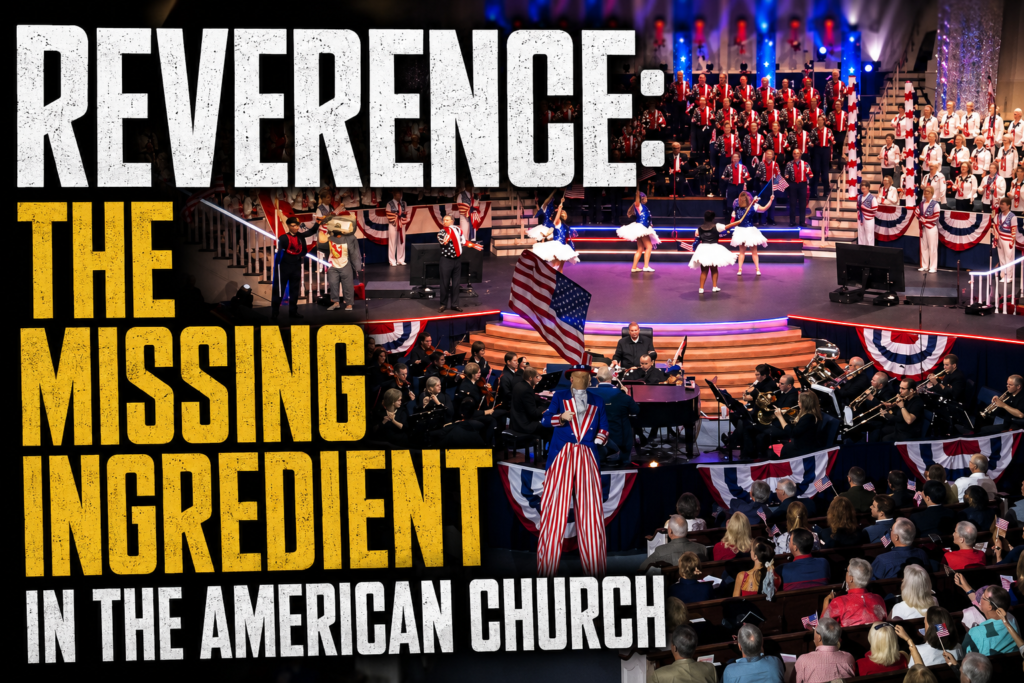
Recently, video from a patriotic service at First Baptist Church in Columbia, South Carolina, spread rapidly online. The service featured patriotic pageantry, dancing performers, a stilt walker, and an atmosphere that resembled a circus more than a gathered assembly of believers. I am unapologetically patriotic. I thank God for America and believe this nation has been uniquely blessed by His providence. Christians ought to be good and grateful citizens.
But the local church is not America’s stage. It is Christ’s church.
When the worship of God is eclipsed by dancing spectacle, we have crossed a line that should cause every Bible-believing Christian to pause. Turning the church into that kind of production dishonors the holiness due to God. We should tremble at the thought of making the gathering of Christ’s church revolve around anything that overshadows Him.
The prophet Malachi confronted priests who no longer treated God as holy. The Lord asked, “If then I be a father, where is mine honour? and if I be a master, where is my fear?” (Malachi 1:6). That question echoes through the centuries into our own generation.
Where is His honor? Where is His fear?
The psalmist declared, “God is greatly to be feared in the assembly of the saints, and to be had in reverence of all them that are about him” (Psalm 89:7). The assembly of believers is not a political rally. It is the gathered people of God assembling before a holy God.
Ecclesiastes 5:1 gives a warning that seems almost forgotten today: “Keep thy foot when thou goest to the house of God, and be more ready to hear…” Solomon did not tell God’s people to come expecting a performance. He told them to come prepared to listen.
Modern Christianity often reverses that order. Churches feel pressure to impress people before they instruct them. Sermons become lighter, music becomes louder, productions become grander, and entertainment becomes the attraction. Meanwhile, reverence quietly slips out the back door.
This same spirit has affected preaching itself. Ask Christians today why they enjoy a particular preacher, and you will often hear the same answer: “He’s hilarious.” Since when did that become the standard?
The New Testament never instructs pastors to become comedians. It commands them to “Preach the word” (2 Timothy 4:2). The pulpit is not a comedy club, a late-night talk show, or a place to audition for laughs. It is the place where eternal truth is proclaimed to eternal souls.
There is nothing wrong with an occasional moment of humor, but if people leave remembering the jokes while forgetting the text, something has gone terribly wrong. The Lord Jesus Christ was not crucified because He was funny. Paul was not beheaded because of his comedic timing. They preached with gravity because eternity is serious.
One of Satan’s greatest victories has been convincing churches that reverence drives people away. Scripture teaches the opposite. When Isaiah saw the Lord high and lifted up, he did not applaud; he cried, “Woe is me!” When John saw the glorified Christ, he fell at His feet as dead. Encounters with God’s holiness produce humility, not amusement.
May God restore to His churches what has been largely lost, not bigger productions, not funnier preachers, not more elaborate programs, but hearts that tremble at His word, pulpits that exalt Christ, and congregations that once again know what it means to worship Him with reverence and godly fear.
“He sent redemption unto his people: he hath commanded his covenant for ever: holy and reverend is his name.” Psalm 111:9
About The Author











Spot on!
Amen
Thank you