
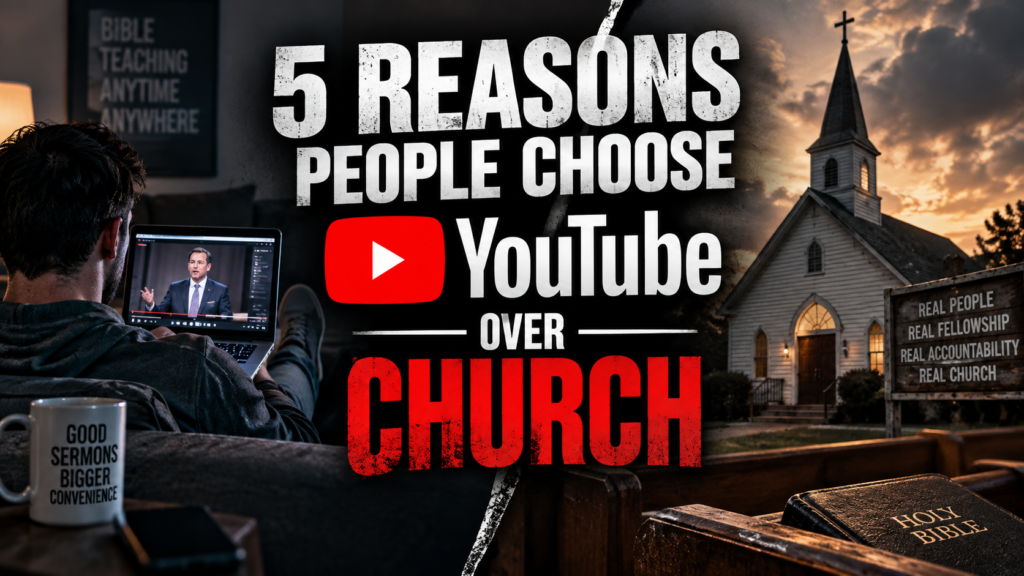
Something has changed in the way Christians consume preaching. It was not that long ago that if you wanted to hear a sermon, you had to go somewhere to hear one. Today, you can roll over in bed on Sunday morning, grab your phone, and within seconds listen to some of the best preaching in the country. You can find verse-by-verse Bible teaching, livestreamed services, podcasts, theological discussions, and entire Bible conferences without ever putting on your shoes.
As someone who has an online ministry, I am certainly not against Christian content on the internet. I believe it can accomplish a tremendous amount of good. I want Bible-believing Christians using every tool available to spread the truth as far as we possibly can. But there is a difference between using YouTube and replacing the local church with YouTube.
It would be easy for pastors to blame the people. We could simply say Christians have become lazy, rebellious, and unwilling to attend church. Sometimes that is exactly the problem. But that answer is far too convenient. Some people are looking online because they are finding something there that they are not finding in their churches. If we are going to deal honestly with the problem, both the pulpit and the pew need to be examined.
1. Shallow Sermons
One reason people are turning to YouTube is painfully simple. They are hungry.
There are Christians sitting in churches every Sunday who genuinely want to understand their Bible. They want somebody to open the Bible, explain the text, compare Scripture with Scripture, and actually teach them something. Instead, far too many pulpits are giving them twenty minutes of motivational speaking, recycled illustrations, personal stories, and three points loosely attached to a Bible verse.
Paul’s command to Timothy was not complicated: “Preach the word; be instant in season, out of season; reprove, rebuke, exhort with all longsuffering and doctrine” (2 Timothy 4:2). Paul warned that the time would come when people would “not endure sound doctrine,” but would heap to themselves teachers, “having itching ears” (2 Timothy 4:3). There is certainly responsibility on the hearer. Some people do not want strong preaching. They want their ears scratched instead of their hearts searched. But that does not excuse shallow preaching.
Paul could say in Acts 20:27, “For I have not shunned to declare unto you all the counsel of God.” Timothy was commanded to study, to be a workman, and to be “rightly dividing the word of truth” (2 Timothy 2:15). The preacher has a responsibility to know his Bible and feed his people. Far too many preachers wouldn’t know right division from a right hook.
Pastors cannot complain that people are going online for Bible teaching while refusing to give them serious Bible teaching from their own pulpits. If a man can learn more about his Bible from a forty-five-minute YouTube video than he does after six months of sitting under your preaching, we ought to at least be willing to ask why.
In fact, part of the reason I am writing this article is because I recently saw two preachers online complaining about podcasts and YouTube channels. One specifically issued the challenge to “put up or shut up.” But what exactly are we supposed to put up? Unregenerate converts who have been led in a prayer devoid of the Gospel? Pictures of socks and cuff links? Jokes about coffee or women’s weight? If churches want to know why Christians are looking for serious Bible teaching elsewhere, perhaps the answer is not to complain about the people producing it. Perhaps we ought to take a harder look at what some pulpits have been producing instead.
2. Cover-Up Culture
This one is considerably uglier. Some people have not lost confidence in the local church because they hate Christianity. They have lost confidence because they watched a church demand accountability from ordinary members while protecting pastors, prominent families, ministries, or institutions when serious wrongdoing occurred.
Sometimes this is dressed up in spiritual language. We are told that we need to “protect the testimony of the church.” But covering sin does not protect the testimony of the church. It destroys it. Protecting a guilty man because exposing what happened might embarrass the ministry is not defending the church.
The Bible gives protection to church leadership against reckless accusations. First Timothy 5:19 says, “Against an elder receive not an accusation, but before two or three witnesses.” But the passage does not end there. Paul immediately says, “Them that sin rebuke before all, that others also may fear” (1 Timothy 5:20). He then commands Timothy to observe these things “without preferring one before another, doing nothing by partiality” (1 Timothy 5:21).
There cannot be one standard for the man in the pew and another for the man behind the pulpit.
Ephesians 5:11 says, “And have no fellowship with the unfruitful works of darkness, but rather reprove them.” Proverbs 28:13 warns, “He that covereth his sins shall not prosper: but whoso confesseth and forsaketh them shall have mercy.”
When wrongdoing is buried because exposing it might hurt the ministry, people notice. When ordinary members are disciplined while important people are protected, people notice. When preserving the reputation of the institution becomes more important than doing what is right, people notice. Eventually some of those people leave.
3. Accountability
Now the spotlight needs to turn around, because there is another reason YouTube Christianity is attractive. YouTube asks almost nothing from you.
You can listen to a preacher every week without that preacher knowing your name. He does not know whether you are living right. He does not know whether you have disappeared for six months. He cannot personally admonish you. He cannot ask you difficult questions. He cannot watch for your soul in any meaningful pastoral sense. If he says something you do not like, you can close the video and find another preacher who agrees with you within thirty seconds.
That is an incredibly comfortable form of Christianity.
Hebrews 13:17 says, “Obey them that have the rule over you, and submit yourselves: for they watch for your souls, as they that must give account.” First Thessalonians 5:12 tells believers to “know them which labour among you, and are over you in the Lord, and admonish you.” There is pastoral authority in those passages, and there is real responsibility attached to that authority.
That does not mean pastors are dictators. First Peter 5:2–3 tells pastors to feed the flock and take the oversight while specifically warning them against being “lords over God’s heritage.” Biblical pastoral authority has boundaries. Submission to a pastor is not blind obedience to a man.
But the opposite error is creating a Christianity where nobody has any meaningful spiritual authority in your life. YouTube allows you to have preaching without accountability. For some people, that is not an unfortunate weakness of online ministry. It is precisely the attraction.
4. Confusing Content With Church
Technology has blurred an important distinction. For many Christians, the church itself has been reduced to another piece of Christian content. If church is nothing more than a sermon, some singing, and a few announcements, then a podcast, livestream, or on-demand video begins to look like a reasonable substitute. After all, the content can be delivered through a screen just as easily as it can from a pulpit. But the church was never intended to be merely content that Christians consume. A livestream can show you what happened at church, but watching church happen is not the same thing as being part of the church that assembled.
Look at what happened when people believed Peter’s preaching in Acts 2. “Then they that gladly received his word were baptized: and the same day there were added unto them about three thousand souls” (Acts 2:41). The next verse says they “continued stedfastly in the apostles’ doctrine and fellowship, and in breaking of bread, and in prayers.”
They did not merely continue listening to Peter’s sermons. They were baptized. They were added. They continued together.
Paul uses equally clear language in 1 Corinthians 14:23: “If therefore the whole church be come together into one place.” The church literally came together.
Watching an assembly is not assembling. Watching someone serve is not serving. Watching somebody else take the Lord’s Supper is not taking the Lord’s Supper.
None of this makes online ministry worthless. Far from it. Online preaching can reach people who might never walk through the doors of your church. It can answer questions, strengthen believers, spread sound doctrine, and introduce people to truths they have never heard. But Christian media works best as a supplement to the local church, not a substitute for it.
5. Bad Ecclesiology
Ultimately, I believe this is the root of the problem. If you have a bad doctrine of the church, replacing church with YouTube makes perfect sense.
If church is basically a weekly event where you sit down, sing a few songs, listen to a sermon, and go home, then why wouldn’t YouTube replace it? In fact, YouTube might seem better. You can choose the preacher. You can choose the subject. You can pause him, rewind him, or turn him off. You do not have to drive anywhere, and you can probably find someone who teaches the Bible better than the average preacher within driving distance of your house.
But all of that assumes that church exists primarily for you to consume something. That is bad ecclesiology.
Acts 2:42 says the believers “continued stedfastly in the apostles’ doctrine and fellowship, and in breaking of bread, and in prayers.” Church involves doctrine, but it does not stop with doctrine. Paul describes believers as members of a body. First Corinthians 12:25 says “that the members should have the same care one for another.” When one member suffers, the others suffer with him. When one member is honoured, the others rejoice with him. Then Paul says, “Now ye are the body of Christ, and members in particular” (1 Corinthians 12:27).
The Christian is not merely an audience member.
First Peter 4:10 says, “As every man hath received the gift, even so minister the same one to another.” Your spiritual gifts were not given merely for your own benefit. They were given so that you could minister to somebody else.
That changes the question completely. And, this question cannot be answered with a YouTube subscription.
There is plenty of blame to go around. Pastors need to preach the Bible deeply enough that hungry Christians are actually fed. After all, pastors are to be “apt to teach.” Churches need to stop protecting institutions and personalities when truth demands accountability. Christians need to stop using online preaching as a way of avoiding pastoral accountability. And all of us need to recognize the difference between consuming Christian content and participating in the life of a local church.
I believe in online ministry. I intend to keep doing it. We ought to use every tool available to preach the Gospel and teach the Bible to as many people as we possibly can. But we need to understand the purpose of the tool.
YouTube can help the church. But YouTube cannot be the church.
For more cultural commentary, Bible studies, and interviews, subscribe to The Watchman’s Warning on YouTube.
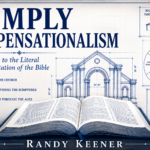
If you would like to learn more about dispensationalism and how rightly dividing the word of truth helps you understand the Bible, click HERE to purchase Simply Dispensationalism, a straightforward introduction to dispensational thought and the literal interpretation of Scripture.
About The Author






Amen..well stated!
Another excellent article.
Thank you
Truth !