
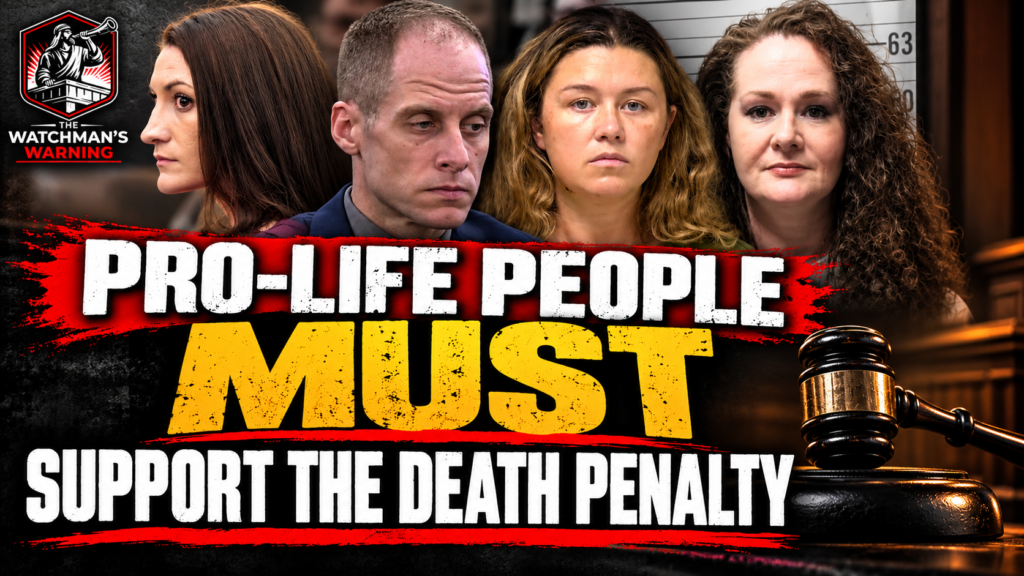
With several high-profile trials and scandals once again placing questions of crime, punishment, and justice before the public, I believe it is necessary to revisit a subject I have addressed before: capital punishment. A consistent pro-life position demands both the protection of innocent life and justice for those who deliberately take it. If human life truly possesses the value we claim it does, then the intentional murder of an innocent person must carry a penalty proportionate to what was taken. For that reason, I contend that a morally consistent pro-life position must include support for the death penalty.
One of the most common charges made against Christians who oppose abortion while supporting capital punishment is that the two positions are inconsistent. The argument is simple enough: if you are really “pro-life,” how can you support putting someone to death? The objection sounds compelling until we recognize that it treats every taking of human life as morally equivalent. There is a fundamental difference between taking innocent life and the lawful punishment of someone who has deliberately taken innocent life. In fact, the biblical argument for capital punishment begins not with a low view of human life, but with an extremely high one.
Following the flood, God established a principle for human society that reaches all the way back to the value He placed upon mankind at creation. Genesis 9:6 says, “Whoso sheddeth man’s blood, by man shall his blood be shed: for in the image of God made he man.” God does not demand the life of the murderer because human life is cheap or disposable. He demands an accounting for murder because man was made in the image of God. Murder is therefore more than an offense against another individual or against society. It is an attack upon a creature who is made after the similitude of his Creator.
This is precisely why opposition to abortion and support for capital punishment are not inherently contradictory. The child in the womb is innocent. He has committed no crime and harmed no one. He is defenseless and completely dependent upon others for his protection. A murderer stands in an entirely different moral position. He has deliberately deprived another person of something that can never be restored. When someone murders another human being, he takes not only the victim’s present life but every day that person would have lived afterward. He takes years from a husband or wife, a father or mother, a son or daughter. He takes birthdays, anniversaries, conversations, memories and experiences that can never occur. The seriousness of the punishment reflects the seriousness of what has been taken. The murderer has truly stolen the most precious commodity any of us have been given by God, time.
The above principle established in Genesis does not disappear when we reach the New Testament. Paul plainly recognizes the authority of civil government to punish evil. Romans 13:3–4 says, “For rulers are not a terror to good works, but to the evil. Wilt thou then not be afraid of the power? do that which is good, and thou shalt have praise of the same: For he is the minister of God to thee for good. But if thou do that which is evil, be afraid; for he beareth not the sword in vain: for he is the minister of God, a revenger to execute wrath upon him that doeth evil.” Whatever else may be said about this passage, Paul certainly did not regard the civil ruler as possessing merely symbolic authority. The ruler bears a sword, and a sword is an instrument capable of taking life. Government has been entrusted with an authority that does not belong to private individuals.
That distinction is especially important because capital punishment is sometimes dismissed as nothing more than revenge. Scripture actually separates personal vengeance from civil justice. At the end of Romans 12, Paul tells believers, “Dearly beloved, avenge not yourselves” (Romans 12:19). Yet almost immediately afterward he describes the civil ruler as “a revenger to execute wrath upon him that doeth evil.” Those statements are not contradictory. They describe two different spheres of authority. I do not have the right to hunt down someone who has wronged me and administer whatever punishment I believe he deserves. Civil government, however, does possess the authority to investigate crime, establish guilt and impose lawful punishment.
None of this means that government should exercise the death penalty carelessly. If anything, a biblical view of the sanctity of life demands an extraordinarily high standard before a person is executed. Death is irreversible. False testimony, dishonest prosecutors, corrupt officials and unreliable evidence are serious matters. Executing an innocent person would itself constitute a terrible miscarriage of justice. Scripture repeatedly emphasizes the necessity of establishing guilt and condemns false witnesses. Supporting capital punishment does not require supporting careless convictions or pretending that governments are incapable of making mistakes. Government possesses legitimate authority, but government can abuse legitimate authority just as parents, pastors and individuals can abuse theirs.
Once guilt has been established beyond reasonable doubt, however, Scripture also warns against allowing punishment to become an empty threat through endless delay. Ecclesiastes 8:11 says, “Because sentence against an evil work is not executed speedily, therefore the heart of the sons of men is fully set in them to do evil.” Solomon understood something about human nature that modern society often prefers to ignore. When wrongdoing is followed by consequences that are distant, uncertain or endlessly postponed, the restraining effect of punishment is weakened. A sentence that exists only on paper while decades of delay follow can cease to communicate the seriousness that the sentence was intended to convey.
Executing judgment speedily does not mean executing it recklessly. There must be a trial. Evidence must be examined. Witnesses must be tested. The accused must have an opportunity to defend himself, and reasonable procedures should exist to uncover wrongful convictions. There is nothing biblical about rushing an innocent man to his death. At the same time, there is a difference between careful justice and perpetual delay. A system can become so cumbersome that punishment is postponed for decades while the victim’s family grows old waiting for the sentence to be carried out. Ecclesiastes warns that such delay has moral consequences for society because men learn from what they see government tolerate, excuse, and postpone.
There is also no conflict between capital punishment and the Christian doctrine of forgiveness. A Christian may forgive the man who murdered someone he loves while still believing that the murderer should face the legal consequences of his crime. Forgiveness concerns the disposition of the heart and our refusal to pursue personal vengeance. It does not require the abolition of civil justice. If forgiveness automatically removed earthly consequences, Christian judges could never sentence criminals, Christian parents could never discipline children and churches could never exercise discipline against members who had been forgiven. Mercy and consequence can exist at the same time.
Neither does the death penalty place a murderer beyond the reach of the grace of God. The gospel is able to save murderers. Moses killed a man. David arranged the death of Uriah. Paul participated in the persecution of Christians and consented to the death of Stephen. There is no murderer whose sins are too great for the blood of Jesus Christ. A man sitting under a sentence of death can believe the gospel. He can receive eternal life even while facing the temporal consequences of what he has done.
That is why many Christians can oppose abortion and support capital punishment without seeing a contradiction between the two positions. The unborn child and the convicted murderer are both human beings, but they do not stand in the same relationship to justice. Treating those situations as though they were morally identical does not demonstrate a greater respect for life. It removes the distinction between the innocent and guilty.
Christians oppose the murder of the innocent because human beings are made in the image of God. For that very same reason, many Christians believe the murderer must face the penalty God attached to the deliberate shedding of innocent blood. There is no contradiction in those positions. Both begin at the same place: human life has enormous value because the God who created it has declared that it does.
For more cultural commentary, Bible studies, and interviews, subscribe to The Watchman’s Warning on YouTube.
To support the Watchman’s Warning, click HERE.
About The Author













Amen
Very well explained
Thank you