
There are three institutions that God established for the ordering of human life: the home, the church, and civil government. Each has its own purpose and sphere of authority, and none has the right to swallow up the others. Yet there is a principle common to all three. None of them can function as God intended unless people are willing to submit to legitimate authority. However, human beings have an authority problem.
We usually notice rebellion when somebody else is guilty of it. Parents see it in their children. Pastors see it in church members. Citizens see it in criminals. But resistance to authority is much deeper than outward lawlessness. It is woven into fallen human nature. We are perfectly comfortable with authority as long as we agree with it. The real test comes when authority crosses our will.
That conflict goes all the way back to the beginning. Satan said, “I will be like the most High” (Isaiah 14:14). His rebellion was an attempt to abandon his proper place as a creature under the authority of his Creator. The same idea appeared when the serpent approached Eve. “Ye shall be as gods” (Genesis 3:5) was an invitation to step outside the boundaries God had established and determine good and evil independently of Him. That temptation has never disappeared. Fallen man still wants to be his own god.
This explains why biblical submission is so offensive to modern thinking. Submission requires us to acknowledge that there are legitimate authorities outside ourselves. It means there are circumstances in which another person has the God-given right to lead and I have the responsibility to follow. That does not sit well with a culture that increasingly treats personal autonomy as one of its highest virtues.
Consider the home. Paul writes, “For the husband is the head of the wife, even as Christ is the head of the church” (Ephesians 5:23). That verse is almost guaranteed to produce objections today, but Paul does not apologize for it or qualify it out of existence. God placed an order within the family.
Of course, biblical headship is not tyranny. The same passage commands the husband to love his wife “even as Christ also loved the church, and gave himself for it” (Ephesians 5:25). A man’s position does not give him permission to be cruel, selfish, manipulative, or abusive. In fact, the husband himself is a man under authority. Christ is his head, and he will answer to Christ for the way he leads his family.
Nevertheless, the abuse of authority does not eliminate authority. God still tells wives to submit to their own husbands and children to obey their parents. A family in which nobody recognizes any authority eventually becomes a collection of individuals fighting for their own interests. Love is certainly necessary in the home, but love does not remove order. The biblical family requires people who are willing to accept the place God has given them.
The same principle appears in the local church. Jesus Christ is the head of the church, and no pastor has the right to take His place. A congregation does not belong to the preacher, the deacons, the largest family, or the biggest giver. Peter warned elders against being “lords over God’s heritage” (1 Peter 5:3). Pastoral authority is therefore limited and delegated. A preacher has no biblical right to control every detail of another Christian’s life, bind consciences where Scripture has left men free, or demand obedience to something contrary to the Bible.
At the same time, Hebrews 13:17 still says, “Obey them that have the rule over you, and submit yourselves: for they watch for your souls.” There really is such a thing as spiritual authority within the local church. A church cannot function when every member recognizes pastoral leadership only when the pastor agrees with them. Neither can a congregation survive when every correction becomes grounds for departure and every disagreement is treated as an attack. Sometimes a Christian simply has to be willing to be led.
That does not require blind loyalty. It requires enough humility to recognize legitimate authority while keeping every human authority beneath the Scripture. If a pastor contradicts the Bible, the Bible wins. But if Scripture gives him room to lead, then the problem may not be the leadership. It may be our resistance to being under anybody.
Civil government operates on a similar principle, though within a very different jurisdiction. Romans 13:1 says, “Let every soul be subject unto the higher powers. For there is no power but of God.” Peter likewise writes, “Submit yourselves to every ordinance of man for the Lord’s sake” (1 Peter 2:13). Civil authority exists for the preservation of order and the punishment of evil. Romans 13 even describes the ruler as bearing the sword.
Government is not absolute, because no human authority is absolute. When rulers command what God forbids or forbid what God commands, the apostles give the Christian his answer: “We ought to obey God rather than men” (Acts 5:29). There comes a point where obedience to a higher authority requires disobedience to a lower one.
But Acts 5:29 should not become a convenient excuse for refusing every law we dislike. There is a difference between being commanded to disobey God and simply being inconvenienced. Christians can be just as susceptible as anyone else to dressing personal stubbornness in the language of principle.
The issue of authority reaches beyond human institutions. It affects the way we approach the Bible itself.
This is one reason the King James Bible issue is about far more than manuscript evidence, Greek vocabulary, or translation philosophy. At its heart is a question of final authority. Does the Christian possess the words of God in a Book to which he can submit, or does he possess a book that remains subject to continual correction by an academic class standing over it?
This is why the battle over the Bible touches the same nerve found everywhere else. Man does not like having something above him that he cannot correct. He would rather corrupt the Book than allow the Book to correct him.
That instinct is not confined to liberal theologians or unbelieving academics. Bible believers have to guard against it too. It is possible to loudly defend biblical authority while quietly refusing to submit to what the Bible says about our marriage, our church, our money, our temper, our pride, or our conduct. There is little virtue in defending the authority of Scripture in theory while resisting it in practice.
The answer to rebellion is not unlimited human authority. Scripture never gives husbands, pastors, or governments a blank check. Every earthly authority is delegated, limited, and accountable to God. The husband who demands submission while refusing Christ’s authority has missed the point. So has the pastor who demands obedience while ignoring Scripture, or the government that treats its own power as supreme.
Biblical authority always has something above it until we finally reach God Himself.
That is why Christian submission is not servility. We do not obey men because men are always right. We submit to legitimate authority because God has established order, and our submission to that order is ultimately an act of submission to Him.
Jesus Christ Himself demonstrated this perfectly. Though He was God manifest in the flesh, Luke tells us that as a young man He went home with Joseph and Mary “and was subject unto them” (Luke 2:51). In Gethsemane, facing the cross, He prayed, “nevertheless not my will, but thine, be done” (Luke 22:42).
That stands in remarkable contrast to Satan’s declaration in Isaiah 14. Satan said, “I will.” Christ said, “not my will, but thine.”
We spend a great deal of time talking about what is wrong with our homes, churches, and governments. There are certainly plenty of failures among those who hold authority, and Scripture gives us no reason to excuse them. But there is another side to the equation that receives far less attention. Good authority cannot accomplish much among people determined not to be governed.
A marriage cannot operate biblically when husband and wife are competing for control. A pastor cannot effectively shepherd people who refuse to be led. Civil society cannot maintain order when every individual considers himself a law unto himself. The issue underneath all of these is remarkably simple: Who has the right to tell me no? Our answer to that question reveals quite a bit about us.
Scripture also says, “submitting yourselves one to another in the fear of God” (Ephesians 5:21). There is a mutual submission that ought to characterize the entire body of Christ. We are not all trying to get our own way, defend our own territory, or prove our own importance. We willingly yield to one another when no biblical principle is at stake, preferring our brethren above ourselves and seeking the good of the body rather than our own interests. This does not erase the offices or authority God established; it describes the spirit in which the whole Christian ought to function.
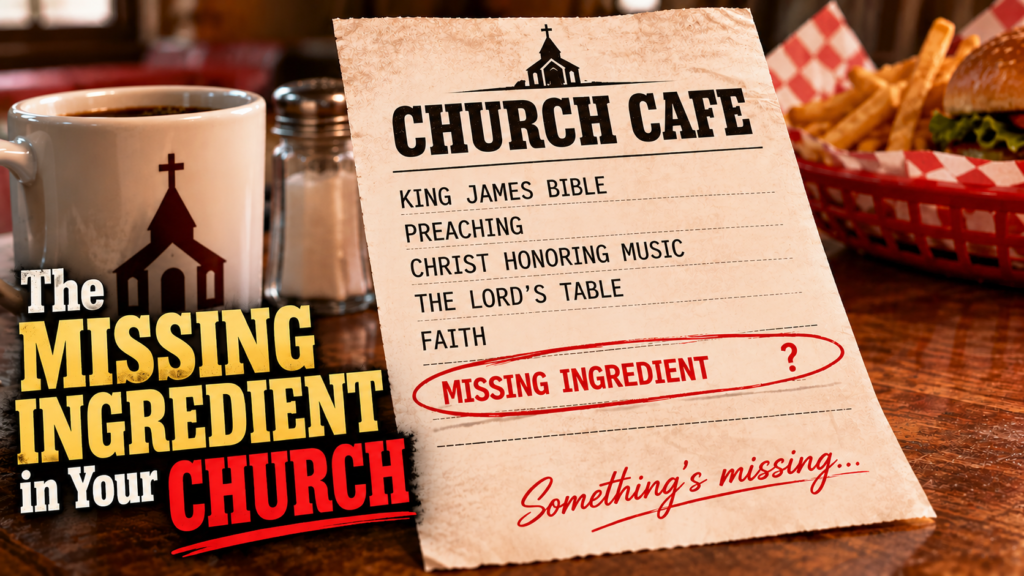
On a practical level, if your home is falling apart, your church is stagnant and unable to move forward, or your Christian life has grown stale, perhaps the first place to look is in the mirror. Am I submitting to the authority He has established, or am I fighting against it because it crosses my own will? Sometimes the secret sauce is simply finding your place in God’s order, submitting to the authority He has established, and faithfully doing what He has given you to do.
After all, when I knowingly rebel against the authority God has placed in my life, my rebellion is not merely against man; ultimately, it is against God.
For more cultural commentary, Bible studies, and interviews, subscribe to The Watchman’s Warning on YouTube.
If you would like to learn more about the local church and surrounding authorities, click HERE to purchase Children of Obedience, a straightforward introduction to this topic and its application.
About The Author











Great articles!
Amen
Excellent
Thank you