The source of our faith is the word of God (Rom. 10:17). Where did our Bible come from? How do we know we have exactly what God intended today? A church council? Through the ongoing discoveries of academic scholarship? Are we missing books of the Bible?
Secular historicists and textual critics often argue that we should analyze the Scriptures from the ground up, relying solely on human reason, empirical evidence, and naturalistic probability to examine ancient manuscripts. This human-centered approach, known as homo mensura, considers the Bible merely as a human creation, placing fallible human scholars as the ultimate authority over God’s words. However, as believers, we are called to a markedly different, top-down approach. True bibliology starts not with human intellect alone but with the self-authenticating word of the living God (autopistos), which conveys His living voice directly to believers through an infallible standard that we can hold in our hands.
The Biblical origin is clear:
2 Timothy 3:16 “All scripture is given by inspiration of God…”
2 Peter 1:20-21 “Knowing this first, that no prophecy of the scripture is of any private interpretation. For the prophecy came not in old time by the will of man: but holy men of God spake as they were moved by the Holy Ghost.”
1 Corinthians 2:10 “But God hath revealed them unto us by his Spirit: for the Spirit searcheth all things, yea, the deep things of God.”
Therefore, our reasoning must be rooted and grounded in what the Bible reveals about itself. It is an epistemological issue, not a manuscript-evidence issue.
The true foundation of Scriptural authority is unveiled in the High Priestly Prayer of Jesus Christ in John 17. As Jesus poured out His heart to the Father, He revealed the exact nature of the words He uttered throughout His earthly ministry: “For I have given unto them the words which thou gavest me; and they have received them, and have known surely that I came out from thee” (John 17:8). Jesus operated in total, sinless submission, speaking not of Himself, but communicating exclusively what the Father commanded Him to utter (John 7:16, 12:50). Having received these divine words, Christ then transferred them directly to His chosen Apostles through God-ordained authority, conferring full Scriptural authority upon their testimony.
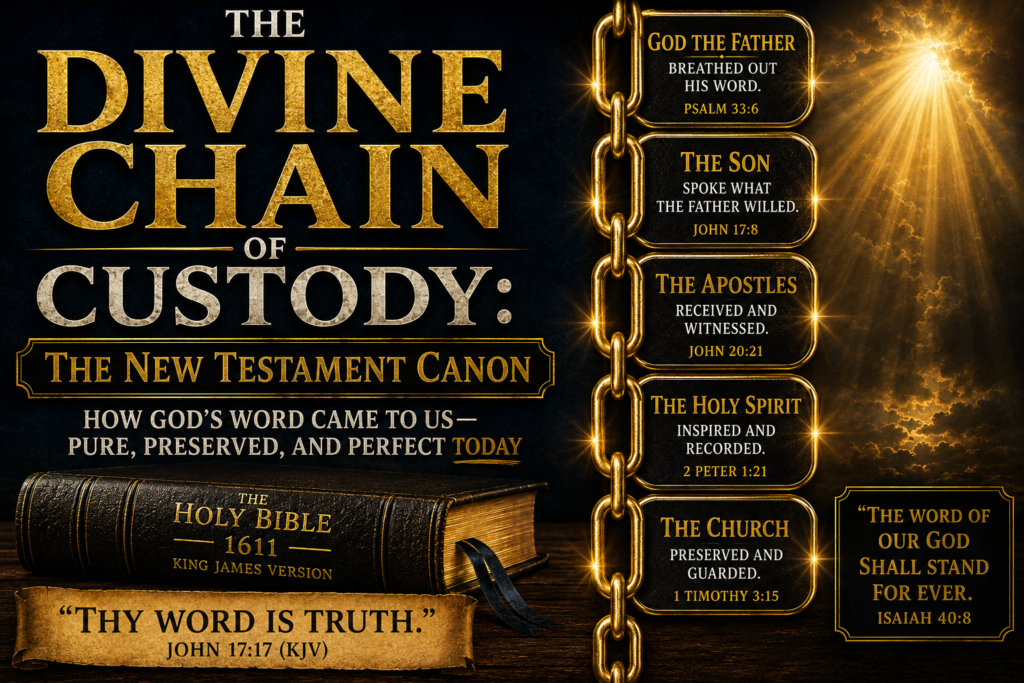
This reveals an unbroken divine chain of custody that anchors our faith:
- God the Father to the Son: The Father breathed out His words to Christ, who spoke precisely what the Father willed.
- The Son to the Apostolate: Christ appointed the Twelve as His plenipotentiaries (diplomats or agents who are given full power and authority to act and sign agreements on behalf of their government), granting them full delegated power of attorney to speak authoritatively in His stead (John 17:8, 17, 20; 20:21).
- The Holy Spirit to the Apostles: Superintended by the Holy Spirit (inspiration), the human authors recorded this divine revelation as they were moved by God (John 14:26, 2 Pet. 1:21).
- The Apostles to the Church: This written deposit was committed to the local church, which serves not as the author or source of Scripture’s authority, but as its designated steward and guardian—the pillar and ground of the truth (1 Tim. 3:15, Rom. 3:2).
When we examine the biblical validation of Scripture, it explicitly grounds its divine authority in this unrepeatable office and witness of Christ’s Apostles. The New Testament writers did not view their words as tentative suggestions; they explicitly asserted prophetic, divine authority. Paul boldly declared to the church at Corinth, “If any man think himself to be a prophet, or spiritual, let him acknowledge that the things that I write unto you are the commandments of the Lord” (1 Cor. 14:37). Writing to the Galatians, Paul certified that the gospel he preached was not after man, nor received of man, “but by the revelation of Jesus Christ” (Gal. 1:11–12).
The early believers recognized this apostolic authority immediately upon reception. Writing to the Thessalonians, Paul gave thanks that “when ye received the word of God which ye heard of us, ye received it not as the word of men, but as it is in truth, the word of God“ (1 Thess. 2:13). Furthermore, the Apostles recognized one another’s inspired writings as canonical Scripture in real time. Peter explicitly equated Paul’s epistles with Old Testament divine revelation, warning against those who twist Paul’s letters “as they do also the other scriptures, unto their own destruction” (2 Pet. 3:15–16). Similarly, in 1 Timothy 5:18, Paul quotes Luke 10:7 (“The labourer is worthy of his reward”) alongside Deuteronomy 25:4, designating both Old and New Testament writings under the single authoritative heading of “scripture.”
Because the Church is built once-for-all “upon the foundation of the apostles and prophets, Jesus Christ himself being the chief cornerstone” (Eph. 2:20), the closure of the apostolic office upon the death of the last eyewitness necessitated the permanent closure of the New Testament Canon. The faith was “once delivered unto the saints” (Jude 3), leaving a complete, unchangeable standard against which all doctrine must be measured. Therefore, the Bible argues that the Canon is closed, not the Church or scholarship.
Roman Catholic authorities and their apologists have continuously maintained that the Holy Scriptures were not produced by the Holy Spirit independent of the Roman institution:
- “The Bible is a Catholic book, and insofar as Protestants retain Scripture, they retain a Catholic book.” – Karl Keating (Catholicism and Fundamentalism, 1988)
- “The Catholic Church is the mother of the Bible… she compiled the books of the Old and New Testaments, and she alone has preserved them from error.” – Archbishop James Gibbons (The Faith of Our Fathers, 1876)
- “For my part, I should not believe the gospel except as moved by the authority of the Catholic Church.” – St. Augustine of Hippo (Against the Epistle of Manichaeus Called Fundamental, A.D. 397)
- “A book is not inspired because it is authentic and canonical… It is the Church which, by its infallible magisterium, tells us which books are inspired and canonical.” – The Catholic Encyclopedia (1912, “Tradition and Living Magisterium”)
Internal biblical evidence demonstrates, however, that early church councils did not confer sacred authority upon raw human documents; rather, God’s people simply recognized (Acts 2:14, 8:14, 11:1, 17:11; 1 Thes. 2:13) the intrinsic divine signature that was already present the instant the ink dried. External, empirical criteria like academic metrics, secular dates, or papal decrees fail to account for the supernatural nature of Scripture. As Christ promised, His sheep hear and recognize the Shepherd’s voice (Jn. 10:16, 27). Through the internal testimony of the Holy Spirit, the Scriptures attest to their own divine origin, presenting a unified, infallible message of redemption centered on Jesus Christ.
Peter also emphasized that their eyewitness testimony was not rooted in “cunningly devised fables,” (2 Peter 1:16-21) but in what they directly observed. He further stated that the prophecy in Scripture is a more “sure word of prophecy,” dismissing emotional experiences and anecdotal evidence. He asserted that Scripture alone provides sufficient evidence.
This brings us to a deeply thought-provoking conclusion: if we are to believe what God explicitly promises about His own words, what should we expect to hold in our hands today? God promises that His words are pure, incorruptible, and providentially preserved (Psalm 12:6-7, Matt. 24:35, Isa. 59:21). He guarantees that His word “liveth and abideth for ever” (1 Pet. 1:23–25). He did not inspire a perfect original text only to let it decay into historical uncertainty or be lost to the shifting probabilities of academic guesswork. By His singular care and providence, God has kept His words pure in all ages.
This providential preservation reached its glorious historical culmination in the King James Bible. The KJV is not merely a historic relic, but the sacred English text in which the Holy Spirit has codified and preserved the divine doctrinal substance (substantia doctrina) for over four centuries, never pointing the believing church to any further revision. If God is true to His promises, we do not have a fluid, approximate, or lost Bible—we possess the pure, perfect word of God today.
Is our understanding of Scripture rooted in human opinion or in God’s word?
1 Thessalonians 2:13 “For this cause also thank we God without ceasing, because, when ye received the word of God which ye heard of us, ye received it not as the word of men, but as it is in truth, the word of God, which effectually worketh also in you that believe.”
About The Author





Amen
Thank you