
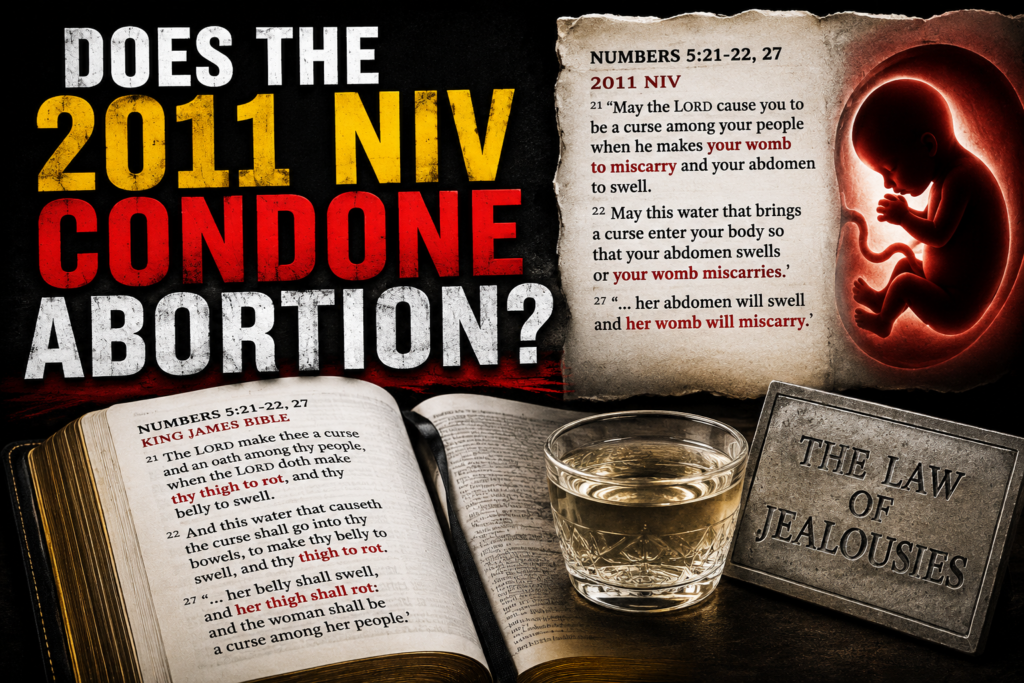
The other night at church, a brother in our church, Jacob Salter, came up to me and asked if I had ever encountered Numbers 5 in the 2011 NIV. I had not. But after reading the passage for myself, I was surprised by the evils that could be extrapolated from its wording. I have long been aware of the problems with modern Bible versions, but this particular rendering struck me differently. The 2011 NIV changes the nature of the judgment altogether. Where the King James Bible describes God’s judgment falling upon the guilty woman, the NIV introduces the termination of a pregnancy. In doing so, it creates an abortion argument where the King James Bible gives no such ground.
Numbers 5 contains what the Bible calls “the law of jealousies.” If a husband suspected that his wife had committed adultery, she was brought before the priest. The priest prepared what Scripture calls “the bitter water that causeth the curse,” and the woman was required to drink it. If she was innocent, she was free from the curse. If she was guilty, God brought judgment upon her.
The Bible could hardly be clearer. Numbers 5:21 says, “The LORD make thee a curse and an oath among thy people, when the LORD doth make thy thigh to rot, and thy belly to swell.”
The judgment falls upon the guilty woman herself. Nothing in the wording of the King James Bible gives the reader any reason to conclude that this ceremony was intended to terminate a pregnancy.
The 2011 NIV tells a different story.
Numbers 5:21 says that the curse will cause “your womb to miscarry and your abdomen to swell.”
That is not simply a difference in translation. “Thigh to rot” and “womb to miscarry” are not two ways of saying the same thing. The NIV has introduced an entirely new element into the passage: a pregnancy and its termination.
Consider what the NIV has just created. A woman is suspected of adultery. She is brought before a priest. The priest prepares something for her to drink according to the law of God. She drinks it, and if she is guilty, the NIV says that her “womb will miscarry.” If she is pregnant, the death of the unborn child becomes part of the punishment for the mother’s adultery. Worse still, according to the NIV’s rendering, this termination occurs under a ceremony established by God Himself. The result is not merely a miscarriage appearing somewhere in a historical narrative; it is a divinely instituted judgment in which the termination of a pregnancy is presented as the consequence of the woman’s guilt.
The theological implications are horrendous.
The NIV has handed the abortion advocate an argument against the Bible that the Bible never gave him. He can open Numbers 5, from there, the argument practically writes itself: If God instituted a ceremony capable of terminating a pregnancy, how can Christians maintain that the intentional destruction of unborn life is always wrong?
That argument is not coming from the King James Bible. It is coming from the NIV.
The problem becomes even more obvious when we recognize that Numbers 5 (KJV) never establishes that the woman is pregnant. The accusation is adultery, not pregnancy. Nothing says that she conceived a child through the alleged affair. Yet the NIV makes miscarriage part of the curse anyway. A miscarriage necessarily presupposes a pregnancy. If the NIV intends the language to describe the destruction of a present pregnancy, it has introduced that pregnancy into the account. If it intends the curse to describe damage to the woman’s reproductive system resulting in the loss of future pregnancies, the problem is hardly improved. Either way, the NIV has transformed a bodily judgment upon an adulterous woman into language involving the death of unborn children.
This is what makes the rendering so reprehensible. The NIV does not merely make Numbers 5 easier for an abortion advocate to misuse. It supplies the very premise necessary for the argument. The abortion advocate needs a pregnancy. The NIV gives him one. He needs the pregnancy to end. The NIV gives him an intentionally induced miscarriage. He needs the event connected with a divinely instituted ceremony. The NIV places the miscarriage directly within the law of jealousies.
Then Christians are left trying to explain why the passage does not really mean what their NIV plainly says.
This is one of the multitudes of reasons the Bible-version issue matters. We are constantly told that modern versions simply remove archaic language and make Scripture easier for modern readers to understand. But changing “her thigh shall rot” into “her womb will miscarry” is not updating archaic English. And here that change carries enormous moral consequences.
That is not clarification or correction. That is corruption.
Want to Learn More?
If you would like to learn more about dispensationalism and how rightly dividing the word of truth helps you understand the Bible, click HERE to purchase Simply Dispensationalism, a straightforward introduction to dispensational thought and the literal interpretation of Scripture.
For those interested in a more structured study of the Scriptures, click HERE to learn more about Asheville Baptist Institute, our Bible institute dedicated to equipping students with a sound, practical, and Bible-believing education.
About The Author












Every conservative anti abortion advocate in America should be anti NIV.
Wow
Thank you
Didn’t know that.
All versions are pure wicked
We Thank God for our King James Bible