
When it comes to Bible prophecy, every major world event seems to spark a new wave of speculation. While there is nothing wrong with viewing the world through a biblical lense, many Christians have become so preoccupied with prophetic events that they have forgotten the central purpose of prophecy itself.
When the Apostle John fell before the feet of the angel to worship him, the angel immediately rebuked him:
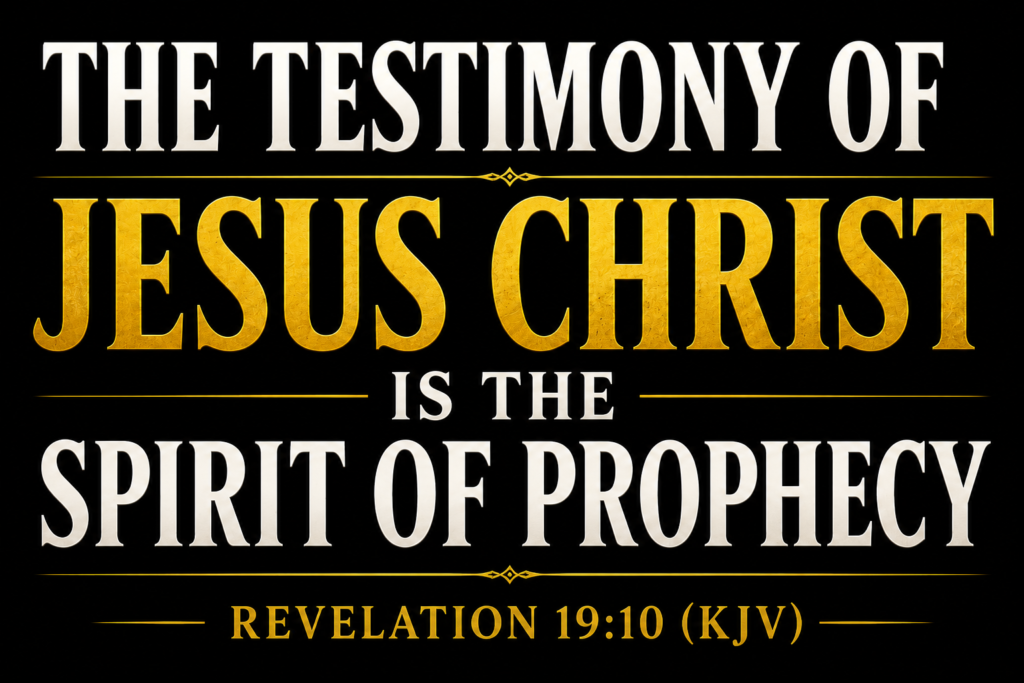
“And I fell at his feet to worship him. And he said unto me, See thou do it not: I am thy fellowservant, and of thy brethren that have the testimony of Jesus: worship God: for the testimony of Jesus is the spirit of prophecy.” (Revelation 19:10, KJV)
That final statement is one of the most profound descriptions of biblical prophecy in all of Scripture. The spirit, or essence, of prophecy is not merely the prediction of future events. Its purpose is not to satisfy our curiosity about tomorrow. The testimony of Jesus Christ is the very spirit of prophecy. Every prophecy ultimately bears witness to Him.
This truth also provides one of the strongest evidences that the Bible is the word of God. Genuine prophecy is unlike anything produced by human wisdom. Men may make educated guesses. But biblical prophecy is fundamentally different. It declares the end from the beginning because its Author stands outside of time.
Not everything that claims to be prophecy deserves that title. Scripture presents prophecy as something that can be tested. Throughout history, countless individuals have claimed divine revelation only to be exposed as false prophets. The God of the Bible, however, never speaks uncertainly. His words are always fulfilled exactly as He has declared.
Several characteristics distinguish true prophecy from mere prediction.
First, prophecy must be given before the event occurs. A history book written after the fact proves nothing. Prophecy demonstrates divine knowledge because it speaks of future events before they unfold.
Second, there should be a meaningful distance between the prophecy and its fulfillment. While some biblical prophecies were fulfilled within months or years, many span centuries. Isaiah foretold the coming of the Messiah long before Bethlehem witnessed His birth. Micah identified the very town in which Christ would be born hundreds of years before Joseph and Mary ever journeyed there.
Third, true prophecy is specific. Vague predictions can be made to fit almost any circumstance. Biblical prophecy narrows the possibilities. The Messiah would descend from Abraham, come through Judah, inherit David’s throne, be born in Bethlehem, be betrayed for thirty pieces of silver, have His hands and feet pierced, be buried with the rich, and rise again. Each prophecy reduces the possibility of coincidence.
Fourth, biblical prophecy often foretells events beyond human control. A man may choose to ride a donkey into Jerusalem, but he cannot choose where he will be born. He cannot determine the actions of Roman soldiers casting lots for his garments. He cannot orchestrate every circumstance surrounding His death, burial, and resurrection. Again and again, Scripture records details that no mere man could manipulate.
Fifth, prophecy must have an objective fulfillment. God’s word does not consist of mystical riddles that can mean anything we wish. When God speaks, history eventually confirms exactly what He said.
Taken individually, any one fulfilled prophecy would be remarkable. Taken together, they form an overwhelming testimony. The Lord Jesus Christ fulfilled not merely a handful of predictions but an entire tapestry woven throughout the Old Testament. Every fulfilled prophecy points to one conclusion: Jesus Christ is exactly who He claimed to be.
This is why Revelation 19:10 declares that “the testimony of Jesus is the spirit of prophecy.” Prophecy was never intended to make us marvel primarily at future events. It was given to make us marvel at Christ.
The Law pointed to Him. The sacrifices pointed to Him. The tabernacle pointed to Him. The priesthood pointed to Him. The kingdom points to Him. The promises made to Israel point to Him. Even the future Tribulation, the Second Coming, the Millennial Kingdom, and the eternal state ultimately display His glory. From Genesis to Revelation, prophecy is not merely about events. It is about the King.
This truth should also shape how we study prophecy today. We should not approach Scripture merely asking, “What is going to happen next?” Rather, we should ask, “What does this reveal about Jesus Christ?” If our study of prophecy leaves us fascinated with timelines but indifferent toward the Saviour, we have missed the very purpose God intended.
The greatest evidence for Christianity is not found merely in archaeology, philosophy, or scientific arguments, valuable as those may be. One of God’s own chosen witnesses is fulfilled prophecy. It stands as His divine signature upon the pages of Scripture, continually pointing men to His Son.
Every prophecy fulfilled in Christ strengthens our confidence that every prophecy concerning His future return will likewise come to pass. The same God who foretold His first coming has also promised His second. Just as surely as Bethlehem, Calvary, and the empty tomb became historical realities, so too will His return in power and great glory.
About The Author




Amen
Excellent
Thank you