
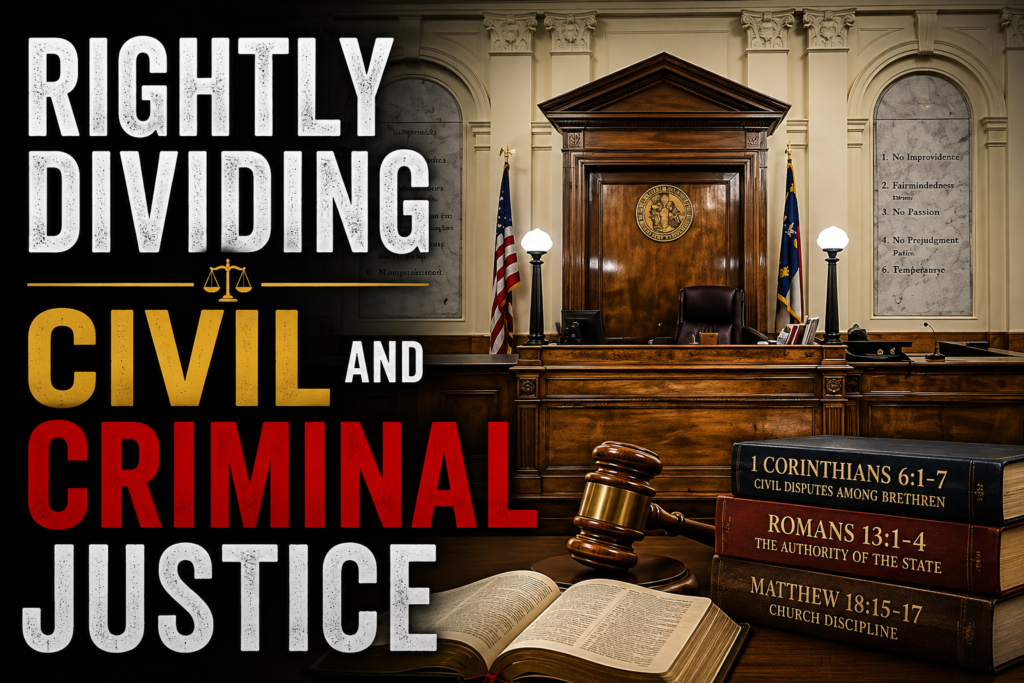
The other night on Watchman’s Warning LIVE, I discussed the biblical distinction between civil and criminal matters. This is an important conversation because Scripture does not treat the two as though they were the same. There is a significant difference between a Christian willingly suffering personal loss rather than taking a brother before a secular court and a criminal act that necessitates the intervention of civil authorities. Understanding that distinction is essential if we are going to apply the Scriptures faithfully to matters of justice, church discipline, and civil government.
Unfortunately, victims have sometimes been discouraged from reporting crimes because 1 Corinthians 6 has been interpreted as prohibiting Christians from taking another believer before civil authorities under any circumstances. Here, the apostle Paul is addressing civil disputes between brethren, not criminal offenses. Confusing these two categories undermines both the authority of the local church and the God-ordained responsibility of civil government.
The context of 1 Corinthians 6 is clear. Paul rebukes the Corinthian believers for taking “judgments of things pertaining to this life” before unbelieving judges. Instead of settling their disputes among the saints, they were airing them before the world. Paul asks, “Dare any of you, having a matter against another, go to law before the unjust, and not before the saints?” (1 Corinthians 6:1).
Paul does not merely criticize their behavior; he gives them a procedure for resolving such disputes: “If then ye have judgments of things pertaining to this life, set them to judge who are least esteemed in the church” (1 Corinthians 6:4). The local church is to appoint judges or arbitrators to hear civil disputes between believers. Paul expected the church to possess enough spiritual wisdom to render judgment between brethren. Rather than dragging one another before unbelieving courts, Christians were to submit their disputes to judgment within the church.
Paul then takes the principle even further: “Now therefore there is utterly a fault among you, because ye go to law one with another. Why do ye not rather take wrong? why do ye not rather suffer yourselves to be defrauded?” (1 Corinthians 6:7). The Christian’s ultimate concern should not be personal vindication or the recovery of earthly possessions at any cost. Even when wronged, there comes a point when Paul says it is better to suffer the loss than to take a brother before an unbelieving court.
Suppose, for example, you pay a brother a certain amount of money to complete a job, but he takes the money and never completes the work. The proper place to settle that civil dispute is through the judgment and arbitration of the church body. The offending brother should submit to the judgment of the church and, if found at fault, make proper restitution.
But what happens if he refuses? Jesus gives the church a procedure for dealing with a brother who will not hear correction, ultimately saying, “And if he shall neglect to hear them, tell it unto the church: but if he neglect to hear the church, let him be unto thee as an heathen man and a publican” (Matthew 18:17). If the offending brother refuses to hear the church, he is to be removed from the fellowship and treated as one outside the church. The wronged believer, meanwhile, is left with Paul’s difficult instruction to “rather take wrong” and “suffer yourselves to be defrauded” rather than pursue his brother through secular civil litigation.
None of this, however, provides shelter for criminal conduct. A civil dispute involving money, property, contracts, or other obligations between brethren is fundamentally different from murder, sexual assault, child abuse, or other criminal offenses. First Corinthians 6 establishes how believers are to deal with civil controversies among themselves; it does not abolish the God-ordained authority of the state to punish crime.
God has established separate institutions with different jurisdictions. The local church has authority to preach the gospel, exercise church discipline, restore the repentant, and judge matters among believers. Civil government has been given the authority to restrain and punish criminal wrongdoing. Romans 13 declares that “the powers that be are ordained of God” and says of the civil ruler, “he beareth not the sword in vain: for he is the minister of God, a revenger to execute wrath upon him that doeth evil” (Romans 13:1, 4). Peter likewise describes governors as those sent “for the punishment of evildoers” (1 Peter 2:14). The sword belongs to the state, not the church.
Criminal conduct, therefore, properly belongs before the civil authorities God has ordained. The church has neither the authority nor the ability to perform the state’s function. It cannot execute warrants, compel evidence, imprison offenders, or impose criminal penalties. Those responsibilities belong to civil government. Reporting a crime is therefore not a rejection of biblical authority; it is an acknowledgment of the authority God Himself established.
Sadly, churches have sometimes attempted to handle criminal accusations entirely within the congregation. Victims have even been discouraged from contacting law enforcement. This dangerously confuses two distinct biblical jurisdictions. First Corinthians 6 cannot legitimately be used as a shield against criminal accountability. A church may certainly exercise discipline concerning the sin involved, but that does not remove the state’s authority to deal with the crime.
The solution is straightforward: let the church judge civil disputes between brethren, and let civil government prosecute crimes. Honor the jurisdiction God has given to each. When we rightly divide the Bible, we can rightly divide the responsibilities God has given to His church and to the civil magistrate.
About The Author















Amen
Excellent
Thank you