Today, I came across another social media post treating Sunday as a Christian Sabbath of sorts. It is a claim that resurfaces with surprising frequency. Some insist the Sabbath has merely been moved from Saturday to Sunday. Others argue Christians remain obligated to observe the fourth commandment, only on a different day. While these positions may sound convincing on the surface, they fail to account for the New Testament’s teaching concerning the Lord Jesus Christ and the believer’s relationship to the Sabbath.
The greatest misunderstanding surrounding the Sabbath is not that many neglect it. The greatest misunderstanding is believing it was ever ultimately about a day. The Sabbath was always pointing to a Person. Like every other shadow in the Old Testament, it anticipated the coming of Jesus Christ. The Sabbath was never an end in itself. It was a prophetic picture of the rest that would one day be found in Christ alone.
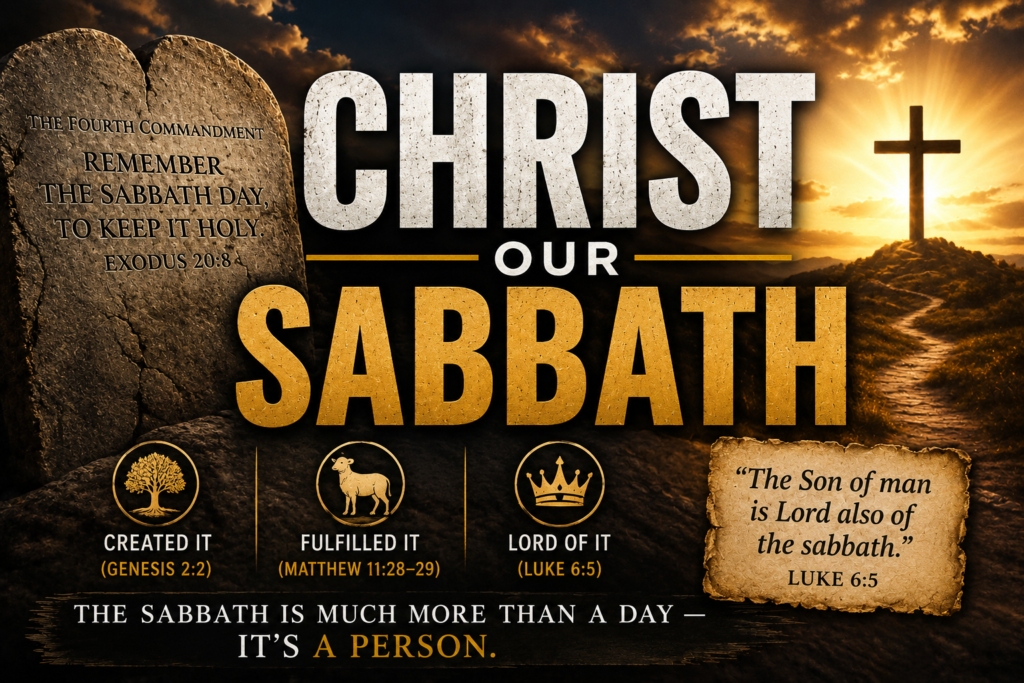
This truth is beautifully illustrated in Luke 6:1-11. The religious leaders had elevated the Sabbath above the One who created it. They had surrounded God’s commandment with layer upon layer of man-made traditions until the day intended to picture rest had become a burden. When Christ and His disciples passed through the cornfields, the Pharisees accused them of violating the Sabbath simply because they plucked ears of corn to eat. Jesus answered by reminding them of David eating the shewbread and then made one of the most remarkable declarations in all of Scripture: “That the Son of man is Lord also of the sabbath” (Luke 6:5).
Notice first Christ’s Position — His Authority (vs 1-5). Jesus did not merely claim authority over the Sabbath; He claimed to be its Lord. That statement only makes sense if He is the One who instituted it. John writes, “All things were made by him; and without him was not any thing made that was made” (John 1:3). Paul likewise declares, “For by him were all things created, that are in heaven, and that are in earth” (Colossians 1:16). The Creator of the Sabbath possesses every right to define its purpose. The Pharisees believed they were defending God’s law, yet in reality they were rebuking the Lawgiver Himself.
The Sabbath did not begin with Moses. It began at creation. “And on the seventh day God ended his work which he had made; and he rested on the seventh day from all his work which he had made” (Genesis 2:2). God did not rest because He was weary. The Almighty neither faints nor grows tired. His rest signified the completion of His creative work. Nothing remained to be added. His work was finished.
When Israel later received the Law, the Sabbath became a covenant sign between God and the nation of Israel. “Wherefore the children of Israel shall keep the sabbath, to observe the sabbath throughout their generations, for a perpetual covenant. It is a sign between me and the children of Israel for ever” (Exodus 31:16-17). The Sabbath distinguished Israel from the surrounding nations and continually reminded them of both God’s creative work and His deliverance of them from Egypt (Deuteronomy 5:15). Scripture never identifies the Sabbath as a covenant sign given to the Church.
In Luke 6, the passage also demonstrated Christ’s Power — His Activity (vs6-9). Immediately after declaring Himself Lord of the Sabbath, He entered the synagogue where a man had a withered hand. Once again the Pharisees watched, hoping to accuse Him. Rather than avoiding controversy, Christ publicly healed the man. “Stretch forth thy hand. And he did so: and his hand was restored whole as the other” (Luke 6:10). The miracle revealed that the Sabbath was never intended to prevent acts of mercy. Instead, it pointed to the One who restores what sin has ruined. The religious leaders had reduced the Sabbath to regulations. Christ revealed its true purpose by bringing life, restoration, and hope. Through this miracle, Jesus also justified His claim as Lord of the Sabbath. He didn’t only claim authority over the Sabbath, He proved He held this authority.
The Sabbath always anticipated a greater rest than physical cessation from labor. Jesus later extended this invitation: “Come unto me, all ye that labour and are heavy laden, and I will give you rest” (Matthew 11:28). Notice carefully where rest is found. Christ did not say, “Come unto a day.” He said, “Come unto me.” The invitation was never centered upon a calendar but upon Christ Himself. He continues, “Take my yoke upon you, and learn of me… and ye shall find rest unto your souls” (Matthew 11:29). The deepest rest man can experience is not physical but spiritual. It is the rest of a conscience cleansed by the blood of Christ and a soul reconciled to God.
This brings us to Christ’s promise — His Assurance (v.10). Every believer presently enjoys a spiritual rest in Christ. We rest, not because our works have earned God’s favor, but because Christ finished the work of redemption. As He cried from the cross, “It is finished” (John 19:30). Salvation is not accomplished through our labor but through His completed work. If Jesus declared the work finished, what could you or I ever add to it?
This is precisely why Paul warned believers not to return to ceremonial observances as though they were still binding. He wrote, “Let no man therefore judge you in meat, or in drink, or in respect of an holyday, or of the new moon, or of the sabbath days: Which are a shadow of things to come; but the body is of Christ” (Colossians 2:16-17). The language could hardly be clearer. Sabbaths were shadows. Christ is the substance. A man who possesses the substance no longer chases the shadows.
This passage also answers the common assertion that Sunday is now the Christian Sabbath. The New Testament never declares such a thing. Believers certainly gathered on the first day of the week in recognition of Christ’s resurrection (Acts 20:7; 1 Corinthians 16:2), but nowhere does Scripture transfer the Sabbath commandment from the seventh day to the first day. Sunday, the day we meet, and the Sabbath are not identical. One commemorates the resurrection of Christ; the other pointed forward to Him. Confusing the two obscures the beauty of both.
Hebrews expands this truth even further. “There remaineth therefore a rest to the people of God” (Hebrews 4:9). The chapter points beyond Joshua, beyond Canaan, and beyond the weekly Sabbath to a greater rest accomplished through Christ. Believers have already entered that rest spiritually by faith, yet we also await its full realization.
The Christian lives between two Sabbaths. Today we enjoy rest for our souls because we are in Christ. Soon, we shall enjoy rest upon the earth when Christ returns to establish His kingdom. Paul comforted suffering believers with these words: “And to you who are troubled rest with us, when the Lord Jesus shall be revealed from heaven with his mighty angels” (2 Thessalonians 1:7). That future rest looks beyond the present age to the glorious appearing of Jesus Christ and His millennial reign.
Every Sabbath in the Old Testament pointed forward to Him. Every sacrifice anticipated Him. Every feast foreshadowed Him. Every shadow finds its fulfillment in Him.
The Christian’s hope has never rested in observing a particular day of the week. Our hope rests in the Lord of the Sabbath Himself. He who created the Sabbath, fulfilled the Sabbath.
The Sabbath is much more than a day — it’s a person.
About The Author







Excellent
Thank you
I’m starting to like this guy. I might have to meet him someday.