
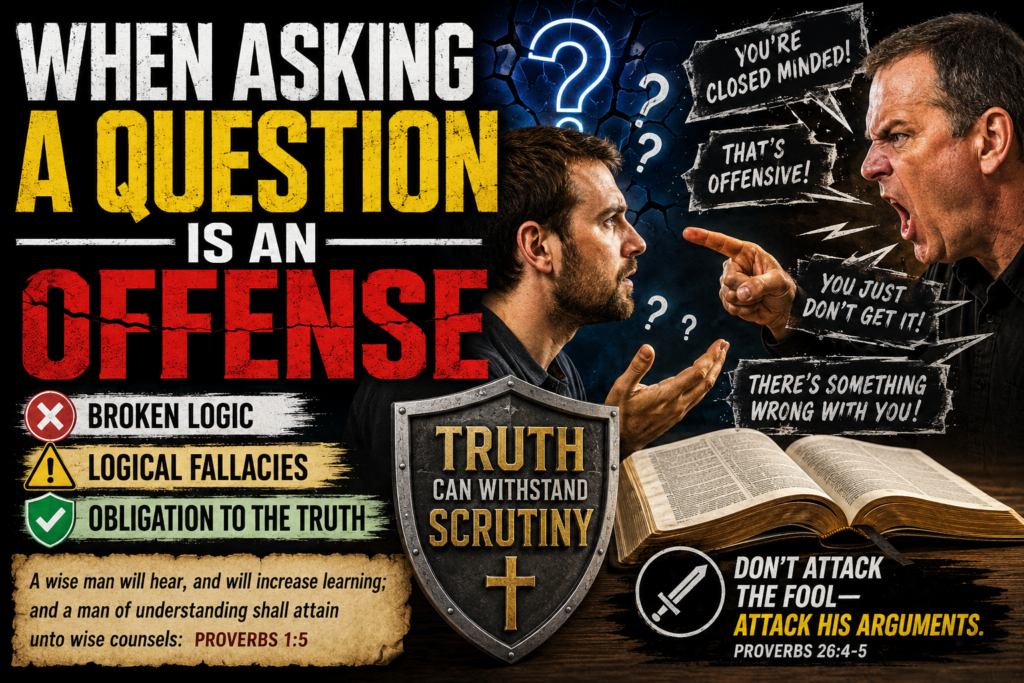
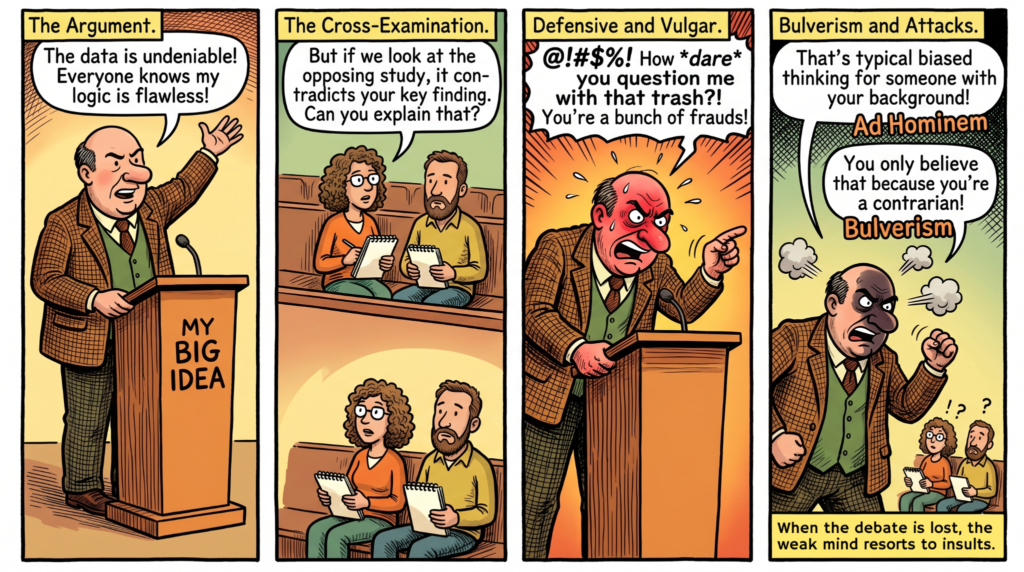
In this day and age, when professing believers make a claim or argument, they rarely welcome a robust cross-examination of their ideas. They are more interested in telling others what to believe than being open to any feedback themselves.
Proverbs 1:5 A wise man will hear, and will increase learning; and a man of understanding shall attain unto wise counsels:
Proverbs 13:1 A wise son heareth his father’s instruction: but a scorner heareth not rebuke.
Broken Logic
The moment a foundational claim is met with a question and the immediate response is to cry offense, a quiet retreat from reason has begun. Sincere inquiry is never a threat to reality. It is an invitation to clarify our premises, to sharpen our terms, and to strengthen the architecture of what we believe. An intellectually honest thinker does not hide behind a defensive wall. They welcome a robust challenge because they view it as the perfect opportunity to demonstrate that their position is well thought out, coherent, and grounded.
When someone completely bypasses a critique of their arguments and resorts to personal animus, they are engaging in a predictable cluster of logical fallacies. These tactics are rarely accidental. They are classic maneuvers designed to evade the burden of proof when the underlying logic begins to fracture.
We see this breakdown occur in three distinct ways:
- The Invincible Ignorance Fallacy: This manifests when a person simply refuses to engage with counterarguments or cross-examination. They maintain their conclusion regardless of what the inquiry demonstrates, essentially shouting over the critique to keep their presuppositions safe from scrutiny.
- The Red Herring via Attack: Because they cannot defend their weak premises, they introduce a sudden distraction. They turn to personal attacks, try preemptively to discredit your source, or assume you are wrong by diagnosing your psychological biases. These are all attempts to change the subject from “Is this claim true?” to “What is wrong with the person asking the question?”
- The Special Pleading Fallacy: the formal name for a double standard. It occurs when someone applies a strict set of rules to your arguments but demands an unearned immunity for their own. They assert that their identity, their intent, or their favored group should be exempt from the standards of consistency, without providing any objective, logical justification for the exemption.
Obligation to the Truth
In a valid logical framework, rules must be universal. When consistency is abandoned, the argument collapses into a structural failure. By attacking the interrogator rather than defending the premise, the speaker implicitly demands that you defend your right to ask the question. This shifts the focus entirely, replacing a logical defense with psychological warfare.
This is disingenuous and unbecoming of someone who names the name of Christ.
This structural collapse is precisely why a rigorous defense of historic Christian presuppositions must be upheld, specifically the core doctrines of New Testament Christianity (Salvation by grace alone, divine preservation, right-division of Scripture, etc.). A genuine commitment to truth has absolutely nothing to fear from cross-examination.
Truth can withstand scrutiny.
There is a constant emphasis that, as believers, we have an obligation to the truth. This obligation entails the responsibility to defend the faith and to provide good reasons for what we believe (1 Peter 3:15; Colossians 4:6).
Paul argued that because God is true, we must avoid contradictions (essentially lies), and that “our word” must reflect the nature of our Creator:
2 Corinthians 1:18 But as God is true, our word toward you was not yea and nay.
Again, Paul explains that our words have a moral commitment to God’s words:
1 Corinthians 2:13 Which things also we speak, not in the words which man’s wisdom teacheth, but which the Holy Ghost teacheth; comparing spiritual things with spiritual.
The Challenge
True intellectual honesty means rejecting special pleading, sophomoric replies, or defensive emotionalism, and instead letting the Bible’s contextual footprint and internal consistency speak for itself. When your foundation is pure and inerrant, the evidence will easily bear the weight of any inquiry, eliminating any need to evade hard questions or poison the well against sincere skeptics.
1 Corinthians 13:11 When I was a child, I spake as a child, I understood as a child, I thought as a child: but when I became a man, I put away childish things.
To communicate these truths effectively, our defense of the faith must reflect this certainty through a style characterized by classic clarity and conciseness. By stripping away artificial anger and fancy words, we cut through modern skepticism with definite, specific language. We do not need to lecture or shout down the critic; like a friend sitting across the table, we simply reason from the Scriptures, ready to give an answer with meekness and fear, knowing that the word of God can withstand any test.
Answer not a fool according to his folly, lest thou also be like unto him. Answer a fool according to his folly, lest he be wise in his own conceit. Proverbs 26:4-5
We never answer a fool according to his folly (his temperament, fallacious thinking, emotionalism, etc.) lest we “be like unto him”; however, we should answer a fool in a way that dismantles his worldview and demonstrates the structural weakness of his arguments so that he cannot “be wise in his own conceit”.
Don’t attack the fool – attack his arguments.
We never know if the skeptic is one answered objection away from believing the Gospel.
Titus 1:9 Holding fast the faithful word as he hath been taught, that he may be able by sound doctrine both to exhort and to convince the gainsayers.
About The Author











Excellent
Thank you