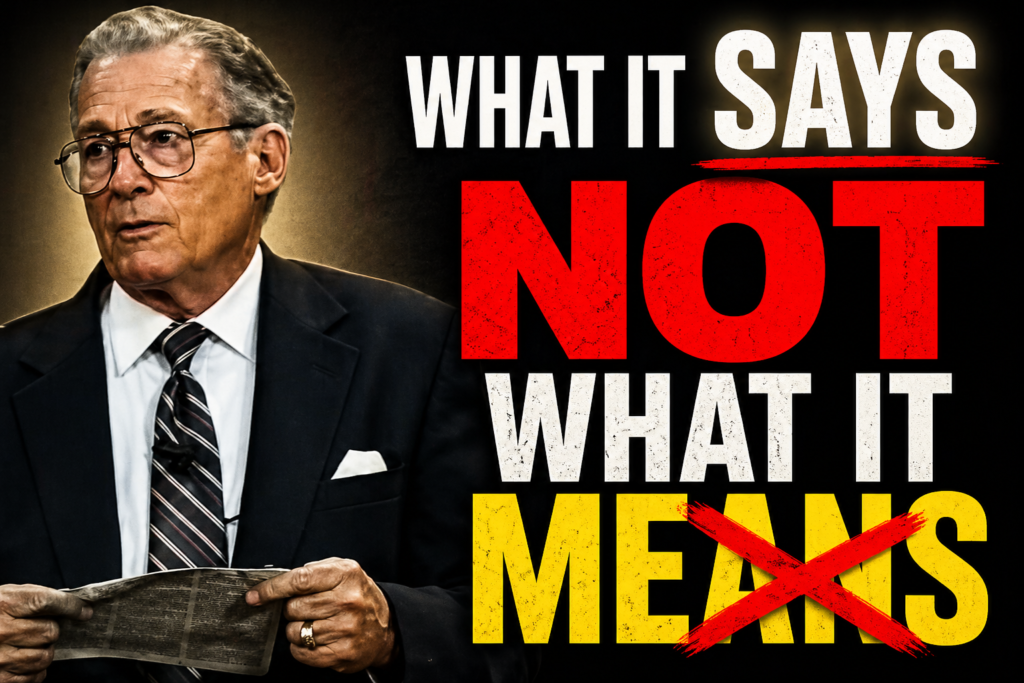
I recall Dr. Ruckman frequently emphasizing a key point about Bible interpretation:
“It doesn’t matter what you think it means; what matters is what it says.”
At first, I struggled with this idea because I believed our main task was to understand Biblical passages. Yet, this approach created an unnecessary intellectual hurdle for engaging with the word of God. The core truth is that Scripture’s meaning isn’t dependent on personal understanding. There is no divine commandment to understand the Bible; there is, however, the expectation to believe it.
This leads to a very important distinction in Scripture: words vs principles. While there are certainly principles in the Bible, the greatest demand for obedience always applied to individual words.
Faith is not founded on human “ideas” or “concepts” but on the specific, objective words of God.
In modern Christianity, there is a philosophical shift toward prioritizing “the spirit of the text” or “the general idea” over the literal words of God. We are often told that the “concepts” or the “message” matter, while the specific vocabulary is secondary. However, the Bible teaches the exact opposite. God did not breathe “ideas” into the hearts of men; He gave them words.
The Authority of the Word
Our faith does not rest on a fluid interpretation or a scholar’s “concept” of what God might have meant. It rests on the “words of the Lord,” which are described as silver tried in a furnace and purified seven times (Psalm 12:6).
- Objective Standard: Words provide an objective boundary that “ideas” cannot. An idea can be reshaped by culture or personal feeling, but a word remains fixed on the page. We may often disagree on what a passage means, but we cannot be confused by what it plainly says.
- The Spirit’s Role: We are not called to be the interpreters of the Bible through our own intellect. The Holy Spirit is the Interpreter. He guides the believer into truth by using the very words He inspired.
- Belief over Understanding: Human “understanding” is often a polite term for rationalization. We are not commanded to first “make sense” of God’s word through the lens of science or philosophy; we are commanded to believe what is written. This does not mean we abandon our God-given reason and blindly accept everything without question; it simply means our autonomous reason must be in subjection to the words of God.
I. Obedience to Every Written Word
Obedience is not a vague pursuit of “godliness”; it is the meticulous execution of what is written. Notice the appeal to literal words:
- Deuteronomy 17:19: The king was commanded to read the law all the days of his life “to keep all the words of this law and these statutes, to do them.” Obedience was not possible without a constant reference to the specific words.
- Deuteronomy 28:58: God warns of “wonderful plagues” if a man will not “observe to do all the words of this law that are written in this book.” The standard of judgment is the written word, not human intention.
- Deuteronomy 12:32: “What thing soever I command you, observe to do it: thou shalt not add thereto, nor diminish from it.” To add or subtract a word is to corrupt the obedience itself.
II. The Response of the People: Agreement to the Words
In the Old Testament, the covenant relationship was founded on the people’s verbal commitment to the literal words of the Lord.
- Exodus 24:3: “And Moses came and told the people all the words of the LORD… and all the people answered with one voice, and said, All the words which the LORD hath said will we do.”
- Exodus 24:7: Moses then read the “book of the covenant” in the audience of the people, and they reiterated, “All that the LORD hath said will we do, and be obedient.”
III. The Rejection of the Word as Disobedience
Disobedience is frequently described in Scripture as “rejecting the word” or “not hearkening to the words,” emphasizing that departing from the text is the point of rebellion.
- 1 Samuel 15:23: Samuel told Saul, “Because thou hast rejected the word of the LORD, he hath also rejected thee from being king.” Saul’s failure was not an “idea” of rebellion, but a failure to follow the specific instructions given to him.
- Jeremiah 11:3: “Cursed be the man that obeyeth not the words of this covenant.”
- Jeremiah 35:13: God asks, “Will ye not receive instruction to hearken to my words? saith the LORD.” Hearing and obeying are tied directly to the vocabulary of the Almighty.
IV. The New Testament Standard: Christ’s Sayings
Jesus Christ reinforced that the foundation of a believer’s life is built upon His specific sayings.
- Matthew 7:24: “Therefore whosoever heareth these sayings of mine, and doeth them, I will liken him unto a wise man, which built his house upon a rock.” The “sayings” (the words) are the rock.
- John 14:23: “Jesus answered and said unto him, If a man love me, he will keep my words: and my Father will love him, and we will come unto him, and make our abode with him.” Love for Christ is measured by the retention and observation of His words.
- John 15:7: “If ye abide in me, and my words abide in you, ye shall ask what ye will, and it shall be done unto you.” Fruitfulness and answered prayer are contingent upon the words remaining in the believer.
- Matthew 4:5: “But he answered and said, It is written, Man shall not live by bread alone, but by every word that proceedeth out of the mouth of God.” This profound rebuke to Satan reveals what is necessary for man to truly live.
Speak The Word Only
In Matthew chapter 8, we find a Roman centurion approaching Jesus with a request that would cause the Son of God to “marvel.” His servant was sick, paralyzed, and in great pain. When Jesus offered to come and heal him, the centurion’s response revealed the very foundation of biblical faith:
“The centurion answered and said, Lord, I am not worthy that thou shouldest come under my roof: but speak the word only, and my servant shall be healed.” (Matthew 8:8)
This man understood something many modern theologians miss: authority does not reside in “concepts,” “principles,” or “general ideas.” It resides in the explicit word spoken by the one in power. Jesus Christ didn’t just call this a good perspective; He called it “great faith.”
The Logic of Authority
The centurion compared Christ’s authority to his own military command. He didn’t need to see Jesus perform a ritual or feel a “presence.” He knew that if the Commander issued a word, the reality on the ground would change.
In our walk with God, we are often tempted to look for a “feeling” or to distill the Bible down into manageable “ideas.” But God did not inspire ideas; He inspired words. As Independent Baptists, we recognize that the King James Bible is the culmination of God’s divine preservation, every word is pure and there by design.
The Foundation of our Faith: The word of God
Let us not be frustrated because we do not often understand what the Bible means, but rather let us entrust our faith to what is said and trust that God will shed His light upon the text when the time is right.
“So then faith cometh by hearing, and hearing by the word of God.” – Romans 10:17
About The Author






Amen
Thank you