
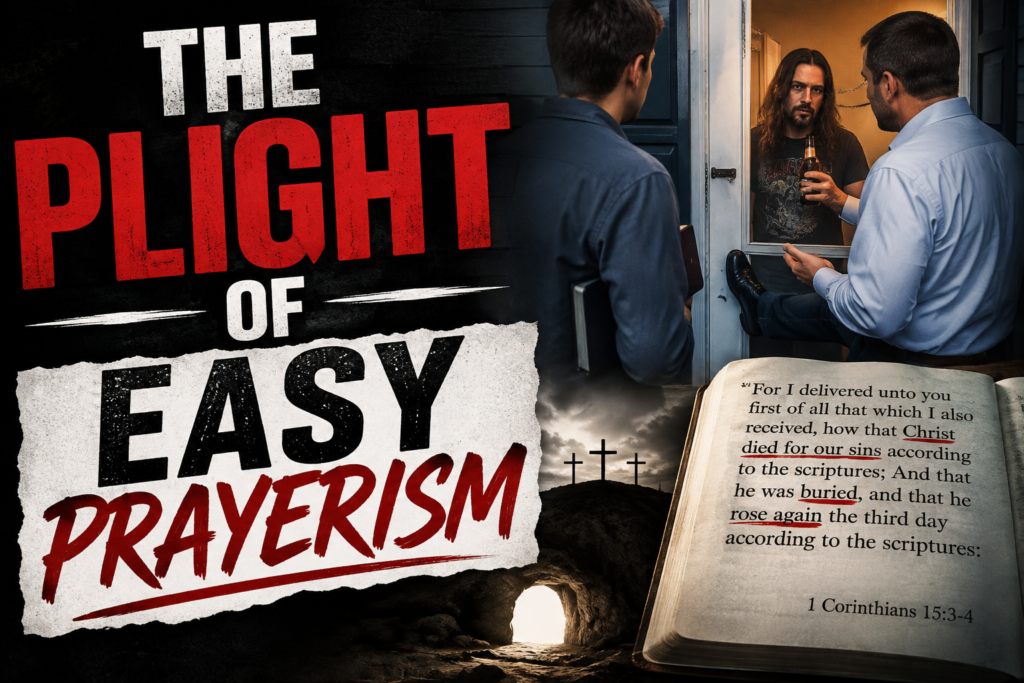
Salvation is simple. A man does not have to understand systematic theology, master the doctrines of Scripture, clean up his life, join a church, get baptized, or perform religious works before he can be saved. Salvation is the gift of God, received by faith in the death, burial, and resurrection of the Lord Jesus Christ. But there is a dangerous difference between the simplicity of salvation and what has sometimes been called easy believism — or, more fittingly, easy prayerism.
Easy prayerism reduces evangelism to a formula: “1-2-3, repeat after me.” Ask a few questions, get the sinner to repeat a prayer, and then assure him that because he said those words, he is saved. The problem is not that salvation has been made too easy. Salvation is easy for the sinner because Jesus Christ did the hard part. The problem is that, in eagerness to make salvation simpler, and often to make numbers of converts greater, generally for the praise of men, the Gospel can be entirely removed from the equation.
Years ago, I was out on Tuesday night visitation with a man who was known as one of the best soul winners in our area. We walked up to a house and knocked on the door. A man with long black hair and a beer in his hand answered. He was friendly but firm. “Hey, guys, I appreciate the invitation, but I’m not really interested. Thanks anyway.” As he slowly began closing the screen door, the man I was with put his foot in the doorway and said, “Wait a second. Don’t you want to go to heaven? All you have to do is pray this prayer.”
With slight frustration masked by Southern hospitality, the man replied, “Sure, I want to go to heaven. What do I need to say?” The man I was with proceeded to lead him in the sinner’s prayer — without, by the way, a single mention of the resurrection. The man repeated the words, smiled politely, and closed the door.
We walked back to the car, and the gentleman I was with looked at me triumphantly and said, “That’s another one going to heaven!”
I was sick.
The man at the door had shown no interest in spiritual things. He had not heard a clear presentation of the Gospel. There had been no explanation that Christ died for his sins, was buried, and rose again the third day according to the Scriptures. There was no indication that he understood the Gospel or had placed his faith in Jesus Christ. From everything I could see, he simply wanted to say whatever was necessary to politely end the conversation and get back to his prime-time television. Yet because he had repeated the prescribed words, he was immediately counted as another soul won to Christ.
As expected, that was the last we ever saw of him.
Paul gives us the basic content of the Gospel plainly in 1 Corinthians 15:1-4: “Moreover, brethren, I declare unto you the gospel which I preached unto you . . . For I delivered unto you first of all that which I also received, how that Christ died for our sins according to the scriptures; And that he was buried, and that he rose again the third day according to the scriptures:” At the most basic level, there must be an understanding of this Gospel message. Jesus Christ died for our sins according to the Scriptures, He was buried, and He rose again the third day according to the Scriptures.
A person does not have to understand everything about the Bible to be saved. He does not have to be able to explain every aspect of the atonement. He does not need a theological vocabulary. But faith must have an object, and saving faith has as its object Jesus Christ as revealed in the Gospel and what He accomplished for the sinner. Paul and Silas did not tell the Philippian jailer to repeat certain words after them. When he cried, “Sirs, what must I do to be saved?” their answer was wonderfully simple: “Believe on the Lord Jesus Christ, and thou shalt be saved, and thy house” (Acts 16:30-31). Notice the simplicity: believe. But notice also the object: the Lord Jesus Christ.
This is where easy prayerism becomes dangerous. A sinner may be led to place his confidence in something he said rather than Someone he believed. Years later, when asked why he knows he is saved, his answer may be, “Because I prayed the prayer.” But a prayer did not die for our sins. A prayer was not buried. A prayer did not rise again the third day. Jesus Christ did.
Romans 10:9 says, “That if thou shalt confess with thy mouth the Lord Jesus, and shalt believe in thine heart that God hath raised him from the dead, thou shalt be saved.” The issue is not merely what passes across the lips. There is something that must be believed in the heart. That does not mean there is anything wrong with a sinner calling upon the Lord. Romans 10:13 plainly says, “For whosoever shall call upon the name of the Lord shall be saved.” The problem is not prayer. The problem is substituting prayer for faith.
A sinner may certainly express his faith in prayer. He may call upon Christ for salvation. But we should never teach him that the arrangement of certain words has saving power. There are no magic words in a sinner’s prayer. Salvation rests entirely upon Jesus Christ and His finished work. The prayer may be the expression of faith, but the prayer itself is not the object of faith.
This distinction is especially important when dealing with children. Yes, children can be saved. I was saved as a child, as were two of my children. My third child is simply too young to understand. But a child can be very easily persuaded to repeat whatever an adult tells him to say. We can ask, “Do you want to go to heaven?” Of course he does. “Do you want Jesus?” Yes. “Then repeat after me.” Thirty seconds later, we pronounce that child saved. But did he understand the Gospel? Did he understand that he was a sinner? Did he understand that Christ died for his sins and rose again? Was he actually trusting Christ, or was he simply following the instructions of an adult he trusted? We must be careful that our desire to see people saved does not cause us to manufacture professions of faith.
Paul said in Romans 1:16, “For I am not ashamed of the gospel of Christ: for it is the power of God unto salvation to every one that believeth…” The power is in the Gospel, not our salesmanship. Biblical soul winning must therefore involve more than getting someone to repeat a sentence. We must preach Christ. We must explain the Gospel clearly enough that the hearer understands whom he is trusting and what Christ has done for him.
That does not require an hour-long theological lecture. Salvation is not complicated. We should never place theological hurdles between a sinner and the Saviour. But neither should we confuse simplicity with emptiness.
There is a ditch on both sides of the road. On one side, men make salvation so complicated that the sinner must understand an entire theological system, demonstrate sufficient repentance, reform his behavior, persevere in good works, or prove the genuineness of his faith before anyone will tell him that he can know he is saved. That is not the simplicity of the Gospel. On the other side, men can reduce salvation to little more than a religious incantation: say these words, raise this hand, sign this card, repeat this prayer. That is not biblical faith either.
The answer to easy prayerism is not hard salvation. The answer is clear Gospel preaching. Tell the sinner that Christ died for his sins. Tell him that Christ was buried. Tell him that Christ rose again the third day. Tell him that eternal life is a gift and that he cannot earn it. Then point him away from himself, away from his works, away from religion, and even away from the prayer itself, and point him directly to Jesus Christ and His Gospel.
Want to Learn More?
If you would like to learn more about the Bible and grow in your understanding of the Scriptures, click HERE to subscribe to our YouTube channel, where you’ll find Bible teaching, preaching, and discussions on biblical doctrine.
For those interested in a more structured study of the Scriptures, click HERE to learn more about Asheville Baptist Institute, our Bible institute dedicated to equipping students with a sound, practical, and Bible-believing education.
About The Author











Amen
Thank you