
The Importance of Local Church Membership
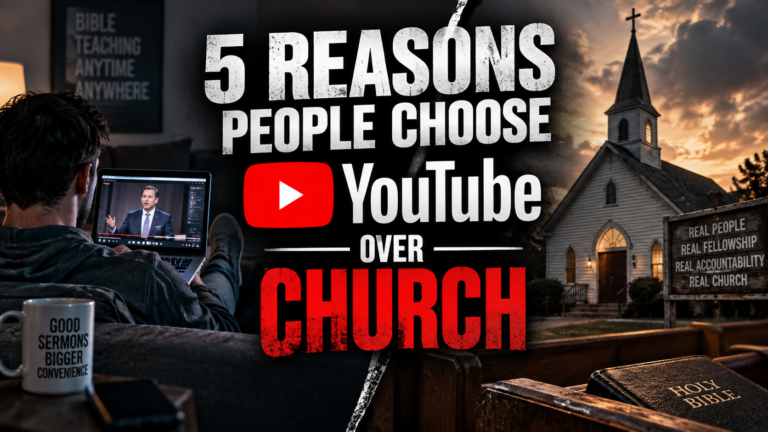
We live in an era of unprecedented access. With a few clicks, you can go on the internet and type in any topic to find sermons, lectures, and endless theological resources. For many, this digital access has slowly replaced the physical, local assembly. It is increasingly common to hear Christians argue that they do just fine on their own, believing they can be just as good a believer without ever setting foot inside a local church. But this isolationist mindset is not just a lifestyle choice; it is a direct violation of biblical order.
A pastor once offered this insight: “God will always use order before right”. Order matters to God (1 Corinthians 14:40; 2 Samuel 6:3-10 with Numbers 4:15, 7:9 and Exodus 25:12-15).
The local church is the only institution Christ founded to preserve the Truth, and attempting to live the Christian life apart from it is spiritually dangerous. Here are the key biblical principles and arguments that advocate for the absolute necessity of the local, visible church.
1. The Inherent Dangers of Isolationism and “Free Agents.”
The modern mindset often claims that we do not need spiritual authority. However, when you combine endless internet access with a rejection of a local church, you become your own authority and your own systematic theology. There’s no accountability or balance. Isolated believers often roam the “world wide web” simply looking for an echo chamber that repeats back what they have already decided to believe, building a wall around themselves that makes them impervious to biblical correction. Neglecting the essential feedback loop among fellow believers (Proverbs 27:17) fosters spiritual blind spots, which can easily become stumbling blocks to others (Romans 14:13; 1 Corinthians 8:9-13).
Brother Kyle Stephens, in his book, “The Pillar and Ground of the Truth,” accurately points out that “free agents for God” who operate off on their own are often unstable and lack spiritual balance. When you isolate yourself, you lose your spiritual anchor. One of the greatest advantages of a local congregation is that your personal life is subject to accountability, keeping your life and doctrine in check. Without a pastor to “watch for your soul” (Hebrews 13:17) and an assembly to balance you, who gets to reprove you when you are out of line (1 Corinthians 5:2, 5, 6:1-6)? The unchurched believer, existing apart from the local assembly, effectively becomes a lone sheep in the wilderness, making themselves a vulnerable target for ravenous wolves that introduce false doctrine and the corrupting influence of worldliness. Worse, they can become wolves themselves, spreading false doctrines and fostering personality cults online. In the end, staying independent and rejecting submission to a local Baptist church can lead to spiritual pride and ruin.
2. God’s Exclusive “Pillar and Ground”: The Divine Custody of Truth
The Apostle Paul wrote to Timothy to establish exactly how a believer ought to behave in “the house of God, which is the church of the living God, the pillar and ground of the truth” (1 Timothy 3:15).
We must not miss the intentional use of the definite article in this verse: the pillar. That specific language speaks of exclusive singularity. You will not find the ultimate support structure for God’s truth in secular colleges, science, medicine, or human philosophy. God has designed the local, visible assembly to be the exclusive pillar upholding the superstructure of His Truth.
But how exactly does this pillar function? It operates through a divine chain of custody—a deliberate “baton-passing” protocol that God established to preserve doctrine across two millennia. The stewardship of Truth shifted from the Living Word (Jesus Christ), who gave the words to the Inspired Writers (the Apostles), directly to the Institutional Guardian (the local church). This transition was not a change in the content of the Truth, but in the container responsible for its protection.
The church’s role today is entirely custodial. We are not called to invent new truth, rely on progressive revelation, or update the Bible for modern culture. Like a legal guardian or a museum curator, the church’s job is the preservation of the “faith which was once delivered unto the saints” (Jude 1:3). For a Bible-believing, King James Only Baptist, this means the local church is the designated entity that identifies and stands upon the preserved, inerrant deposit of the English Bible.
The Baton-Passing Protocol (2 Timothy 2:2) We find the explicit “Instruction Manual” for this custodial duty in 2 Timothy 2:2: “And the things that thou hast heard of me among many witnesses, the same commit thou to faithful men, who shall be able to teach others also”.
Look at the specific links in this chain:
- The Source: The Apostolic Foundation (Paul).
- The Recipient: The Pastoral Office (Timothy), acting as the primary trustee of the church’s doctrine.
- The Selection: The Guardrail (Faithful Men). The truth is not handed to just anyone; the church filters who gets to teach, preventing the “lone-wolf” syndrome.
- The Perpetuity: The Next Generation (Others Also).
If any of these links are broken, the church ceases to function properly as the pillar, and apostasy creeps in. This verse is the absolute death knell for “individualized” Christianity. Because Timothy was commanded to commit these things within the structured environment of a local assembly, this proves that an individual finds the true, preserved things of God only when they are connected to this biblical chain of custody.
The Ultimate Guardrail Against “Free Agents” This organizational chain of custody acts as a divine “corporate guardrail” against private interpretation and heresy. God knew that if Truth were left solely to individuals, Christianity would fracture into endless personal doctrines. The local church is God’s divine check on human pride. By demanding submission to pastoral authority and the “Unity of the Faith,” the church ensures that believers are not “tossed to and fro, and carried about with every wind of doctrine” (Ephesians 4:14).
When a believer separates themselves from the congregation to become a “free agent for God,” they strip away this vital guardrail. Brother Kyle Stephens aptly notes that these isolationists are rarely stable; in fact, they are often out of balance and “half crack-brained” because they have isolated themselves from biblical correction.
The word used to translate “ground” means a stay, a bulwark, or a permanent settlement. We live in an incredibly dark, spiritually charged world. In electrical terms, every telephone pole requires a thick grounding wire driven deep into the earth to safely absorb stray electrical charges. The local church is your spiritual grounding rod. When the attacks of the “god of this world” strike, that charge flows safely into the grounded structure of the local assembly. If you unplug yourself from the local church, you lose your spiritual ground, and you will take the full, devastating hit of the enemy’s deception alone.
3. You Cannot Obey Scripture in a Vacuum
The classic text on the necessity of church attendance is Hebrews 10:25: “Not forsaking the assembling of ourselves together, as the manner of some is; but exhorting one another: and so much the more, as ye see the day approaching”.
Digital or “invisible” fellowship is fundamentally incapable of replacing the physical assembly. How can you fulfill the command to “provoke unto love and to good works” (Hebrews 10:24) if you are not physically present to provoke and assist your brethren? The New Testament is filled with “one another” commands. Jesus commanded in John 13:34-35, “That ye love one another; as I have loved you…”. Paul commands believers in Philippians 2:3-4 to esteem others better than themselves and look on the things of others. You simply cannot accomplish the ministry of serving, exhorting, and loving your brethren without being an active member of a local congregation.
The local church is God’s “grindstone” for smoothing a believer’s character. Without the friction and fellowship of dealing with other people in the pews, believers become sharp, unyielding, and self-willed.
4. The Great Commission and Church Ordinances are Local
Finally, God’s practical mechanisms for church growth and worship demand a local body. The Great Commission (Matthew 28:19-20) was not given merely to scattered individuals, but to the local church. Teaching converts to “observe all things” implicitly includes integrating them into a local body for scriptural baptism and discipleship. In fact, it is impossible for an independent Christian to properly partake in the local church ordinances of scriptural baptism and the Lord’s Supper. To bypass the local church is to effectively bypass the Great Commission and God’s designated embassy on earth.
The local Church is responsible for three primary functions:
- Exalt the Saviour.
- Evangelize Sinners.
- Edify the Saints.
These goals would be unachievable without a local assembly. Such an assembly relies on each member, whether foot, hand, eye, or ear, being a productive contributor towards these three objectives.
Disclaimer.
Finding a biblically sound local assembly is a significant challenge in our current landscape. While geographic limitations are a reality, they should ideally remain the exception rather than the standard for a believer’s life. Brother Randy Keener provides helpful guidance by viewing potential churches through a grading scale:
- The “A” Church: This represents the ideal—a congregation that is unapologetically Bible-believing, dispensational, evangelical, and doctrinally balanced.
- The “B” and “C” Churches: These serve as the next best options, perhaps lacking certain “ideal” markers but still offering a scriptural foundation.
- The Strategy: Always prioritize the “A” church. If it is unavailable, a “B” or “C” church is a far better alternative than remaining in isolation.
Practicality and stewardship also play a vital role in this decision. As one pastor noted, if a solid church is within an hour’s drive, that commute is a worthy investment in your spiritual health. If the distance exceeds an hour, it may be time to prayerfully consider relocating.
Ultimately, the core objective is to be rooted in a community of like-minded believers who provide mutual encouragement, edification, and exhortation. The spiritual dividends of such a fellowship are so profound that they often outweigh the costs of changing jobs or environments.
Conclusion
The Digital Dilemma: Information vs. Institution
There is undoubtedly truth to be found online; the internet can serve as a vast library of sound doctrine and biblical teaching. However, the internet is a library, not a pillar. It provides information without accountability and teaching without oversight.
- The Guardrail of the Assembly: The local church serves as the divine “guardrail” that helps us register and filter what we learn online. It provides the necessary context to determine if a “digital teacher” aligns with the “faith once delivered.”
- The Application of Ministry: Truth is not meant to be merely hoarded in the mind; it is meant to be exercised in an active, local ministry. The “one another” commands of Scripture cannot be fulfilled through a screen; they require the friction and fellowship of a visible body.
The Mandate for Submission
It is time to reject the isolated, individualized Christianity of the modern era. While we may utilize online tools for study, we must subordinate our digital intake to our local involvement. We must put into practice the principles we learn; otherwise, there’s no benefit (2 Timothy 2:16-17). Application is key to growth and maturity. To remain a “lone-wolf” Christian is to remain outside of the very “ground” God established for your protection.
Final Appeal
Get off the sidelines of the internet and submit yourselves to a local, King James Bible-believing assembly. Your spiritual growth, your protection from the subtle deceptions of this age, and your ultimate obedience to the Lord Jesus Christ depend entirely upon it. The Truth was not given to the individual to possess in isolation, but to the Church to preserve in unity.
About The Author







Excellent
Thank you
Thanks for this. I needed to read this. There is not an “A” church anywhere near me. However, I have been attending a “B-C” church but have been struggling because they are not strong dispensationally. I’m not entirely clear on the definition of a “Bible Believer” (I did not grow up Baptist). But I don’t think they are Bible Believers even though they believe the God’s Word and defend the KJV. I have noticed there are different groups among KJV churches and this one probably would not be in the same group as yours, although I don’t know that for sure. I’m new here. (They dislike anything Ruckman very much – and I know not every loves him. They told me he was a false teacher and racist and likely not saved.) I have been really discouraged because there are no other options here. I had thought about just watching a good church online and staying home. This article answers my question about what to do. Even though I kind of get worn out with the experience sometimes, the people themselves are precious and loving. Maybe God is using this to refine me. Blessings!