
In a previous article, I wrote about the importance of allowing other believers to admonish, correct, and encourage us in our walk with Christ. Scripture makes it clear that God often uses fellow Christians as instruments of growth and sanctification in our lives. That naturally leads to another question: Where is that kind of biblical accountability and encouragement meant to take place?
The answer is found in the local church.
In an age of podcasts, livestreams, online sermons, and social media ministries (which I love), many Christians have begun to ask an important question: Do I really need a local church?
For some, the question arises from convenience. For others, it stems from disappointment, hurt, or frustration. Still others believe that because they have access to sound preaching online, regular participation in a local church has become optional. While there are certainly situations where a believer may temporarily find himself without a church home, Scripture consistently presents the Christian life as something that is lived within the context of a local body of believers. The local church is not merely a place where Christians gather; it is an institution established by Christ for the growth, protection, and ministry of His people.
The reality is that there are certain blessings and opportunities that are difficult, if not impossible, to fully experience outside the local church.
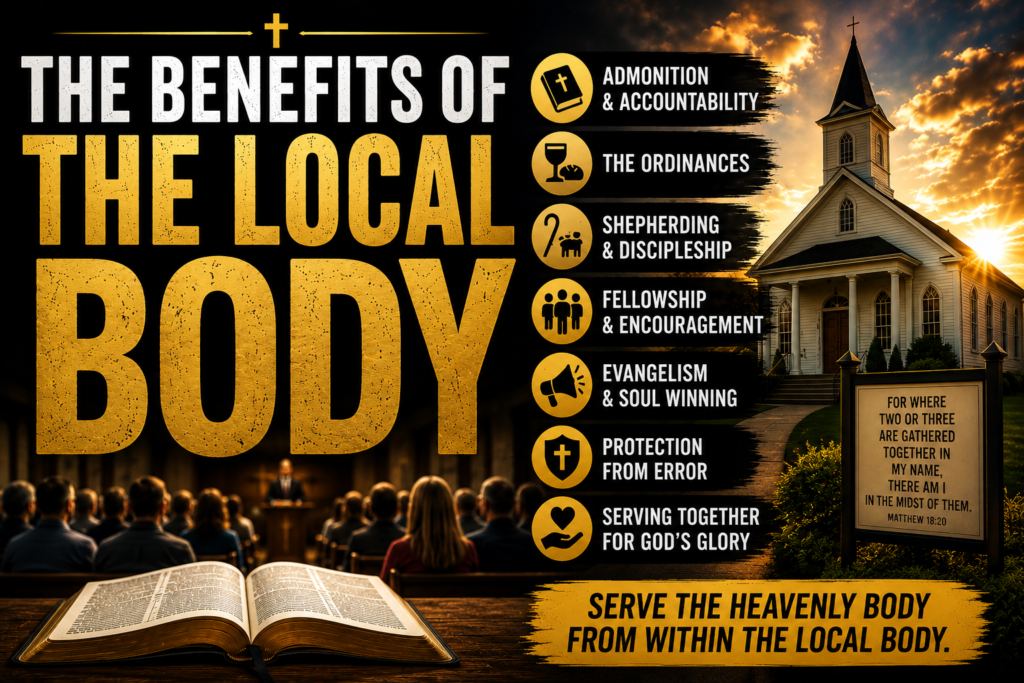
The Benefit of Admonition and Accountability
One of the greatest gifts God gives believers is loving correction. Every Christian possesses blind spots, and all of us have areas where our doctrine, attitudes, habits, and conduct need refinement. Left entirely to ourselves, we can easily drift from truth without realizing it.
Within a healthy church, pastors and fellow believers provide admonition, reproof, correction, and instruction in righteousness. They encourage us when we are discouraged, challenge us when we become complacent, and lovingly confront us when we begin moving in the wrong direction. While a believer operating in isolation may have access to information through books, sermons, and online resources, he lacks the accountability that comes from people who actually know him and are invested in his spiritual growth.
The Benefit of the Ordinances
The ordinances are not merely individual acts of devotion; they are church ordinances that God entrusted to the local assembly. Baptism publicly identifies a believer with Christ and His body, while the Lord’s Supper is observed within the fellowship of the church as believers collectively remember the sacrifice of Christ. When a believer disconnects himself from the local body, he forfeits two of Christ’s commands that are to be practiced by New Testament Christians.
The Benefit of Shepherding
Christ gave pastors and teachers to the church for the perfecting of the saints and the edification of His people. While a podcast preacher or online teacher may provide valuable information, a local pastor provides something far more personal: shepherding.
A pastor knows the people under his care. He prays for them, counsels them, warns them, teaches them, and helps guide them through seasons of difficulty and uncertainty.
The Benefit of Corporate Worship
There is something uniquely encouraging about gathering with God’s people to sing, pray, worship, and hear the Word of God together. Corporate worship reminds us that Christianity is not just an individual relationship with God but also a shared life among fellow believers.
The writer of Hebrews instructed believers not to forsake the assembling of themselves together. This command was not given because God needs our attendance but because we need one another. Gathering regularly with other believers strengthens our faith, encourages our hearts, and reminds us that we are part of something much larger than ourselves.
The Benefit of Service
Many Christians approach church asking what they can receive, but Scripture often emphasizes what believers can contribute. God has given each Christian spiritual gifts and abilities that are meant to be used for the benefit of others.
The local church provides opportunities to exercise those gifts by serving fellow believers, assisting those in need, supporting missionaries, teaching others, and participating in ministries that extend far beyond what an individual could accomplish alone. Through service, believers grow in maturity and become active participants in God’s work. The Christian life was never intended to be a spectator sport but a life of meaningful involvement in the body of Christ.
The Benefit of Discipleship
Jesus commanded His followers not merely to make converts but to make disciples. Genuine discipleship requires more than information; it requires relationships, observation, instruction, encouragement, accountability, and time.
These elements occur most naturally within the life of a local church, where believers can learn from one another and grow together in their faith. A Christian who remains disconnected from the local body may accumulate a great deal of knowledge, but he often misses the relational environment where true discipleship flourishes. As a result, he may become rich in information while remaining poor in spiritual formation.
The Benefit of Encouragement During Trials
Every believer experiences seasons of suffering, loss, discouragement, and uncertainty. During those difficult times, the local church often becomes one of God’s greatest means of grace and comfort.
Brothers and sisters in Christ pray, pastors provide counsel, friends offer encouragement, and practical needs are often met through the care of the church family. Burdens are shared rather than carried alone. Many Christians do not fully appreciate the value of a church family until they face a crisis and experience firsthand the support that comes from being surrounded by fellow believers who genuinely care.
The Benefit of Protection from Error
Throughout the New Testament, believers are repeatedly warned about false teachers, false doctrine, and spiritual deception. One of the primary purposes of the church is to serve as a safeguard against these dangers.
Through sound preaching, biblical accountability, faithful leadership, and doctrinal clarity, the local church provides guardrails that help protect believers from error. Christians who attempt to navigate the spiritual life entirely on their own are often far more vulnerable than they realize.
Often we call people who remain separate from the local church lone wolves. But a quick glance to nature demonstrates the danger of being a lone wolf. Contrary to the use of the phrase, lone wolves are not strong and independent. They die weak and alone.
Conclusion
The local church is not perfect because it is composed of imperfect people. Yet despite its imperfections, it remains God’s chosen institution for the growth, encouragement, protection, and ministry of His people.
The question is not whether a Christian can survive outside the local church. The more important question is whether he can fully experience all that God intended for him apart from it. The ordinances, shepherding, accountability, discipleship, corporate worship, service, evangelism, encouragement, and protection found within the local body are not accidental. They are gifts from God, designed to help believers grow and thrive in their walk with Christ.
My admonition is this: Find a local, King James Bible-believing, rightly-dividing, soul-winning Baptist church and faithfully serve there. Though all believers belong to the Body of Christ, God designed the Christian life to be lived within the fellowship, accountability, and ministry of a local assembly. Serve the heavenly Body from within the local body.
About The Author












Amen, brother Randy! While I love the resources Bible believers have access to online, nothing replaces one-on-one fellowship with other believers. What a great list of benefits you listed that should always encourage fellow brothers and sisters in Christ and motivate them to participate in a local Bible believing work!
Amen
Thank you