Over the past several months, as I have launched The Watchman’s Warning and begun publishing articles on a variety of theological, cultural, and apologetic topics, I have received no shortage of criticism. Some of it has been thoughtful and helpful. Some of it has been reactionary. Some of it, I suspect, came from individuals who never actually read the article they were criticizing. Personally, I would think reading an article should be a prerequisite for critiquing it, but I digress.
Recently, I received two separate admonitions regarding my website and podcast. Whether I ultimately agreed with every point is beside the issue. The fact remains that both individuals took the time to offer correction. Their comments forced me to think carefully about the nature of criticism, correction, and accountability.
As Christians, our first instinct should not be to dismiss criticism simply because it is uncomfortable. Neither should we blindly accept every objection that comes our way. The challenge is to cultivate the humility necessary to receive correction while also possessing the discernment necessary to evaluate it. Not every criticism is valid, nor every critic informed. Yet neither is every criticism wrong.
A wise man is neither stubborn nor gullible. He is willing to listen, willing to examine himself, willing to compare criticism against the word of God, and willing to make changes when necessary. At the same time, he must possess the courage to disregard counsel that is uninformed, unbiblical, or motivated by something other than truth.
As I reflected on the admonitions I had received, I began considering the biblical language of correction itself. Christians often use terms such as admonition, reproof, and rebuke interchangeably, but Scripture employs them with different emphases.
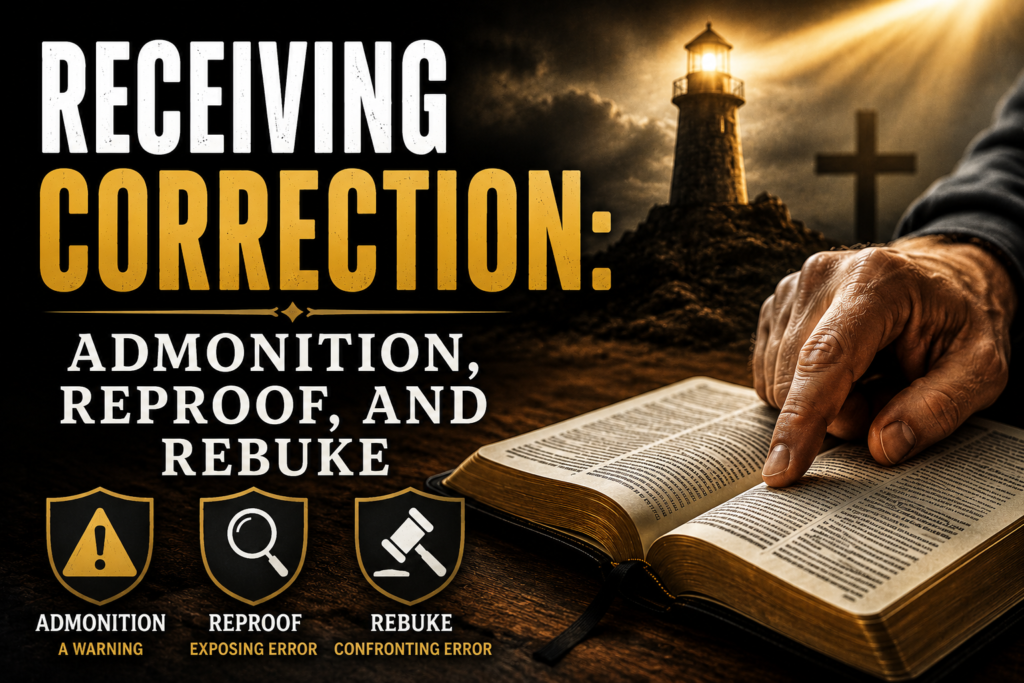
An admonition is fundamentally a warning. Paul instructed believers to “admonish one another” (Romans 15:14) and to “admonish the unruly” (1 Thessalonians 5:14). Parents are to raise their children in the nurture and the admonition of the Lord (Ephesians 6:4). An admonition seeks to prevent a person from going down the wrong path. It appeals to the mind and conscience before serious damage occurs. An admonition says, “Be careful. You are heading toward danger.”
Reproof goes a step further. While admonition warns of danger, reproof identifies and exposes error. Reproof compares a belief or behavior against the standard of God’s word and demonstrates where it is wrong. Reproof says, “This is not right.”
Rebuke is stronger still. A rebuke is not merely the identification of error but a direct confrontation of it. Paul instructed Titus to “rebuke them sharply” when dealing with false teachers. A rebuke says, “This is wrong, and it must stop.”
Scripture never explicitly presents these as a rigid sequence that must always be followed in order. Sometimes a gentle admonition is sufficient. Sometimes reproof is necessary because error has already occurred. In more serious situations, a piercing rebuke may be warranted. Nevertheless, these distinctions help us understand the various forms biblical correction may take.
Yet all correction raises a more fundamental question. By what standard do we determine whether something is right or wrong? Before a person can be admonished, reproved, or rebuked, truth must first be established. Correction requires a standard. This is where Paul’s words to Timothy become especially helpful.
“All scripture is given by inspiration of God, and is profitable for doctrine, for reproof, for correction, for instruction in righteousness:” (2 Timothy 3:16)
For years, I heard this verse quoted primarily as a proof text for the inspiration of Scripture. While it certainly teaches that truth, Paul is emphasizing something more. He is explaining what Scripture actually does in the life of the believer. In a single verse, he provides a framework not only for spiritual growth but also for understanding correction itself.
The verse presents four distinct functions of Scripture. Doctrine tells us what is right. Reproof tells us what is not right. Correction tells us how to get right. Instruction in righteousness tells us how to stay right.
Doctrine always comes first because truth must be established before error can be identified. Much of the criticism we encounter today is rooted in personal preferences, traditions, assumptions, or emotions. Biblical correction begins elsewhere. It begins by asking, “What does God say?” Without doctrine, correction becomes little more than a clash of opinions. Every meaningful conversation about right and wrong must begin with a clear understanding of God’s revealed truth.
Once truth has been established, reproof becomes possible. Reproof exposes where our beliefs, actions, attitudes, or arguments fail to align with Scripture. This is often the uncomfortable part of the process. Most people enjoy being taught what is right. Far fewer enjoy being shown where they are wrong. Yet reproof is one of God’s greatest gifts to His people. It reveals blind spots we cannot see ourselves. A person who refuses reproof is not demonstrating strength; he is demonstrating pride. Wisdom listens when error is exposed.
However, identifying a problem is only half the battle. Anyone can point out flaws. Social media is full of people who excel at criticism while offering no solutions. Scripture goes further. It provides correction. Correction restores what has gone astray and shows us how to return to the right path. God’s purpose is not merely to expose our errors but to restore us to obedience.
The final step is instruction in righteousness. Once truth has been established, error exposed, and correction applied, believers must learn how to continue walking in obedience. Instruction in righteousness develops habits, disciplines, convictions, and wisdom that help us avoid repeating the same mistakes. It teaches us how to stay right.
Some of my critics have provided genuine reproof. They exposed weaknesses in my reasoning or reveal areas where greater clarity is needed. Others provide valuable correction by suggesting ways to improve my communication. Still others never advance beyond personal preference. They identify no doctrinal issue, expose no actual error, provide no corrective solution, and offer no instruction for growth. The mature Christian must learn to distinguish between these categories.
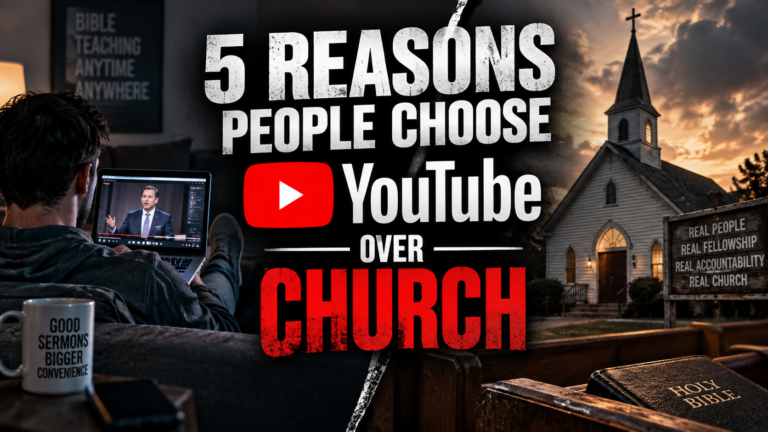
One of the great tragedies of modern Christianity is that many believers have become suspicious of correction while simultaneously distancing themselves from the very institution God designed to provide it. The local church exists not merely as a place for worship but as a God-ordained environment where doctrine is taught, error is exposed, lives are restored, and believers are instructed in righteousness.
Many people today view churches that practice biblical accountability as judgmental. Yet Scripture presents a very different picture. The church is not a collection of autonomous individuals pursuing their own spiritual paths. It is a body. The members are connected to one another and bear responsibility for one another. When a church teaches sound doctrine, confronts false teaching, and lovingly addresses sinful behavior, it is not being judgmental. It is fulfilling its God-given mission.
The local church provides guardrails that protect believers from both doctrinal error and destructive living. Every Christian possesses blind spots. Left entirely to ourselves, we are capable of embracing false doctrine, justifying sinful behavior, and drifting from truth. God has given pastors, teachers, and fellow believers to help prevent that drift. Their role is not merely to comfort the flock but also to protect it.
This protection is especially important in an age where every individual has a platform and every opinion can be broadcast to thousands of people. The internet provides access to endless information, but information alone does not produce wisdom. A believer who operates apart from the accountability of a local church can easily mistake personal preference for doctrine and confidence for correctness. Biblical correction serves as a safeguard against these dangers.
None of this means churches should become harsh, argumentative, or unnecessarily critical. Paul instructed Timothy to minister “with all longsuffering and doctrine.” Correction without compassion becomes cruelty. Yet love without correction becomes indifference. The healthiest churches are those that maintain both truth and grace. They are places where believers can be challenged without being humiliated, corrected without being condemned, and restored without being discarded.
The modern world often treats correction as an attack on personal freedom. Scripture presents it as an expression of charity. Proverbs reminds us that “faithful are the wounds of a friend.” A friend who refuses to warn us when we are wrong is not acting charitably. Likewise, a church that refuses to address error or sin may appear kind on the surface, but it ultimately abandons its responsibility to care for God’s people.
As I continue this journey with The Watchman’s Warning, I hope to remain teachable. I want to be open to admonition, willing to receive reproof, and humble enough to accept correction when I am wrong. At the same time, I want the discernment to recognize criticism that should be disregarded. Every objection should be weighed against the standard of Scripture, not the shifting opinions of men.
In the end, the goal is not to become immune to criticism. The goal is to become more faithful to the truth. A wise Christian is neither stubborn nor gullible. He is humble enough to receive correction, discerning enough to evaluate it, and committed enough to follow wherever the word of God leads.
About The Author





Excellent brother Randy
Absolutely excellent !!
Thank you again, brother Randy, for an insightful post. I love your statement, “Correction without compassion becomes cruelty. Yet love without correction becomes indifference.” Balance is so important in the life of the believer. I recently heard another outline for 2 Tim. 3:16 – thought it was interesting: Doctrine (Teaching); Reproof (Convincing); Correction (Restoring); Instruction in Righteousness (Schooling).