In 1948, something happened that many considered impossible. After nearly two thousand years, the nation of Israel was reborn.
The Bible had long foretold that God would regather His people and restore them to their land. Jeremiah 23:3 declares:
“And I will gather the remnant of my flock out of all countries whither I have driven them, and will bring them again to their folds; and they shall be fruitful and increase.”
Yet only a few years before Israel’s rebirth, such an event seemed unthinkable. The nation had ceased to exist for nearly twenty centuries. Its people had been scattered throughout the world.
Furthermore, the Jewish people—a nation that God described as being among the fewest of all people (Deuteronomy 7:7)—had just suffered one of the darkest tragedies in human history. During the Holocaust, approximately six million Jews were murdered at the hands of Adolf Hitler and the Nazi forces.
In 1953, the newly restored nation of Israel enacted legislation to preserve the memory of the Holocaust. The goal was not only to ensure that future generations would remember the suffering, death, hatred, and persecution, but also to honor those who risked everything to save Jewish lives.
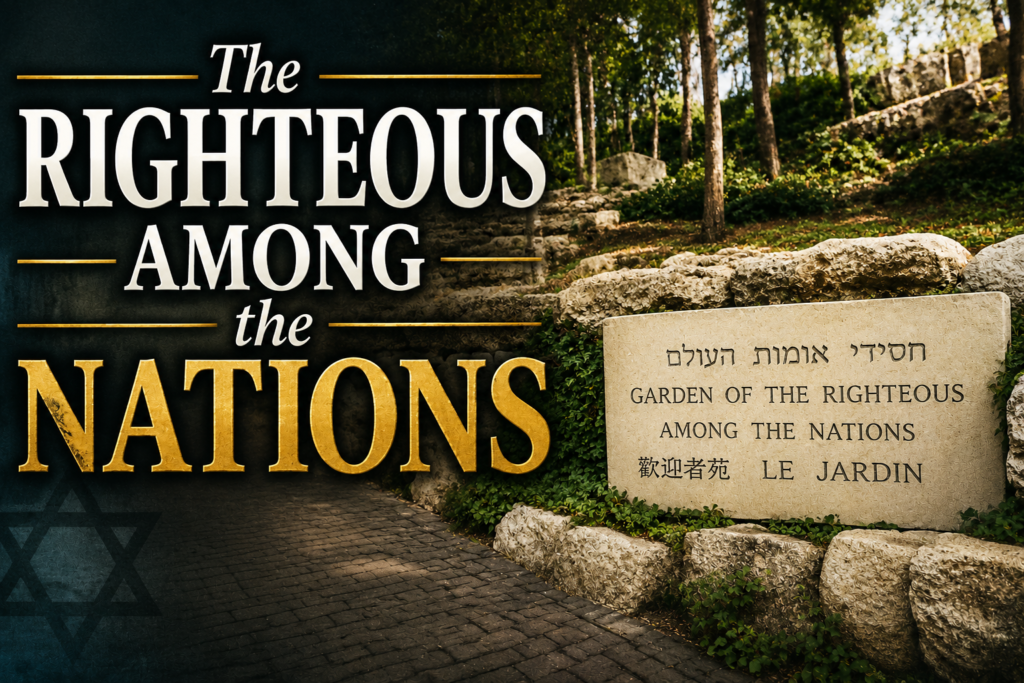
From that effort emerged the designation known as “Righteous Among the Nations.”
The title is awarded to non-Jews who, at great personal risk, rescued one or more Jews during the Holocaust without seeking payment, reward, or personal gain. These individuals are honored by the State of Israel for their courage and sacrifice.
To receive this recognition, four requirements must be met:
- The individual must have actively participated in saving one or more Jews from execution or deportation.
- The rescue must have involved risk to the rescuer’s life, liberty, or position.
- The rescuer must have acted solely out of a desire to help persecuted Jews and not for compensation.
- The rescue must be supported by credible documentation or testimony.
Since the program began, approximately 25,000 people have been recognized. The most famous is undoubtedly Oskar Schindler, whose story was popularized by the 1993 film Schindler’s List.
Far less known is a man named Reinhold Chrystman.
For decades, his story was nearly forgotten. Then in 2015, Jerry Klinger, a descendant of Holocaust survivors, began reviewing his aunt’s unpublished memoirs. In those writings she described how her family had worked at the Kara-Hortensja glass factory in Poland and how their lives had been saved by its manager, Reinhold Chrystman.
As researchers investigated further, additional testimonies surfaced. Memories preserved through family stories were uncovered. Childhood acquaintances were located. Historical documents were recovered. Even Chrystman’s granddaughter contributed details preserved by the family.
Together these pieces revealed the remarkable story of a man who quietly risked everything for others.
Reinhold Chrystman was a born-again Christian and a member of a Baptist church. Like the Jews he employed, as a Baptist, he was a minority within predominantly Catholic Poland.
Being a manager of a large glass factory, he oversaw hundreds of Jewish workers. Because he was of German descent, he had opportunities that many Poles did not. When Germany occupied Poland, he could have embraced his German heritage, claimed German citizenship, joined the Nazi Party, and improved his social standing.
He never did.
Instead, he chose a different path.
On Yom Kippur, he gathered approximately seven hundred Jewish workers and told them to take the day off.
“I will do what I can for you.”
Those were not empty words.
Chrystman immediately began working to have as many of his Jewish employees as possible classified as “essential workers.” Those who carried that designation were often spared deportation to the death camps.
Many of those he protected possessed no specialized skills whatsoever. Nevertheless, he found ways to keep them on the essential-worker lists.
His compassion extended even further.
Recognizing that the children of his workers were also in danger, he established what has been described as a special sanctuary for them. He entrusted their care to a young Jewish girl named Franka Berk.
Franka later testified that she cared for eight or nine children between the ages of two and ten. Two of them, she recalled, were “hellions.”
Yet Chrystman arranged for these children to be classified as essential workers as well.
What essential work could a two-year-old perform?
The answer is obvious. They could do nothing for him.
They brought no profit to the factory. They offered no economic advantage. From a worldly perspective, protecting them made no sense.
From a biblical perspective, however, it made perfect sense.
Matthew 25:40 says:
“And the King shall answer and say unto them, Verily I say unto you, Inasmuch as ye have done it unto one of the least of these my brethren, ye have done it unto me.”
One of those children was Israel Lau, who would later become Chief Rabbi of Israel.
On another occasion, a fifteen-year-old Jewish worker was seized by Nazi authorities and taken to a local synagogue where Jews were being held before transportation to the camps.
When Chrystman learned what had happened, he immediately went to the synagogue and confronted the Gestapo officer in charge. Through his efforts, the boy was released and returned to safety.
Again, Matthew 25:40 comes to mind:
“And the King shall answer and say unto them, Verily I say unto you, Inasmuch as ye have done it unto one of the least of these my brethren, ye have done it unto me.”
According to Jerry Klinger’s aunt, Chrystman saved approximately seven hundred Jews. She wrote that those survivors later presented him with a beautiful white leather book containing their names as a token of gratitude.
Yet despite all of this, Reinhold Chrystman has not been recognized as one of the Righteous Among the Nations.
Why?
Because of the third requirement.
No one has been able to prove exactly what motivated him.
Some have speculated that because he was an evangelical Baptist Christian, he may have acted in hopes of converting Jews to Christianity.
That explanation seems unlikely.
First, Baptists do not believe salvation can be purchased, forced, or exchanged for favors. Faith in Christ must be a personal decision.
Second, Chrystman openly respected Jewish religious practices. He gave his workers Yom Kippur off, hardly the action of a man attempting to coerce religious conversion.
Personally, I believe the evidence points in another direction.
He simply did what was right.
Perhaps one day additional evidence will emerge, and Israel will officially recognize him as one of the Righteous Among the Nations.
I hope so.
I believe he deserves it.
The Bible also speaks of righteous nations.
In Matthew 25, Christ describes a future judgment in which the nations are divided as sheep and goats. The sheep nations are blessed, while the goat nations face judgment.
One of the distinguishing marks of the sheep nations is how they treated Christ’s brethren during a time of persecution.
This principle reaches all the way back to God’s promise to Abraham in Genesis 12:3:
“And I will bless them that bless thee, and curse him that curseth thee: and in thee shall all families of the earth be blessed.”
There is also a biblical standard for individual righteousness.
The standard is not our works.
Romans 3:10 states:
“As it is written, There is none righteous, no, not one:”
No man is righteous in himself.
Yet God offers righteousness as a gift through faith in Jesus Christ.
The gospel is simple: Christ died for our sins, was buried, and rose again the third day.
When a sinner places his faith in Christ, God credits Christ’s righteousness to his account.
Romans 3:24-25 says:
“Being justified freely by his grace through the redemption that is in Christ Jesus: Whom God hath set forth to be a propitiation through faith in his blood, to declare his righteousness for the remission of sins that are past, through the forbearance of God;”
Whether Reinhold Chrystman is ever recognized by Israel or not, there is a greater recognition that matters.
If he truly trusted Christ as Saviour, then he has already been declared righteous before God.
Many Christians speak about being willing to follow Christ no matter the cost. Reinhold Chrystman (Christman) appears to have done exactly that.
How fitting are the words of 2 Timothy 2:19:
“Nevertheless the foundation of God standeth sure, having this seal, The Lord knoweth them that are his. And, Let every one that nameth the name of Christ depart from iniquity.”
About The Author



Wow !!
Excellent
Thank you !!