
On October 31, 1517, Martin Luther nailed his 95 Theses to the church door in Wittenberg, sparking the beginning of the Protestant Reformation. Every October 31, Protestant Christians around the world celebrate this momentous occasion as “Reformation Day.” The great hero of the faith, Martin Luther, is remembered for his contribution to the restoration of “true Christianity” and the doctrine of salvation by grace through faith.
Sadly, the real Martin Luther was not always the great Christian he is often portrayed to be.
Setting aside (for now) the obvious fact that the true gospel was never lost, and therefore was never in need of restoration, and the fact that even in the darkest periods of history there were faithful groups such as the Waldenses and Paulicians who held firmly to the truth of Scripture, we will briefly examine Luther’s views regarding the Jews.
In 1543, over twenty years after his “conversion”, Luther wrote his 65,000-word antisemitic work, On the Jews and Their Lies. In this book, he encouraged Protestant rulers to, among other things:
- Confiscate Jewish property
- Burn down synagogues
- Forbid rabbis from teaching on pain of death
- Force Jews into physical labor for “Christians”
While there may be debate over various aspects of Luther’s theology, all Bible-believing Christians should be able to acknowledge that such writings are deeply contrary to Scripture.
The Bible is clear that God will curse those who curse Israel:
Genesis 12:2–3 (KJV)
“And I will make of thee a great nation, and I will bless thee, and make thy name great; and thou shalt be a blessing: And I will bless them that bless thee, and curse him that curseth thee: and in thee shall all families of the earth be blessed.”
For those who argue that this promise applies only to Abraham as an individual and not to national Israel, it should be noted that verse 2 explicitly connects the promise to a nation.
Furthermore, the persecution of the Jews reflects the spirit of Antichrist:
Revelation 12:13 (KJV)
“And when the dragon saw that he was cast unto the earth, he persecuted the woman which brought forth the man child.”
Psalm 10:2 (KJV)
“The wicked in his pride doth persecute the poor: let them be taken in the devices that they have imagined.”
Often, when Luther’s errors are brought up, his defenders argue that he was simply a product of his time and should be judged accordingly. This brings us to Balthasar Hubmaier.
Though a contemporary of Luther, and, in some respects, one of the most influential preachers in church history, Hubmaier is largely unknown today. Yet his life provides a meaningful comparison.
Like Luther, Hubmaier began as a Catholic priest. Interestingly, he too was once a fierce persecutor of the Jews. As pastor in Regensburg, he led in their persecution. In the spring of 1519, just months before Luther posted his 95 Theses, a mob, stirred by Hubmaier’s preaching, drove the Jews out of the city, burned their synagogue, and built in its place a chapel dedicated to “the Beauteous Mary.”
But Hubmaier would soon experience a profound change of heart (Psalm 51:10).
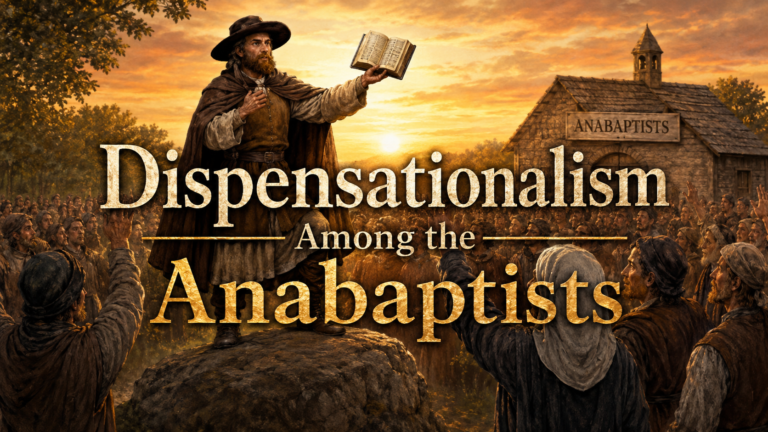
In the early 1520s, he began to read the Scriptures, something he later admitted he had never done as a Catholic priest. Giving special attention to the epistles of Paul, and through the word which makes one wise unto salvation (2 Timothy 3:15), he was converted sometime before 1522. Soon after, he became a committed Anabaptist preacher.
In 1524, he published Concerning Heretics and Those Who Burn Them, a work recognized by historian Henry Vedder as the earliest known plea for complete religious liberty. In it, Hubmaier argued that no one, not even a Turk (Muslim), should be persecuted for his faith.
Regarding his former treatment of the Jews, he later wrote in On the Christian Ban (1526):
“I should show friendship toward Jews and heathen… so that they might be drawn by a Christian example to Christian faith.”
After his conversion, Hubmaier turned from persecution and showed compassion toward those he had once oppressed. This stands in sharp contrast to Luther, who, decades after separating from Rome, was still calling for their persecution.
Hubmaier’s plea for religious liberty went largely unheeded by both Catholics and Protestants. On March 10, 1528, he was burned at the stake in Vienna, Austria, for his faith.
The city of Vienna plays an interesting role in this discussion, as it later served as the home of one of history’s most notorious antisemites: Adolf Hitler. Hitler held Martin Luther in high regard as a great German, and some Nazi leaders even cited Luther’s writings during the Nuremberg Trials to justify their actions, actions that mirrored, in many ways, the very persecutions Luther had advocated.
This brings us to the second Baptist preacher: Arnold Köster.
While Dietrich Bonhoeffer is often recognized as the face of Christian resistance to Nazism, far less is known about Köster, a faithful Baptist pastor who stood firmly against the same evil.
Köster became pastor of the Baptist Church in Vienna in 1929, just four years before the Nazi Party rose to power in Germany. The church had around 300 members, including approximately 50 Jewish converts. Notably, Hans Herzl, the son of Theodor Herzl, founder of modern Zionism, was baptized there in 1924.
Even before Hitler came to power, Köster recognized the danger. In 1932, he published an article titled Swastika and Soviet Star, arguing that both Nazism and Communism were expressions of Antichrist ideology. This was an unpopular, and increasingly dangerous, position.
In March 1938, Austria was annexed into the Reich. Many Christians supported the expansion, believing it would open doors for missionary work. To oppose it risked social and political consequences.
Yet Köster did not waver.
When challenged by fellow Baptists to remain silent, he pointed them to Scripture and warned that this rising power was only a “fading power,” rooted in antichristian thinking. His warnings were mocked.
When Baptist publications were shut down under pressure, Köster continued preaching against Nazism in both Sunday services and weekday Bible studies. Members of his congregation courageously transcribed and distributed his sermons, even as Gestapo officers attended services, took notes, and gathered evidence.
In 1942, when confronted by a Gestapo officer and urged to accept the Nazi worldview, Köster responded:
“If I were to accept your worldview… I would have to confirm publicly that it will accomplish victory. That I cannot do… it will end in a terrible catastrophe.”
As persecution intensified, Köster warned his congregation in 1943 that if he were arrested, they must continue to meet.
At a time when many Christians distanced themselves from the Old Testament, Köster continued to preach from it. Drawing from Romans 9–11, he affirmed that Israel remained God’s elect people.
Remarkably, despite repeated scrutiny and confrontation, Köster was never arrested, perhaps owing only to the providential protection of God (Psalm 4:8).
He survived the war and continued pastoring until his death on October 28, 1960.
Conclusion
There is a lesson here for Christians today.
Antisemitism is once again on the rise, even among professing Christians. The doctrine of Israel as God’s chosen people is increasingly rejected.
Like Balthasar Hubmaier and Arnold Köster, those who stand firmly on Scripture may be mocked, dismissed, or labeled as unpatriotic. Yet history reminds us that faithfulness often comes at a cost.
Still, there is no doubt that when these men entered the presence of their Savior, they heard the words:
“Well done, thou good and faithful servant.”
What more could any Christian desire?
The promises God made concerning Israel in Genesis 12 remain just as true today as they were in 1528 or 1943. Let us commit ourselves to obeying Scripture, blessing Israel and standing firmly against antisemitism.
The rapture of the Church is imminent; our salvation is nearer than when we first believed.
Let us be found faithful, steadfast, grounded in truth, and not carried about by every wind of doctrine.
As the old song says:
“Hold on a little longer—hold on!”
About The Author








Wow! What a powerful testimony of transformation! I knew of Hubmaier, but did not know the details of his conversion. Your statement, “Furthermore, the persecution of the Jews reflects the spirit of Antichrist…” Couldn’t be more relevant today. Well said brother Caleb!
A fascinating end encouraging article, thank you Bro. Hickam. As for those who would suggest that Genesis 12:3 applied only to Abraham in the past, I point them to Numbers 24:1,5-9 where the same promise is applied to the entire nation of Israel in the wilderness. God bless.
Interesting
Excellent
Thank you