
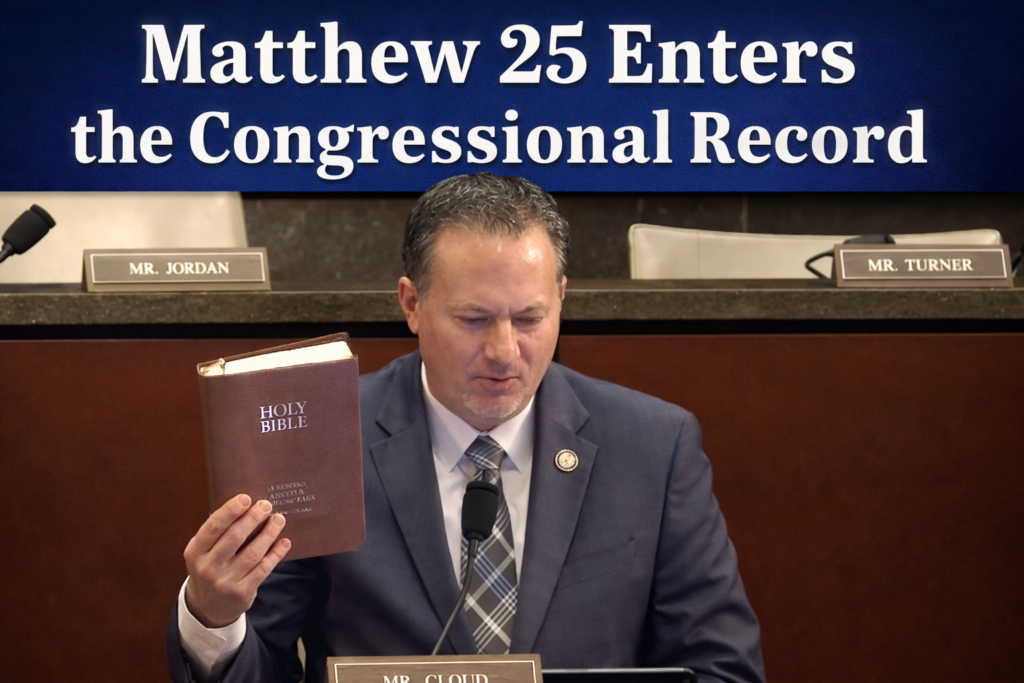
In a recent congressional oversight hearing on fraud, an unexpected authority was formally introduced into the proceedings—not a financial report, but Scripture itself.
During the hearing, Rep. Michael Cloud stated, “I would like to submit the entirety of Matthew 25 into the record.” With that, Matthew 25—one of the most sobering and often misunderstood passages in the New Testament—was entered into the official congressional record.
The moment was brief, but what it revealed was significant. Beneath the surface of a policy discussion on fraud was a deeper conflict. This was not merely about economics or governance, but about the interpretation and application of Scripture itself.
You can find the exchange here.
Scripture in the Public Square
The hearing addressed fraud tied to programs intended to assist vulnerable individuals, including cases connected to Minnesota (such as Somali daycare centers). In that context, “Rev.” Mariah Tollgaard appealed to Matthew 25, invoking Christ’s words concerning “the least of these” to frame the moral seriousness of the issue.
To those who have never read Matthew 25, the appeal may seem plausible. The passage presents a powerful picture of compassion and accountability, portraying a final judgment in which individuals are separated based on how they treated the hungry, the thirsty, the stranger, the sick, and the imprisoned.
Yet the question raised in the hearing was not whether compassion is required.
The question was whether the passage was being applied faithfully.
It was at this point that Rep. Cloud intervened. By submitting the entire chapter into the record, he redirected attention away from selective quotations and toward the full context of the text.
Context Matters
Matthew 25:31–46 describes the judgment of the nations, where Christ separates the sheep from the goats.
From a dispensational perspective, this passage is understood as referring to the treatment of Christ’s brethren, Israel, during the future Tribulation period. In that sense, it carries a specific prophetic and doctrinal context that should not be ignored.
“Inasmuch as ye have done it unto one of the least of these my brethren, ye have done it unto me.” (Matthew 25:40)
Those being judged are identified as part of the nations, yet they are evaluated based on their individual response. At the same time, both within and outside of this strict doctrinal framework, the passage clearly speaks to individual accountability before God.
All nations are gathered, that is who is present, but individuals are judged based on their actions. These actions in the passage are performed by people, not geopolitical entities. A nation, as a structure, does not clothe the naked, visit the imprisoned, or give a cup of water.
Therefore, the passage describes the moral obligations of persons, not the structural responsibilities of governments. To move from one category to the other without clear textual warrant is to go beyond what the passage itself establishes.
A Necessary Correction
Rep. Cloud’s response functioned as a correction, not of the importance of compassion, but of the way the text was being used.
By submitting the entirety of Matthew 25 into the record, he made a simple but crucial point:
If Scripture is going to be invoked, it must be handled in full, not selectively.
Scripture is not a collection of inspirational fragments. It is a unified revelation that must be interpreted in context. When only portions of a passage are emphasized, there is a real danger that the meaning of the text will be shaped by the argument, rather than the argument being shaped by the text.
This distinction is not minor.
A principle drawn from Scripture must still be applied in a way that is consistent with the scope and intent of the passage. Otherwise, even a true statement can be misused.
The Risk of Misapplication
The exchange highlights a broader concern that extends well beyond a single hearing.
In public discourse, Scripture is often invoked as a source of moral authority. Yet there is a difference between appealing to Scripture and submitting to it.
When passages are used to support positions that the text does not explicitly—or even implicitly—address, the authority of Scripture is subtly shifted. Instead of shaping the argument, the text becomes a tool within it.
This is why the biblical admonition to “rightly divide the word of truth” (2 Timothy 2:15) remains essential.
Proper handling of Scripture requires attention to context, audience, and purpose.
Without that discipline, even well-intentioned appeals can lead to distortion.
Maintaining Proper Distinctions
One of the central issues in the hearing was the distinction between moral obligation and governmental responsibility.
Matthew 25 clearly establishes that individuals are accountable for acts of compassion. It does not specify how societies are to structure systems of aid or resolve questions of public policy.
To treat a passage directed at personal conduct as a direct mandate for political or institutional outcomes is to blur categories that Scripture itself keeps distinct.
Recognizing that distinction does not weaken the force of the passage; it preserves it.
There is also an important principle of liberty at stake. When compassion is shifted from personal obedience to enforced policy, it raises a serious question: can charity still be called charity when it is compelled? Scripture consistently presents giving as a voluntary act of the heart, not something extracted under force.
When individuals are required to participate in charitable systems through coercion, it moves beyond moral responsibility into compelled action, raising concerns about conscience and personal liberty.
This tension highlights a historic Baptist distinctive: the separation of church and state. Baptists have long held that the state has no authority to compel religious duty, and that obedience to God must flow from a willing heart, not external pressure.
To use passages like Matthew 25 to justify enforced systems of compassion risks confusing these categories—blending what belongs to the individual believer with what belongs to civil authority (Romans 13).
Maintaining this distinction is not a rejection of compassion; it is a defense of its purity.
True biblical charity cannot be mandated, and our consciences ought not be violated by government taxation that compel us to fund organizations like Catholic Charities, Planned Parenthood, or Somali daycare programs.
Conclusion
The decision to enter Matthew 25 into the congressional record ensured that the full weight of the text, not a partial reading, was brought into the discussion. When the Bible is used to support ideas that extend beyond its context, its message is inevitably altered.
Moments like this remind us that fidelity to Scripture requires more than citation.
It requires careful interpretation and application.
And when the Bible is used to prop up ideologies through a distortion of its context, whether in politics, public discourse, or even within the church, there remains a responsibility to speak.
Because at that point, the issue is no longer merely disagreement.
It is the faithful handling of Scripture itself.
About The Author











Thank you
Yes amen. If one is forced to give to the needy that is not compassion, it is coercion.