
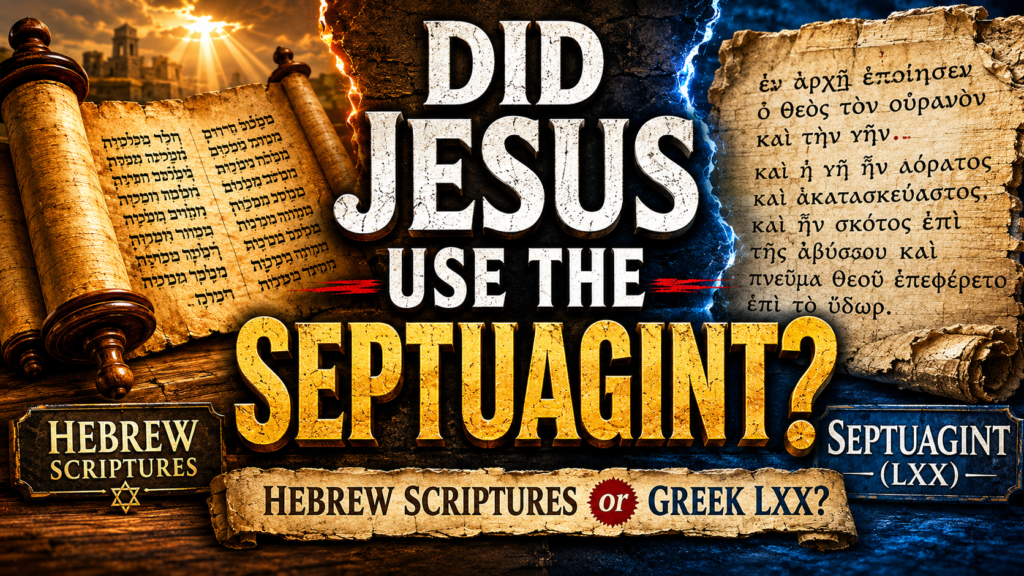
The view of many mainstream scholars today is that Jesus used the Septuagint (LXX; i.e., the translation of the O.T. in Greek) as His Bible. The primary evidence offered in support of this view is that many of His quotations from the O.T. appear to better match the Greek text of the LXX than the Hebrew (Masoretic) text.
That evidence, however, must be weighed against the fact that the earliest extant manuscript copies of the LXX come from several centuries after Christ, creating the possibility that the Greek text for these O.T. verses could have been taken from their N.T. quotations in order to create an exact, verbatim match (which otherwise is not the pattern of scriptural quotation seen in the Bible). Is there alternative evidence in favor of Jesus’ use of the Hebrew O.T. rather than the LXX? The answer to that question is YES, and the evidence is quite compelling.
In Luke 24:44, Jesus made reference to the written O.T. scriptures:
“And [Jesus] said unto them, These are the worlds which I spake unto you, while I was yet with you, that all things must be fulfilled, which were written in the law of Moses, and in the prophets, and in the psalms, concerning me.”
Implicit in these words of Jesus is the structure and organization of the Hebrew Bible (which is equivalent in content to the O.T.). The books of the Hebrew Bible (i.e., TNK, or Tanakh) are organized into three sections: the law [of Moses] (Heb., Torah), the prophets (Heb., Nevi’im), and the writings (Heb., Ketuvim; the first book in this section is the Psalms). By referring to the entirety of the (O.T.) scriptures as the law, the prophets, and the psalms, Jesus presupposed the organization of the O.T. canon that appears only in the Hebrew scriptures.
In contrast, the books in the LXX (which also contains many non-canonical books) are organized much like they appear in modern English Bibles (e.g., historical books, wisdom books, and prophetic books). Thus, Jesus’ words presuppose the Hebrew Bible, not the Greek Septuagint.
This presupposition of a Hebrew Bible is seen again in Matthew 23:35, where Jesus refers to the first and last martyrs in the O.T. as:
“That upon you may come all the righteous blood shed upon the earth, from the blood of righteous Abel unto the blood of Zacharias son of Barachias, whom ye slew between the temple and the altar.”
Abel is the first martyr recorded in Genesis 4, and Zacharias is the last martyr recorded in 2 Chronicles 24. Genesis is the first book in the Hebrew Bible, and 2 Chronicles is the last book in the Hebrew Bible. Again, Jesus’ words presuppose the Hebrew Bible, not the Greek Septuagint.
Did Jesus use the Septuagint? NO, Jesus used the Hebrew scriptures.
About The Author












Great points here.
Amen.
No pooptuagit here.
Praise the Lord for His preserved word!
Great points. I agree and have found it easy to accept this position. I have recently run into a tough question though… there is a man in the geneology portion of Luke 3 that does not appear in the Bible’s OT, but does septuagint version. Have you heard of this before? What are your thoughts on that? I’m just looking for the truth. Thanks.
Yes, “Cainan” appears in Luke 3:36 as a son of Arphaxad, but he does not appear in Hebrew manuscripts of the genealogy in Genesis 11 (and for that reason, he does not appear in Genesis 11 in the KJV). However, Cainan does appear in the genealogy of Genesis 11 in some manuscripts of the LXX. Since I consider the evidence to be overwhelming that the LXX is an AD (post-NT) production, I would consider the appearance of Cainan in Genesis 11 of the LXX as an error, probably an attempt by the translators of the LXX to harmonize Genesis 11 with Luke 3; clearly, that is not correct. Nonetheless, the explanation for the appearance of Cainan as the son of Arphaxad in Luke 3:36 (but not Genesis 11) is a challenge that has not yet been satisfactorily explained. I’m sure a satisfactory explanation exists, which upholds the authority and integrity of the KJV, I just don’t know what it is!
A reasonable explanation, although it is nothing more than speculation, is that Cainan died young and Arphaxad adopted/raised his grandson Shelah as his son/heir (Genesis 11:24). This could explain why Cainan would be included in a full genealogy, but might be left out of an abbreviated genealogy. This appears to happen elsewhere in Scripture, such as in “Zechariah, the son of Berechiah, the son of Iddo” (Zechariah 1:1; Cp., Matthew 23:35) in contrast to “Zechariah, the son of Iddo” (Ezra 5:1; 6:14; Cp., Nehemiah 12:16).
And a reason for including Cainan the son of Arphaxad in the full genealogy presented in Luke 3, which documents the human/bloodline from Adam to Jesus (the last Adam), is to reveal that from Adam to Jesus was 77 generations, a seemingly significant number.