President Trump built his political brand on the promise of securing deals that put America first. His bestselling book, The Art of the Deal, portrayed him as a master negotiator capable of extracting maximum value while giving away as little as possible. Yet if the recently proposed Memorandum of Understanding between the United States and Iran accurately reflects the contours of a future agreement, many Americans may be left wondering whether this deal advances American interests or merely enriches one of America’s oldest adversaries.
At the center of the proposed framework is a staggering commitment: the United States, together with regional partners, would undertake to develop a reconstruction and economic development plan for Iran worth no less than $300 billion. Regardless of how the money is ultimately sourced, whether through direct appropriations, allied contributions, private investment, or a combination thereof, the reality remains the same. The United States would be serving as the chief architect and facilitator of an economic renaissance for the Islamic Republic of Iran.
That raises an obvious question: Why?
For decades, American policymakers have described Iran as a destabilizing force in the Middle East. Iran has funded proxy groups, threatened regional allies, challenged maritime commerce, pursued advanced nuclear capabilities, and repeatedly positioned itself in opposition to American interests. Successive administrations imposed sanctions specifically designed to restrict the regime’s access to capital and limit its ability to project power beyond its borders.
Now, under the proposed framework, many of those restrictions appear destined for removal.
Iran stands to gain sanctions relief, renewed oil exports, access to frozen assets, reduced military pressure, restored commercial access, and the prospect of hundreds of billions of dollars in economic development. America, by contrast, receives promises. Iran promises not to pursue nuclear weapons. Iran promises to cooperate with international monitoring. Iran promises future compliance with terms that remain subject to further negotiation.
The disparity is difficult to ignore.
A successful negotiation generally requires each side to make meaningful concessions. Yet the most immediate and measurable benefits in this agreement appear to flow overwhelmingly toward Tehran. The economic rewards are tangible and quantifiable. The American gains, however, are largely dependent upon future actions, future verification, and future good faith.
History provides ample reason for skepticism.
Governments do not fundamentally change their strategic objectives because economic incentives are offered. Nations pursue their interests. Iran will pursue Iran’s interests just as America should pursue America’s interests. The question is whether this agreement genuinely alters Iran’s long-term behavior or simply provides the regime with additional resources while postponing difficult problems for another day.
A ceasefire that strengthens an adversary without fundamentally changing its behavior may buy temporary calm while creating greater challenges in the future. Economic relief can become economic leverage. Reconstruction can become rearmament. Investment can become influence.
The proposed $300 billion development package illustrates this concern perfectly. If Iran’s economy is revitalized through international investment and sanctions relief, the regime will possess greater financial flexibility, greater regional influence, and greater strategic options than it possesses today. In other words, the deal could accomplish precisely what decades of sanctions were designed to prevent.
Americans should therefore look beyond the headlines and ask a simple question: Who benefits most from this agreement?
If the answer is Iran, then America should not be afraid to say so.
The true test of any deal is not how it is marketed but how it changes reality. A deal is not successful because it temporarily lowers tensions. A deal is successful when the benefits received outweigh the concessions made.
As presently understood, this agreement appears to offer Iran immediate economic opportunity, international legitimacy, sanctions relief, access to capital, and long-term development. The United States receives assurances, negotiations, and the hope that future compliance will justify present concessions.
Perhaps the final agreement will contain stronger safeguards and more substantial reciprocal commitments. But based on what is presently known, the arrangement looks less like America First and more like a massive investment in the future prosperity of the Islamic Republic.
For Christians who take Bible prophecy seriously, the irony is difficult to miss. Iran, the nation historically known as Persia, occupies a unique place in Scripture. Ezekiel 38:5 explicitly identifies Persia as part of a future coalition of nations that will come against Israel in the last days: “Persia, Ethiopia, and Libya with them; all of them with shield and helmet.” While faithful believers may disagree on the precise timing and details of this prophecy, Persia’s inclusion is undeniable.
That reality makes the proposed agreement all the more remarkable. At a time when many Christians view modern Iran as the most likely successor to the biblical Persia described by Ezekiel, the United States appears prepared to facilitate an economic revival measured not in millions, but in hundreds of billions of dollars. Whether one views current events through a geopolitical lens or a prophetic one, the optics are striking. America is not merely negotiating with Persia — it may be helping to finance its resurgence.
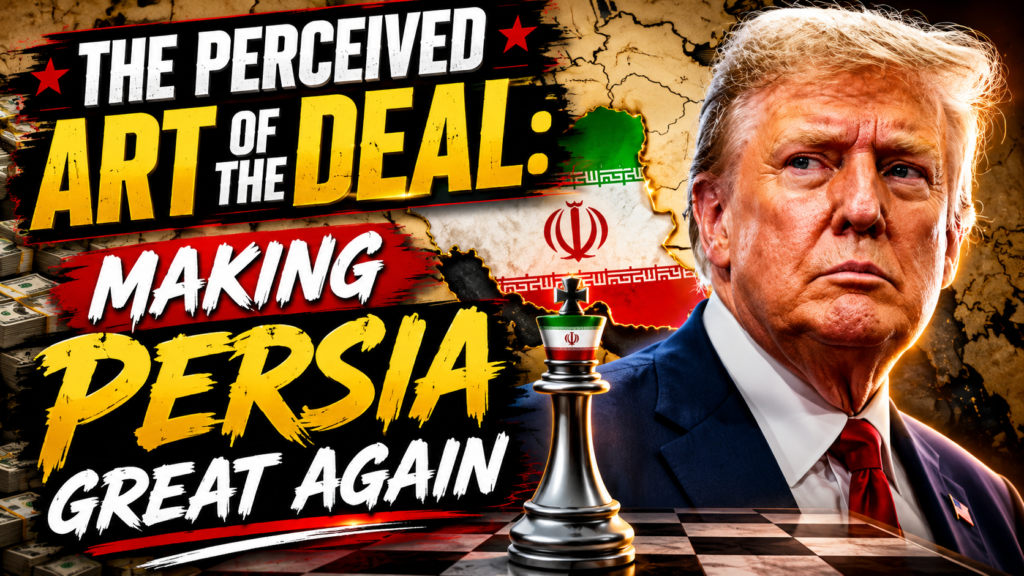
Perhaps that is why the title “Making Persia Great Again” resonates with so many observers. It captures the growing concern that while America is celebrating a diplomatic achievement, it may simultaneously be empowering a nation that Scripture specifically identifies as playing a significant role in future opposition to Israel.
If that perception proves accurate, then this may not be remembered as the Art of the Deal.
It may be remembered as the deal that helped make Persia great again.
About The Author









Interesting
Thank you
Sad that all that money is going to Iran .
I find it particularly fascinating how the truths of the Bible unfold before us. I used to wonder how the world would become unified under a single diabolical leader and what role the US would play in it. I think it’s becoming painfully obvious. All we can do as Christians is continue to stand in defense of the Biblical worldview, and walk circumspectly, being careful to glorify our Savior in all that we do.