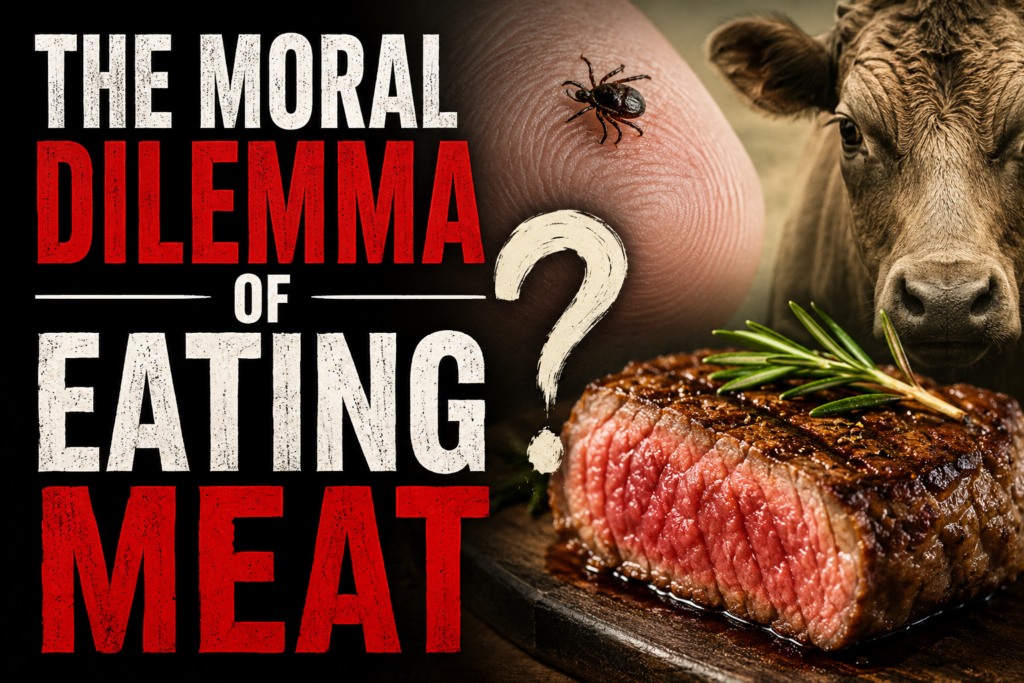
The other night I sat outside by the fire enjoying the cool mountain air. When I finally went inside, I found three ticks crawling on me.
Three.
I had already been down a rabbit trail of articles, social media posts, conspiracy theories, and legitimate news stories about ticks. Some of what I found was fiction. Some was fact. Most was difficult to distinguish.
One article in particular caught my attention. A recent philosophy paper argued that if eating meat is morally wrong, then society should consider genetically engineering ticks to spread alpha-gal syndrome, a condition that causes people to become allergic to red meat. The authors even suggested that such a program could be morally obligatory if it reduced animal suffering.
The proposal exists as a philosophical argument rather than a public policy initiative. But the fact that educated people can seriously discuss such a proposal reveals how far some ethical theories can go once they are disconnected from common sense and biblical stewardship.
I find it fascinating that some people view the consumption of meat as such a moral evil that they are willing to entertain the possibility of intentionally altering human beings in order to stop it.
The irony is that the discussion often ignores something important: our relationship with our food.
Many people today have never killed the food they eat.
Now, I’m not saying that everyone must hunt, fish, butcher livestock, or raise a garden in order to eat ethically. Most of my food comes from the grocery store just like everyone else’s. There is nothing wrong with purchasing food that others have produced.
But I do believe something valuable is lost when we become completely disconnected from where our food comes from.
For me, there is a greater appreciation for both the Creator and His provisions when I have personally taken an animal’s life in order to sustain my own. When I harvest a deer, catch a fish, or practice animal husbandry, I am reminded that my life depends upon the lives of other living things that God has provided.
That realization produces gratitude and responsibility.
Waste becomes more difficult when you have looked into the eyes of the animal that now fills your freezer. Stewardship becomes more meaningful when you have invested the time, effort, and sacrifice necessary to harvest that food yourself.
It is easy to throw away a package of meat that appeared magically on a grocery store shelf.
It is much harder to waste something when you remember the life that was taken and the labor that brought it to your table.
Perhaps that is one reason hunting, fishing, and farming remain valuable even for those who could simply buy everything at the supermarket. They remind us of realities that modern convenience often hides. They remind us that food is not manufactured. It is provided through God’s creation.
Since the Noahic covenant, the biblical worldview has never viewed the ethical consumption of animals as immoral.
God gave mankind dominion over the animal kingdom. He permitted the eating of meat after the Flood.1 Jesus ate fish. The Passover lamb was eaten. The apostles never condemned meat consumption. In fact, Paul warned that some would depart from the faith by commanding people to abstain from foods which God created to be received with thanksgiving.
There is not one unethical thing about eating meat that has been ethically raised and slaughtered.
Cruelty is wrong.
Wastefulness is wrong.
But eating meat is not wrong.
What is wrong is the notion that human beings should be subjected to disease, biological manipulation, or medical harm in order to advance an ideological cause. Any proposal that seeks to weaponize disease against people because of their dietary choices has crossed a moral line.
These thoughts came to mind as I watched the recent discussion surrounding ticks. Some of the stories involve conspiracy theories. Some involve legitimate concerns. Even now, at the request of Robert F. Kennedy Jr., questions are being raised about past research involving ticks and tick-borne diseases. Whether every claim proves true or not, the conversation serves as a reminder that ideas have consequences.
A philosophy paper written in an academic journal may seem harmless enough. Yet history teaches us that when people begin treating human beings as problems to be solved rather than individuals made after the similitude of God,2 dangerous ideas rarely stay confined to paper.
The moral dilemma of eating meat is not really about meat. It is about man’s place and permissions within God’s creation.
BTW, when you go inside tonight, be sure to check for ticks.
About The Author









Amen
Thank you