Editor’s Note: The claims expressed in this article are those of the author. This piece is published as commentary and reflects both the author’s perspective and my editorial judgment.
While I have not had extensive personal interaction with this particular teaching, I have observed what I believe to be concerning patterns in how it is expressed and received. Based on those observations, and conversations within my own circles, I felt it was appropriate to publish this article for the sake of discussion and discernment.
As students of the word, specifically those of us who hold to a dispensational understanding of the Scriptures, we are often reminded that our primary loyalty is to the “rightly divided” Truth, not to the personalities who teach it. Paul’s warning in 2 Corinthians 4:2 is a high bar for any of us: we are to renounce the “hidden things of dishonesty” and avoid “handling the word of God deceitfully.” Likewise, 1 Thessalonians 5:21 tells us to “prove all things; hold fast that which is good.”
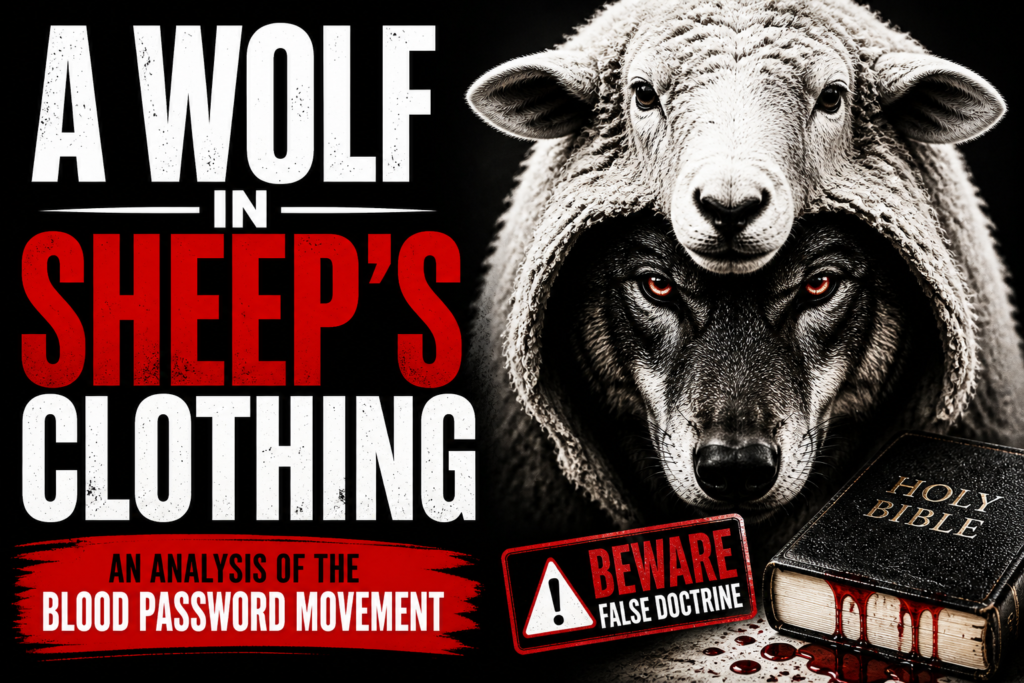
Lately, I’ve had some conversations with folks following the ministry of Robert Breaker. I have also spent several hours reviewing videos of Robert Breaker’s teachings, as well as those of some of his followers and peers. While I take no joy in critiquing another Bible believer, I’ve become deeply concerned about the “Faith in the Blood” doctrine, or what many are calling the “Blood Password.” Please understand that what Breaker and his followers teach is not the correct Biblical doctrine of the Blood Atonement. These are two separate doctrines altogether.
More than just a theological disagreement, I’ve noticed a troubling pattern in how this ministry operates, how it affects the “unstudied” or “unprepared” believer, and the way it builds a wall of blind loyalty around a single man.
Understanding the “BITE” Model of Control
Before we get into the verses, we have to look at the atmosphere this ministry creates. To understand why Breaker’s followers often disengage from scriptural debate and resort to labels like “blood denier,” it helps to look at something called the BITE model. Developed by Dr. Steven Hassan, the BITE model is a way to identify how certain groups or leaders exert undue influence or control over their followers. This model was meant as a metric to identify cults or cultic behaviors. It stands for:
- B – Behavior Control: Regulating where people go or how they act (in this case, “retreading” believers to follow a specific ministerial path).
- I – Information Control: Discouraging followers from considering opposing views or labeling critics as “demonic” to keep them from “poisoning” their minds.
- T – Thought Control: Using “loaded language” or short, repetitive labels (like “Bloody Gospel”) to shut down complex thinking.
- E – Emotional Control: Using fear, specifically the fear of being lost or having an “invalid” salvation, to maintain loyalty.
In Breaker’s ministry, we see this model in full effect. He presents himself as the “exclusive remnant” of truth in an almost entirely apostate church. When you tell people they have found the only guy with the “real” gospel, you create a psychological echo chamber. I’ve noticed that when you try to present a rigorous, text-based defense of 1 Corinthians 15:1-4 with his followers, they don’t address the argument or Biblical reasoning; they employ “Bulverism”, a term C.S. Lewis used for the fallacy of assuming your opponent is wrong and then explaining why they are wrong (e.g., “You only disagree because you hate the blood”). Any genuine engagement often leads to the dialogue being shut down and social media posts accusing you of being a “blood denier” or “blood hater.” This creates tension and a false dichotomy among carnal Christians who believe that, since they did not “put their faith in the blood” when they first professed Christ, as Robert Breaker teaches, they weren’t truly saved—using fear as a tactic.
The Cult of Personality and the “God Complex”
The personality disorders underpinning this movement are hard to overlook. Clinical observations of online debates, YouTube content, and direct interactions reveal traits of grandiose narcissism and a “God complex.” When a teacher uses their subscriber count (over 777,000) as a numerical validation of divine endorsement, they aren’t pointing to the Book; they are pointing to their own platform.
This is coupled with a “persecution complex.” By framing every correction or scriptural rebuttal as an “attack on the blood,” or an attack on them as defenders of the “true gospel,” Breaker effectively insulates himself from accountability. If you correct his interpretation, you aren’t just a brother with a different view; you are a “hater of the blood” or “demonically influenced.” This complicates the “simplicity that is in Christ” and replaces it with a cult of personality where a man becomes the filter through which all Truth must pass.
The Ruckman Dissimulation
Many of us who grew up around the teachings of Dr. Peter S. Ruckman find Breaker’s use of his name particularly dishonest. Breaker appears to be a “Ruckmanite” to lure King James Bible believers, leveraging that past association for “street cred.” However, he often hides the fact that Ruckman himself explicitly rebuked Breaker’s core doctrine.
In a direct letter to Breaker, Ruckman didn’t mince words. He called Breaker’s requirement of a theological “entrance exam” for salvation “nonsense” and a “gross error.” Ruckman diagnosed Breaker’s motive as “hot-dogging” and “self-magnification”, trying to make a name for himself by attacking other pastors to get publicity. Breaker’s use of “contextomy” (ripping Ruckman’s notes out of context to make it look like Ruckman supported a mandatory “blood password”) is exactly the kind of “craftiness” Paul told us to renounce.
Theological Mechanics vs. the Object of Faith
The core error of Breaker’s position is a failure to distinguish between the basis of our salvation and the object of our faith.
- The Basis: The literal, shed blood of Jesus Christ (Leviticus 17:11). Without it, there is no remission.
- The Object: The living Person of the Lord Jesus Christ (Acts 16:31).
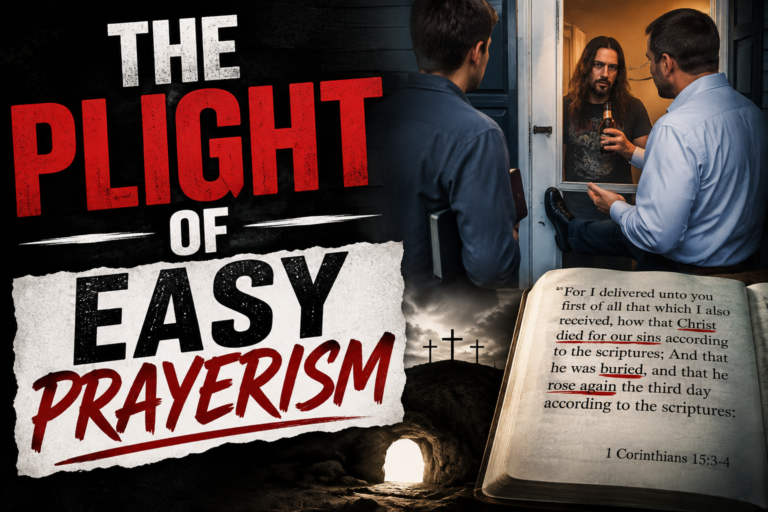
Breaker teaches that a sinner is lost unless they explicitly articulate or mentally acknowledge “faith in the blood” (Romans 3:25) at the moment of conversion. Breaker and his followers have gone so far as to assert that simply trusting in Jesus Christ alone is insufficient for salvation. He argues that the gospel of the death, burial, and resurrection (1 Corinthians 15:1-4) is “incomplete” without his specific formula. He even resorts to a “grammatical hallucination” regarding the phrase “how that Christ died,” claiming “how” is an interrogative demanding a mechanical explanation of the manner of death. In reality, “how that” is a declarative King James idiom meaning “the historical fact that.”
By demanding that a lost sinner understand the “strong meat” of High Priestly mechanics before they can be saved, Breaker is adding a theological work to the grace of God. It becomes a “Shibboleth”, a test of exact syllables rather than a heart trusting the Saviour.
The Fruit of the Ministry: Spiritual Insecurity
The most heartbreaking effect of this ministry is the “retreading” of genuine believers. Breaker uses “gaslighting” to tell people that if they ever doubted their salvation, or if they didn’t acknowledge “the blood” explicitly at the moment of conversion, they were never saved.
During a conversation with one of Breaker’s followers, I provided my testimony of trusting Christ at age sixteen. However, I only learned about the doctrine of the Blood Atonement nearly a year and a half later during discipleship lessons. This person insisted that I wasn’t truly saved until I fully understood this doctrine. The implication was clear: that trusting Jesus Christ and rejecting works, religion, and tradition was insufficient for salvation. If this doesn’t reveal the arrogance of Breaker’s false teachings, I don’t know what does.
This does not create “liberty in Christ”; instead, it fosters reliance on Robert Breaker. It prompts individuals to focus inward on their own actions, such as the “correctness” of their prayer, rather than outward on Christ’s completed work. By dissecting the object of our faith, we shift trust to a part of Jesus Christ rather than to Christ Himself. In this doctrine, where does Jesus Christ hold the preeminence (Colossians 1:18)?
Conclusion
We must choose between a man’s formula and the Spirit’s definition. In 1 Corinthians 15, the definitive chapter on the Gospel, the Holy Spirit mentions the Resurrection over 20 times, but the word “blood” appears zero times. Does the Spirit “hate the blood”? Of course not. But He knows that when you trust the risen Saviour, you get the “package deal.” You get the blood, the righteousness, and the life.
Let’s get back to the Bible. Let’s stop following personalities and start proving all things by the word of Truth. If a man’s ministry relies on logical fallacies, psychological manipulation, and the “dissimulation” of his own history, he is not a safe guide for the sheep. Stand on the Book, brethren.
The Person of Christ is enough.
1 John 5:12 “He that hath the Son hath life; and he that hath not the Son of God hath not life.”
About The Author





Brother great article
Wow! I’m glad that I trusted in Jesus Christ when I was six years old before I ever understood much of anything! Yes… There have been many times that I doubted or questioned my own salvation… However, it was because I didn’t fully understand how to walk by faith through the Holy Spirit! That took time and understanding that God lovingly had to help instill within me over time! Yes! I, In Fact, Trust In The Peron Of The Lord Jesus Christ as My Personal Saviour (Not some force or element of God…)! Jesus Christ is Alive! He His Risen! And even in my ignorance, because I trusted Jesus Christ, I was Saved! I became somewhat worldly because I was not fully taught by those who should have taught me correctly! Those that I looked up to showed me things that caused me error and helped me to live in confusion than in “Rightly Dividing” God’s will for my life! I have certainly grown since then! Amen!
Praise the Lord! I too was saved at 6. I knew the Gospel, that I was a sinner, that I didn’t want to go to hell, but not much more than.