When theological enemies unite solely to attack the preserved word and dispensational truth, it’s not genuine fellowship; it’s an alliance of wickedness driven by the bandwagon fallacy. History shows that just as the Pharisees and Herodians bonded over their hatred of the incarnate Word, modern critics unite in rejecting the written word.
The Unholy Alliance: Why Enemies Unite Against the Truth
Over recent years, scrolling through social media theology debates feels like watching a masterclass in the bandwagon fallacy. The decline of independent thought has led professing Christians to accept whatever ideas the crowd dictates rather than employing objective, personal judgment.
- This herd mentality is largely driven by a profound confirmation bias, where the fear of truth—fueled by academic intimidation or sheer ignorance—overrides the pursuit of factual evidence.
- Nowhere is this epistemological collapse more obvious than in the visceral, unified pushback against Dispensationalism and King James Only (KJVO) advocacy.
When professing Christians attack a KJVO Dispensationalist, you rarely hear a logically sound, well-articulated theological rebuttal. Instead, we are treated to a barrage of straw man arguments and ad hominem attacks. Independent arguments that actually represent our doctrines accurately are exceedingly rare.
This reality becomes unmistakable when Romanists, Calvinists, and modern evangelicals forge alliances against a shared adversary: the truth.
This isn’t a new phenomenon; it is a spiritual principle written in stone.
- Conflicts over the preserved word are not mere intellectual disagreements or matters of preference. They are fundamentally spiritual battles.
- As Paul notes in 2 Corinthians 10:5, our duty is to cast down “imaginations”—the philosophical anomalies and vain philosophies that form the true battlefield.
- Many falsely equate the “works of the flesh” (Galatians 5:19-21)—such as lust, drunkenness, or murder—with the works of the devil. This is a category error. Satan isn’t primarily interested in your carnality; he is interested in worship. He desires to be a proxy God (Isaiah 14:14; 2 Thessalonians 2:4; Matthew 4:9).
- The devil’s true domain isn’t the gutter; it is the pulpit. His primary work is undermining the words of God (Genesis 3:1-3; Job 1:9-11; Matthew 16:21-23). Therefore, religion and doctrine form his chief battlefield, where spiritual deception wears a scholarly disguise to sow cognitive dissonance about absolute authority.
The Historical Precedent of Wickedness
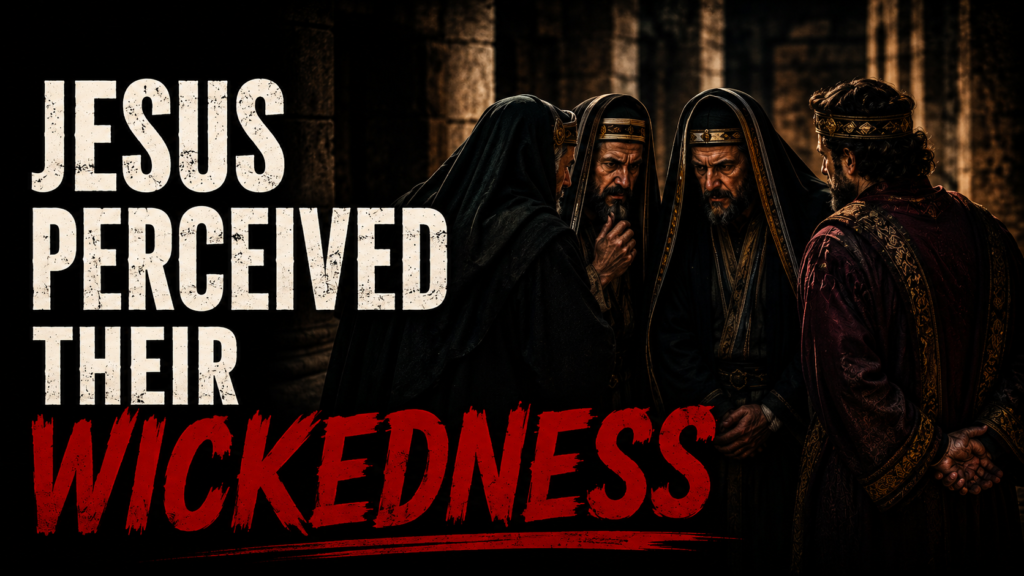
History reveals a strange but consistent pattern: fierce ideological enemies will eagerly set aside their differences to silence the truth. We see this vividly with the Pharisees and the Herodians.
- The Pharisees were strict, religious legalists. The Herodians were secular, political opportunists loyal to Rome.
- They were bitter adversaries, yet their mutual hostility toward Jesus Christ bridged their massive ideological gap.
- They united to destroy the incarnate Word (Mark 3:6), later conspiring to trap Him using a false dilemma regarding taxation (Matthew 22:15-22).
“And the Pharisees went forth, and straightway took counsel with the Herodians against him, how they might destroy him.” – Mark 3:6
We see the ultimate convergence of this theological syncretism in Luke 23:12. Pontius Pilate and Herod Antipas had previously been bitter enemies, but on the exact day they judged Christ, they became friends. It is a sobering illustration of how worldly systems inevitably bond over the rejection of righteousness.
*(Syncretism is blending typically separate religious, political, and cultural ideas into a combined system)
The Modern Parallel
Today, we witness a striking modern parallel. A convergence of compromise occurs when starkly different theological camps unite against those who stand uncompromisingly for the preserved word and right division. Consider these unlikely allies:
- Liberal modernists who openly deny biblical inerrancy.
- Academic textual critics who champion corrupt Alexandrian manuscripts.
- Traditional denominationalists who reject Pauline dispensational distinctions.
What do these groups have in common? Very little, except their shared opposition to absolute authority and strict adherence to the word. Just like the Pharisees and Herodians, their unity isn’t forged by a love for sound doctrine; it is born out of a shared resistance to the convicting power of a pure text.
The Verdict
When a group’s cohesion relies entirely on a shared hatred of the word, it ceases to be spiritual fellowship. True biblical fellowship is grounded in truth (1 Corinthians 13:6; 3 John 3-4). When enemies merge forces solely to oppose divine truth, Christ evaluates that alliance as exactly what it is: wickedness. It perfectly echoes Psalm 2:2: “The kings of the earth set themselves, and the rulers take counsel together, against the LORD, and against his anointed.”
It should come as no surprise that the world unites against Bible believers. As Christ warned in John 15:18, “If the world hate you, ye know that it hated me before it hated you.” The world’s unified hatred of the written word is simply a historical echo of their hatred for the incarnate Word.
What was the Lord Jesus Christ’s estimation of all this?
“Then went the Pharisees, and took counsel how they might entangle him in his talk. … But Jesus perceived their wickedness, and said, Why tempt ye me, ye hypocrites?” – Matthew 22:15, 18
Let the crowd have their groupthink. As for us…
“Jesus answered and said unto him, If a man love me, he will keep my words: and my Father will love him, and we will come unto him, and make our abode with him.” – John 14:23
About The Author






Very accurate and insightful article.
I love this!
Excellent
Thank you
We love our King James Bible !!