
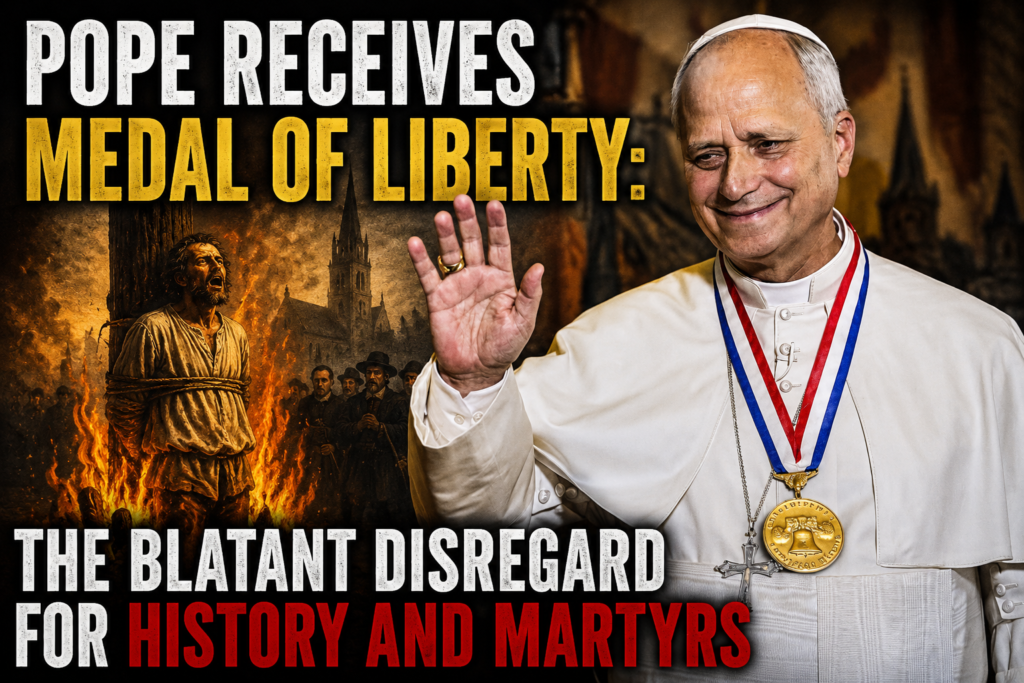
Recently, Pope Leo XIV was awarded the Liberty Medal by the National Constitution Center for what was described as his commitment to religious liberty and freedom of conscience. At first glance, such recognition appears noble. Liberty is among mankind’s greatest earthly blessings. Freedom of conscience is a principle worth defending. Yet the announcement exposes one of the great ironies of history. The Pope receiving an award for championing liberty is the head of the very institution that spent centuries denying it.
Institutions should be judged by what they have taught and what they have done. By that standard, the Roman Catholic Church was never the champion of liberty of conscience. It was its adversary. The issue is not whether Rome occasionally tolerated dissent. The issue is whether she believed that every individual possesses the God-given right and responsibility to follow the dictates of his conscience before God, even if that conscience rejected Rome herself. History answers that question with painful clarity.
For centuries, the Roman Church taught that salvation could only be found within her communion. Heresy was not merely considered theological error; it was treated as a crime worthy of civil punishment. The union of church and state became a weapon by which dissenters were imprisoned, tortured, exiled, and executed. The Inquisition did not exist to defend liberty. It existed to suppress it. The flames that consumed so many so-called heretics were not accidents of history. They were the natural consequence of a theological system that denied liberty of conscience.
Among those who suffered most were the Anabaptists. In 1557, Cardinal Stanislaus Hosius stated, “Were it not that the Anabaptists have been grievously tormented and cut off with the knife during these past twelve hundred years, they would swarm in greater numbers than all the Reformers.”
While Rome viewed religious conformity as something to be enforced, the Anabaptists insisted that faith could never be compelled. They rejected infant baptism because they believed baptism belonged only to those who had personally trusted Christ (credobaptism). They refused to place the conscience of man beneath the authority of princes, bishops, or popes. Every individual, they argued, must stand before God personally.
That conviction was not political before it was theological. It arose directly from Scripture.
The Apostle Paul declared, “So then every one of us shall give account of himself to God” (Romans 14:12). Peter and the apostles answered the religious authorities of their day by saying, “We ought to obey God rather than men” (Acts 5:29). Salvation is a matter of personal faith. Belief cannot be legislated. The conscience belongs ultimately to God alone.
Those Biblical Baptist convictions significantly shaped the American understanding of religious liberty. Baptist Pastor John Leland worked alongside James Madison in Virginia, strongly advocating constitutional protections for religious freedom. While many streams contributed to the founding of the United States, Baptists were among the loudest and most consistent voices demanding that government stay out of the affairs of conscience. The First Amendment did not emerge from Rome’s theology. It emerged in no small measure from men whose theological ancestors had been persecuted by Rome.
This is one of history’s greatest reversals. Those once branded as heretics helped shape one of the freest nations the world has ever known, while the leader of the institution that sought to silence them now receives awards celebrating the very liberty it once opposed.
The irony becomes even sharper when viewed through the lens of Scripture.
Paul wrote, “Now the Lord is that Spirit: and where the Spirit of the Lord is, there is liberty” (2 Corinthians 3:17). Biblical liberty begins with the Gospel. Christ frees men from the bondage of sin. A conscience liberated by Christ recognizes that no earthly institution can stand between the believer and his Saviour. This does not produce lawlessness. It produces responsibility. Every believer must stand before the judgment seat of Christ. Every soul will give an account to God personally.
This stands in contrast to every system that seeks to bind the conscience to ecclesiastical authority. Whether through medieval inquisitions or modern religious authoritarianism, the result is always the same. Where Christ rules the conscience, there is liberty. Where institutions claim ultimate authority over the conscience, bondage inevitably follows.
The Pope may speak today of religious liberty, however we cannot ignore centuries of persecution committed under Rome’s authority against those whose only offense was believing that every man answers directly to God.
The Liberty Medal commemorates freedom of conscience. If history is to be remembered honestly, then some of its truest champions were not the princes, bishops, or popes who wielded the sword of state, but the humble Anabaptists who died beneath it.
About The Author











I can’t say amen loudly enough. Awarding the pope a medal for promoting religious liberty would be on par with giving a noble peace prize to Adolf Hitler. No matter what game he talks, he represents an institution that has historically been the greatest enemy of religious liberty.
Amen
Thank you
“Nothing good ever came out of Rome”
quote from Brother Mitch