
Just Thinking
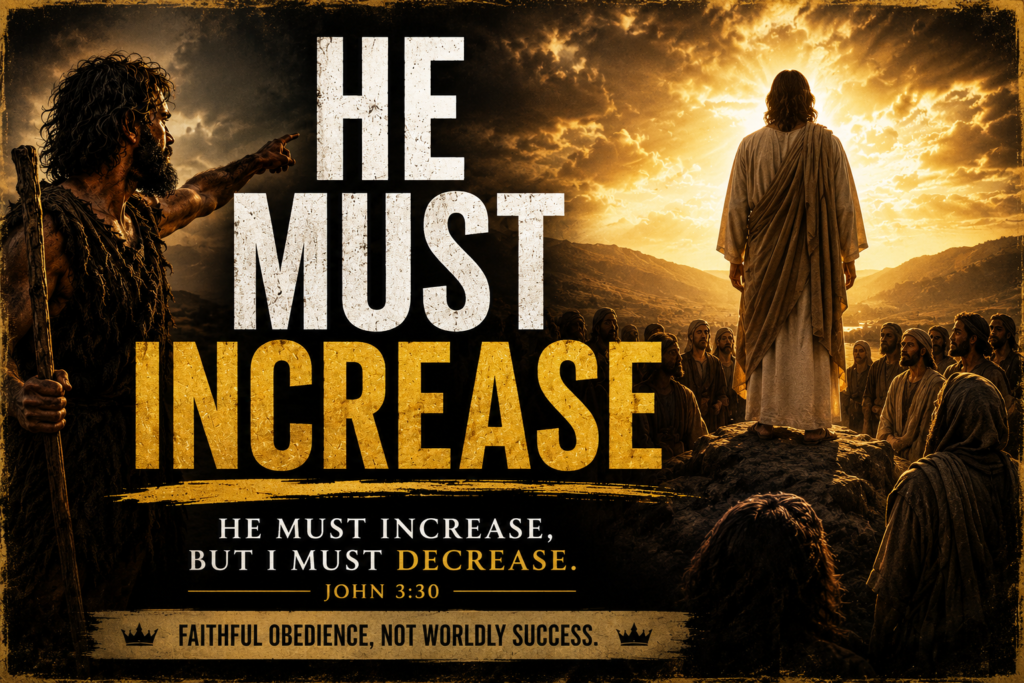
Recently, while reading the Bible, I reflected on John the Baptist’s interaction with his disciples in John chapter 3. In this passage, his disciples mentioned the growth of Jesus Christ’s ministry separate from his own. They observed, “All men come to him.” John affirms Christ’s work and makes a profound statement in verse 30: “He must increase, but I must decrease.” This made me consider the significance of that statement for any man’s ministry, including my own.
A Faithful Ministry Defined
A successful ministry is defined by faithful obedience to God’s specific will, not by longevity, numerical growth, or worldly approval. John the Baptist’s short ministry achieved its ultimate purpose, using the faithful preaching of the word of God to introduce the incarnate Word, Jesus Christ.
“He must increase, but I must decrease.”
These were the words of John the Baptist as his own work drew to a close and Christ’s ministry began to bloom. This simple phrase teaches a foundational principle regarding the purpose of our own ministry.
John the Baptist spent his entire life preparing for a calling that lasted merely six months. In the eyes of the world, this looks like a catastrophic failure. He built no church, he ran no massive programs, and polite society wholly rejected him. Ultimately, his reward on earth was decapitation (Matthew 14:11).
The True Metric
Yet, we must measure success through a different lens. Jesus Christ Himself declared that there was no greater prophet than John the Baptist (Luke 7:28). This stark contrast between worldly metrics and divine approval illustrates a crucial reality.
It is never about the messenger, but always about the message.
Consider the profound implications of John’s calling:
- His singular purpose was to introduce the then-potential King of the Jews.
- His earthly work was brief, yet his ministry is forever captured in the perfect written word of God.
- He faithfully used the written word to point the masses directly to the incarnate Word, Jesus Christ.
- Though his timeline was remarkably short, he accomplished everything he was created to do because of his faithfulness.
As a side note, I understand the prophetical implications of John’s ministry and role in the future tribulation. I am only considering his ministry in light of Christ’s first Advent practically.
The value of a man’s ministry cannot be measured numerically or chronologically. It must be measured by absolute fidelity to God’s direct, specific will. Modern critics might analyze John’s six-month run and argue he lacked impact. All worldly analysis is entirely irrelevant in the light of eternity.
The Final Analysis
The only questions that truly matter are these. Did I please God? Did I do explicitly what God commanded me to do? Did I allow worldly distractions to hinder my willingness to obey?
Despite the very real human doubt John experienced while sitting in a prison cell, the Lord Jesus commended him for his exact role in the divine plan. Much can be learned from this. We must never value our own work based on quantitative metrics or visible fruit. Success is simply being approved by the God who created us.
Can we say the same about ourselves?
“Moreover it is required in stewards, that a man be found faithful.”
1 Corinthians 4:2
About The Author















Amen
Excellent
Thank you