
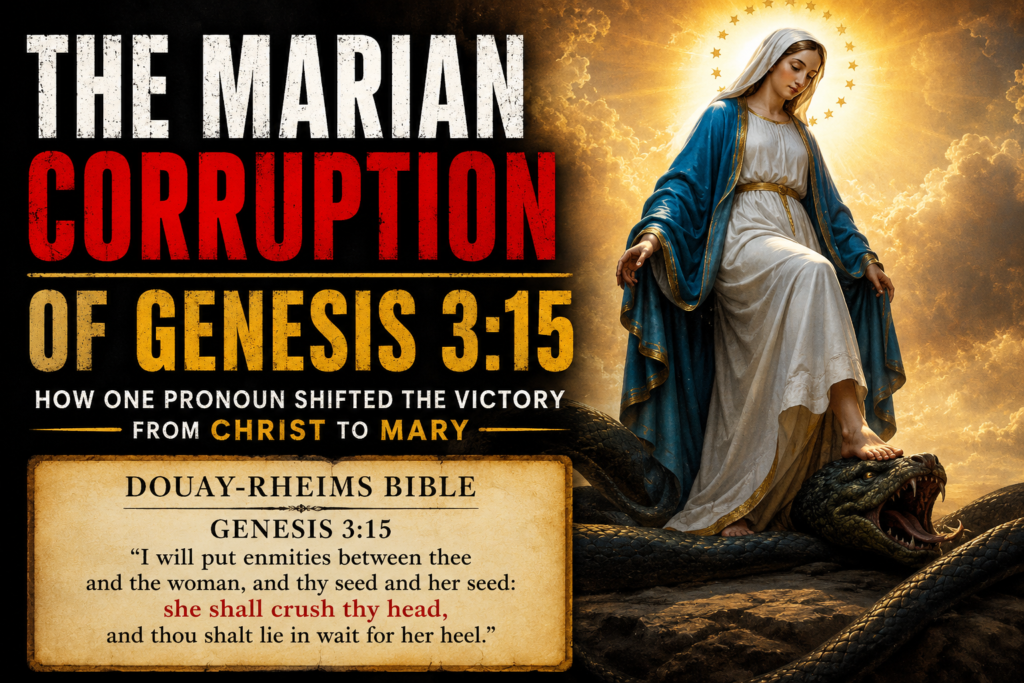
One of the earliest and most beautiful prophecies of the Lord Jesus Christ is found immediately after the fall of man in Genesis 3:15. Often called the Protoevangelium, or the first gospel, this verse records God’s promise that the coming Seed of the woman would one day destroy the serpent who had deceived Eve. From the very beginning of Scripture, God pointed mankind to a coming Redeemer who would conquer Satan and reverse the curse brought about by sin. Yet one mistranslated pronoun in the Roman Catholic Douay-Rheims Bible has helped shift the focus of this glorious prophecy away from Christ and toward Mary.
The King James Bible faithfully translates Genesis 3:15: “And I will put enmity between thee and the woman, and between thy seed and her seed; it shall bruise thy head, and thou shalt bruise his heel.” Although the KJV uses the word “it,” the following phrase, “his heel,” makes it clear that the promised Seed is a person. The prophecy is speaking of an individual male descendant of the woman who would suffer a wound to His heel while dealing a fatal blow to the serpent’s head. This has been universally and historically understood by Bible believers as the first prophecy of the Lord Jesus Christ.
The Douay-Rheims Bible, however, reads very differently: “I will put enmities between thee and the woman, and thy seed and her seed: she shall crush thy head, and thou shalt lie in wait for her heel.” With one simple word, the entire emphasis of the passage is altered. Instead of the promised Seed crushing the serpent, the woman herself becomes the conqueror. The triumph that belongs to Christ is redirected to Mary, providing a convenient foundation upon which centuries of Marian devotion have been built.
The problem for Catholics is that the Hebrew text simply does not say “she.” Moses wrote Genesis in Hebrew, not Latin.1 The pronoun naturally refers back to the woman’s Seed, which is masculine. The grammar follows the flow of the passage perfectly. God speaks of the serpent, then the woman, then the serpent’s seed, then the woman’s Seed. The final pronoun points back to that promised offspring. The prophecy is not about the woman defeating Satan; it is about the Seed born of the woman defeating Satan. The Hebrew grammar leaves no room for Mary becoming the subject of the victory.
Even more importantly, the rest of Scripture identifies the Seed beyond any question. The promise given in Eden is progressively narrowed throughout the Old Testament until it finally arrives in the person of Jesus Christ. The Apostle Paul removes every possible doubt when he writes in Galatians 3:16, “Now to Abraham and his seed were the promises made… which is Christ.” The Seed promised from the beginning is Christ Himself. Mary was the vessel through whom God brought the Saviour into the world, but she was never presented as the one who would conquer the devil. She carried the Redeemer; she was not the Redeemer.
The New Testament consistently attributes Satan’s defeat to Jesus Christ alone. Hebrews 2:14 declares that through His death Christ might destroy “him that had the power of death, that is, the devil.” First John 3:8 plainly states, “For this purpose the Son of God was manifested, that he might destroy the works of the devil.” Through the cross, Christ triumphed over principalities and powers, making a show of them openly. In Revelation, it is Christ who ultimately casts Satan into the lake of fire and crushes the serpent’s head in finality. Search the New Testament from beginning to end and you will never find Mary described as crushing the serpent. Every victory belongs to her Son.
So how did the reading “she shall crush thy head” become so well known to Catholocism? The answer lies not in the Hebrew Scriptures but in the Latin tradition. While the Hebrew text supports the masculine reference to the promised Seed, later copies of the Latin Vulgate contained the feminine reading ipsa, meaning “she.” Because the Douay-Rheims Bible was translated from the Latin Vulgate rather than directly from the Hebrew, it inherited this rendering. What likely began as a textual alteration or copying tradition eventually became embedded within Roman Catholic theology, where it was embraced because it supported an already developing devotion to Mary.
The consequences of that one altered pronoun have been enormous. Walk into almost any Roman Catholic cathedral and you will likely find statues or paintings of Mary standing triumphantly upon a serpent with its head beneath her feet. The image has become one of the defining symbols of Roman Catholicism. While Roman Catholic theologians generally acknowledge that Christ is the ultimate Redeemer, popular devotion often presents Mary as the serpent crusher, the conqueror of Satan, and the victorious Queen of Heaven. The imagery did not arise from the Hebrew Scriptures; it arose from a mistranslated pronoun that redirected the reader’s attention from Christ to Mary.
The irony is striking. The very first promise of redemption was given to magnify God’s coming Son, yet this translation obscures His glory by placing another figure in the center of the prophecy. Satan has always sought to corrupt God’s Word, whether by subtraction, addition, or subtle alteration. In Genesis 3, his first recorded words were, “Yea, hath God said?” It should not surprise us that one of the earliest Messianic prophecies has become the subject of such confusion.
Mary herself never claimed the honor assigned to her by later tradition. When Elizabeth praised her, Mary immediately directed all glory to God, saying, “My spirit hath rejoiced in God my Saviour.” She recognized her own need for salvation. She was blessed among women because God chose her to bear the Messiah, but she never claimed to be the conqueror of Satan, the mediatrix of grace, or the Queen of Heaven.
Genesis 3:15 is one of the clearest promises of the gospel in the entire Old Testament. It announces the coming of Jesus Christ, born of a woman, who would suffer in His humanity and one day deliver the crushing, decisive blow against the devil. The prophecy belongs entirely to Him.
- From the Douay-Rheims Bible:”She shall crush”: Ipsa, the woman; so divers of the fathers read this place, conformably to the Latin: others read it ipsum, viz., the seed. The sense is the same: for it is by her seed, Jesus Christ, that the woman crushes the serpent’s head. ↩︎
About The Author












Wait, I thought all translations say basically the same thing, and that no cardinal doctrine is affected by translation? I’d say the identity of our Redeemer is a cardinal doctrine. Well done!
Excellent
Thank you