
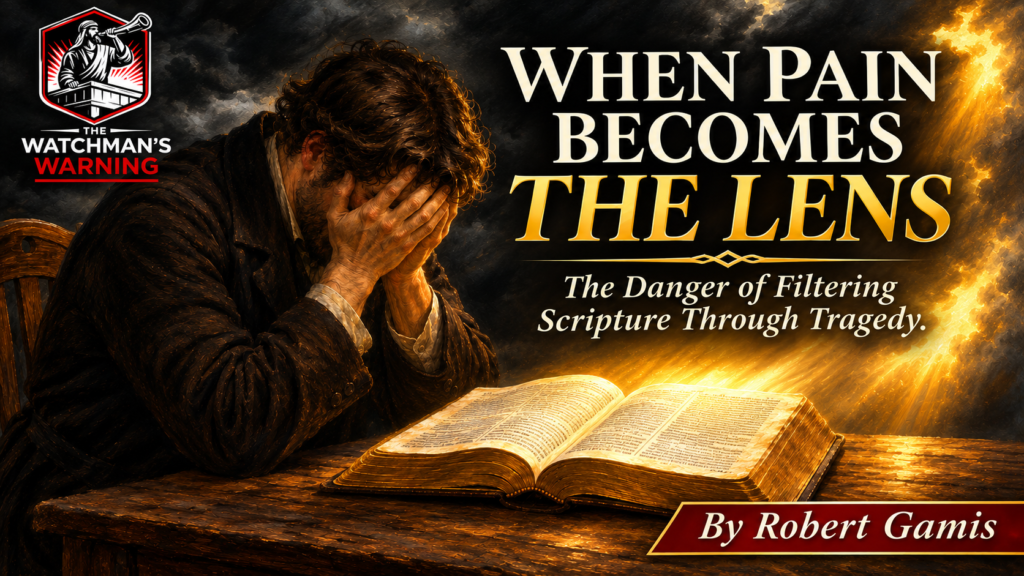
Life can bring some of the hardest blows imaginable. Whether we face a devastating loss, a severe illness, or a heartbreaking betrayal, intense trauma can leave us reeling. A truly horrible experience can create a deep inner conflict—a struggle known as cognitive dissonance. It is the painful mental tension we feel when what we experience in the real world seems to clash with what we believe we know about God and life.
What is Trauma-Induced Belief Revision?
To understand how people can fall into spiritual error after a tragedy, it helps to examine a specific concept: trauma-induced belief revision. Put simply, this is a psychological process in which a person experiences such intense emotional or physical pain that their mind radically revises its core beliefs just to survive. Rather than processing grief within a stable, objective framework, they reshape their understanding of reality, God, and truth to ease the pain or explain why something terrible happened to them. In doing so, they trade objective reality for a comforting narrative that shields them from further suffering.
The Case of Mary Baker Eddy
Mary Baker Eddy, the founder of Christian Science, offers a clear historical example. Her early life brought one severe personal tragedy after another. She endured chronic physical pain, the death of her first husband, separation from her young child, and years of feeling abandoned and helpless.
Instead of turning to objective truth to process her grief and physical suffering, she built a whole belief system out of her trauma. After a severe fall in 1866, she concluded that since physical matter and pain caused her so much agony, matter itself must not be real. She developed a doctrine that denied the reality of sickness, pain, and physical death, viewing them merely as illusions of the mortal mind. Her theology was literally born out of her desire to escape the overwhelming hurt of her past.
The Eternal Consequences of Escaping Sound Doctrine
While Eddy’s new belief system may have given her a psychological coping mechanism for her earthly suffering, the spiritual consequences of her escape from sound doctrine were—and are—eternal and catastrophic.
When a teacher departs from biblical truth to comfort their own flesh, it doesn’t happen in a vacuum. Eddy’s personal rejection of objective Scripture gave rise to a false religious movement that has led millions of souls away from the truth. By teaching that sin, sickness, and death are mere illusions, Christian Science effectively denies human sinfulness, the need for Jesus Christ’s substitutionary atonement, and our Saviour’s literal bodily resurrection.
Millions seeking physical healing and spiritual peace have been drawn into a system that substitutes mental gymnastics and positive thinking for the blood of Christ. The ripple effect of one person’s trauma-driven theology is a tragedy of staggering proportions: souls lulled into a false sense of spiritual security, blinded to the gospel, and led away from Jesus Christ’s saving grace toward an eternity separated from God. This shows that false doctrine is never merely an innocent academic mistake—it carries eternal consequences.
The Danger of Filtering Scripture Through Pain
Mary Baker Eddy’s story serves as a sober warning about what happens when we view spiritual truth through a lens of offense and emotion, rather than through objective truth.
When we let our hurt dictate our theology, we find ourselves on a very slippery slope. It starts with a painful trial. Then comes the emotional wound. Before long, a believer might start questioning God’s goodness, doubting His preserved word, or twisting biblical passages to make sense of their suffering. Little by little, this emotional reaction pulls a person away from the faith once delivered to the saints. Pain becomes the filter, and Scripture gets forced to fit whatever makes our hurting hearts feel better in the moment.
In recent years, I’ve seen Bible-believing Baptists embrace false doctrine, reject Dispensational truth, and abandon the King James Bible—not for Scriptural reasons, but in reaction to hurt or offense. They then generalize that experience to all Bible believers. Once they have gone far down this road, it is nearly impossible for them to escape the devil’s snare.
Letting the Book Be the Standard
This is why we must have an absolute, unchanging standard. If our feelings are the judge, our beliefs will change with every wind of adversity. We need a standard outside of ourselves—something pure, perfect, and completely objective.
For the Bible believer, that standard is the preserved word of God. When life hurts, and when our emotions scream that God has been unfair or that our circumstances are too heavy to bear, we cannot trust our shifting feelings. We have to anchor ourselves to the book.
A Direct Challenge to the Believer
If you are walking through a deep valley of pain right now, here is a direct challenge: Defer your emotions and feelings to objective scriptural truth.
Stop letting your hurt interpret your theology. Instead, let God’s word interpret your life. Your feelings are real, but they are not the standard of truth. Put your complete trust in the preserved words of God, knowing that His word stands firm even when our world is shaking. Do not let a moment of trauma lead you down the path of false doctrine or emotional compromise. Stay anchored to the book, trust the Lord through the pain, and let His truth have the final say.
2 Corinthians 4:16–18: “For which cause we faint not; but though our outward man perish, yet the inward man is renewed day by day. For our light affliction, which is but for a moment, worketh for us a far more exceeding and eternal weight of glory; While we look not at the things which are seen, but at the things which are not seen: for the things which are seen are temporal; but the things which are not seen are eternal.”
Proverbs 3:5–6: “Trust in the Lord with all thine heart; and lean not unto thine own understanding. In all thy ways acknowledge him, and he shall direct thy paths.”
About The Author