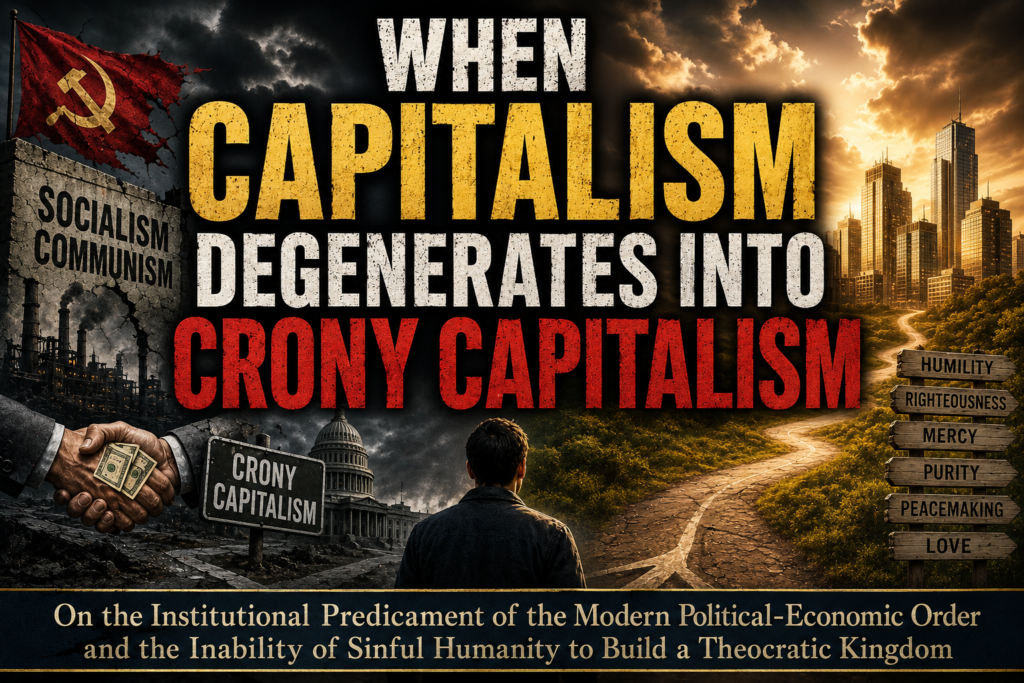
On the Institutional Predicament of the Modern Political-Economic Order and the Inability of Sinful Humanity to Build a Theocratic Kingdom
I. Introduction
One of the basic characteristics of modern political thought is humanity’s continual attempt, through institutional design and historical action, to establish a more just, freer, and more ideal social order. Since the Enlightenment, rationalism, progressivism, and secular political philosophy have together shaped a widespread conviction: that human beings can gradually overcome the injustice and disorder of history by reorganizing power, redistributing resources, reforming institutions, and promoting revolution, ultimately directing society toward an ideal condition. Whether it is socialism and communism in their pursuit of an egalitarian society, or capitalism in its praise of the free market and individual vitality, both are, to some extent, built upon this modern belief that “human beings can construct an ideal order by themselves.”
Yet the course of modern history has posed a profound challenge to this belief. Socialism and communism once attracted countless intellectuals and political activists in the name of liberation, equality, and common prosperity. However, the practical consequences of these systems have often tended toward extreme centralization, suppression of thought, economic rigidity, and institutional violence. When such utopian political ideologies were proven by history to be unable to fulfill their ideal promises, many people turned instead to capitalism as a more feasible alternative. Nevertheless, Western industrial capitalism did not thereby become an institutional model beyond criticism. On the contrary, after it gradually degenerated into crony capitalism, it too provoked widespread doubts. The market was no longer simply a sphere of competition and innovation, but increasingly became a structural space in which power, capital, and policy were mutually entangled.
Therefore, this article is concerned not merely with comparing the relative merits of different institutional models, but with asking a deeper question: when the utopian promises of socialism and communism have already suffered historical failure, and capitalism itself has in practice evolved into crony capitalism, can humanity still rely on itself to establish on earth a truly just, peaceful, and truth-conforming ideal kingdom? The fundamental issue is not the difference between institutional labels, nor merely whether wealth is controlled by the state or by private capital. Rather, the issue is that every institution is ultimately operated by sinful human beings. For this very reason, any institutional ideal built upon human self-redemption and self-perfection cannot truly realize the theocratic kingdom revealed by Jesus in the Sermon on the Mount.
II. The Utopian Promise of Socialism and Communism and Their Historical Predicament
The reason socialism and communism were able to exert such a tremendous influence in modern intellectual history lies in their forceful critique of social inequality, class oppression, and capitalist exploitation. They commonly take equality, collectivity, liberation, and common ownership as their core values, advocating the abolition of private property, the public ownership of the means of production, and the reconstruction of social distribution in order to establish a new society no longer ruled by the minority over the majority. At the level of moral rhetoric, this ideal is undeniably attractive, for it directly addresses such historical problems as the gap between rich and poor, unequal power, and the exploitation of man by man.
However, this type of utopian political ideology often contains a deeper premise: that as long as external institutions are thoroughly reconstructed, the selfishness, greed, envy, and lust for power within human beings will also be overcome, thereby enabling society to enter a higher state of solidarity and justice. It is precisely at this point that socialism and communism reveal an overly optimistic assessment of human nature. One of the core problems revealed by Hayek in The Road to Serfdom is that socialist-style planning presupposes a high degree of social agreement concerning the ordering of goals. Yet once such agreement does not exist in reality, planners can only impose one particular order of values upon society as a whole.
This means that the problem of a planned economy is not merely technical, but political. In a society marked by plural values and dispersed knowledge, if the state is to centrally allocate resources effectively, it must inevitably intervene not only in the economic sphere but also further expand into the political sphere. If central planning is to be fully implemented, it must require a higher degree of obedience and broader coordination, ultimately bringing the originally diverse ways of life, calculations of interest, and standards of value within society under a single centralized will. Thus, a system that originally claims to liberate human beings easily becomes a system that controls them even more completely.
History has repeatedly shown that the practical result of such systems is often not the disappearance of a ruling class, but the emergence of a new privileged bureaucratic group; not the elimination of exploitation, but the reorganization of exploitation in the name of the state; not the abolition of inequality, but the tighter binding of political loyalty to resource distribution. This demonstrates that the historical predicament of socialism and communism should not be understood merely as the accidental consequence of individual policy mistakes or the moral failures of particular leaders. Rather, it should be understood as a theoretical failure caused by their mistaken presupposition regarding human nature.
It is therefore evident that if an institutional theory assumes that simply changing ownership structures and distribution mechanisms can eliminate the fundamental evil within human society, it will inevitably encounter profound frustration in reality. For institutions themselves must still be executed by human beings, and those who execute institutions do not cease to be governed by sin simply because institutional language has changed. When this premise is ignored, the more idealized the institution becomes, the more easily coercion increases in its implementation; the more absolute the ideal becomes, the more easily oppression in reality is justified. This is precisely one of the important reasons why modern utopian politics has repeatedly moved from idealism toward violence.
III. The Achievements and Degeneration of Industrial Capitalism: From Market Order to Crony Capitalism
Compared with socialism and communism, industrial capitalism has indeed demonstrated more significant advantages in productivity within economic history. Through private property, the price mechanism, market exchange, and competition, capitalism has effectively promoted technological innovation, industrial expansion, global trade, and the accumulation of wealth. The liberal tradition to which Hayek belonged especially emphasizes that market order is important not only because it is more efficient, but also because, in a society where knowledge is dispersed, the price mechanism can coordinate knowledge that is scattered, local, and often tacit. In this sense, the market is not merely a place of exchange; it is also a mechanism of social coordination.
However, the historical success of capitalism does not mean that capitalism itself possesses absolute moral immunity. The market can certainly improve efficiency, but it cannot automatically generate justice. Wealth can certainly promote prosperity, but it cannot automatically restrain greed. Institutional competition can certainly limit certain forms of power, but it cannot ensure that all power will remain un-abused. When political power and economic power gradually form a stable alliance, and when law, regulation, and public policy are increasingly captured by large capital and a small number of vested interests, capitalism degenerates from a relatively open market order into crony capitalism.
Here, Hayek’s analysis is especially illuminating. Although Hayek mainly criticized central planning, he also emphasized in The Road to Serfdom that what truly deserves vigilance is the high concentration of power itself. If people are unwilling to limit power within a certain range, then any power that originally claims to serve public goals may gradually evolve into an instrument for dominating human beings. Economic freedom is important not only because it has instrumental value, but also because it constitutes an important precondition for the existence of other freedoms.
Therefore, when capitalism degenerates into crony capitalism, the free competition, openness of opportunity, and market fairness it originally championed gradually lose credibility. At this point, what people face is no longer a pure market order, but a power system that packages structures of privilege in the language of the market. This degeneration further demonstrates that although capitalism is more dynamic than socialism and communism in certain respects, it is not the final answer to humanity’s institutional problem. For as long as the operating subjects of institutions remain sinful human beings, the market too may become an instrument for the expansion of sin.
In other words, capitalism does not automatically prevent institutional corruption. If the rule of law weakens, public responsibility declines, and the boundary between power and capital becomes blurred, then the market order itself will also be eroded and gradually transformed into a structure in which a small number of interest groups manipulate social resources and policy direction. This is precisely why we regard “the degeneration of capitalism into crony capitalism” as an important dimension of the modern institutional crisis.
IV. The Common Predicament Behind Institutional Differences: Sinful Humanity and the Corruption of Order
On the surface, socialism, communism, and capitalism are opposed to one another in institutional logic. The former tends to take collectivity, equality, and public control as its ideals, while the latter emphasizes private property, individual liberty, and market competition. Yet when viewed from a deeper perspective of theology, although these systems differ significantly in their views of property, the state, and distribution, they all face one unavoidable fundamental problem: institutions are ultimately operated by human beings, and human beings themselves are fallen and sinful.
Hayek’s warning against centralized planning can strengthen this judgment. In his view, central planning is not merely a less efficient economic arrangement; it also creates an unprecedented form of “man’s power over man.” Once resource allocation, the ordering of goals, and choices concerning life are all gathered under a single center, those who control that center possess the ability to exercise deep domination over the lives of others. The reason Hayek regarded private property as an important safeguard of freedom is precisely that it disperses control over the means of production among many independent individuals and groups, rather than concentrating it in a single authority.
If the operators of institutions are themselves sinful human beings, then any order that excessively centralizes power, resources, and standards of value will intensify the institutional consequences of sin. Under concentrated power, socialism tends toward totalitarianism; under the high concentration of capital and policy access, capitalism tends toward cronyism. Revolution seeks to eliminate oppression, yet often produces new oppressors. The market seeks to disperse power, yet under moral corruption and institutional capture it may also give birth to new monopolists. Systems that seem opposed to one another ultimately expose similar patterns of failure before the sinfulness of man.
The biblical understanding of human nature provides a fundamental explanation for this phenomenon. According to the Scripture, the problem of fallen humanity is not simply insufficient knowledge, but the deviation of the entire center of human existence away from God. Human beings do not merely make mistakes; they tend to take the self as the ultimate measure, placing interest and power above truth, justice, and obedience to God. For this reason, every political project built upon human self-redemption and self-fulfillment, whether in the name of equality or in the name of freedom, ultimately finds it difficult to escape degeneration.
Therefore, the real question worth asking is not “Which system is perfect?” but rather “Before the sinfulness of man is fundamentally resolved, is it possible for any institution to be truly perfect?” The answer is clearly “no”. Institutions may improve particular circumstances, but they cannot bring ultimate salvation. Institutions may mitigate certain forms of corruption, but they cannot make history into the kingdom. This point lays the foundation for the following discussion of the Sermon on the Mount and the theocratic kingdom.
V. The Kingdom Ethics Revealed in the Sermon on the Mount and the Limits of Human Institutional Ideals
The kingdom ethics revealed by Jesus in the Sermon on the Mount constitute one of Christianity’s most concentrated expressions of ideal order. Here, those who are truly blessed are not those who seize benefits through strength, but the poor in spirit, those who mourn, the meek, those who seek righteousness, the merciful, the pure in heart, and the peacemakers. The core characteristics of the kingdom are not the maximization of power or the optimization of interest, but holiness, righteousness, mercy, sincerity, and love.
This point is highly illuminating, for it shows that there is a fundamental difference between the kingdom and the various institutional ideals of the world. Modern political theory usually focuses on resource distribution, checks and balances on power, class structure, and institutional efficiency. The kingdom revealed in the Sermon on the Mount, however, first requires the inner renewal of the human person: humility of heart, moral purity, a longing for righteousness, mercy toward others, and submission to the will of God. This means that the theocratic kingdom is not a political structure that can be replicated merely by external institutional arrangements, but an order premised upon the renewal of life.
For this very reason, the kingdom ethics revealed in the Sermon on the Mount expose the ultimate limits of human institutional ideals. Human beings may write justice into legal texts, but this does not mean that rulers truly love justice. Human beings may advocate peace in political slogans, but this does not mean that society can truly abandon hatred. Human beings may exalt mercy, freedom, and community, yet in concrete practice they may still turn these words into new instruments of control. If the human heart remains under the dominion of sin, then even the most beautiful political and moral principles may be distorted again in history.
Therefore, the kingdom described in the Sermon on the Mount should not be misunderstood as a historical blueprint that human beings can directly construct through institutional engineering. It certainly has normative significance for earthly ethics and public life, but it does not say that sinful humanity can build a utopian by itself. On the contrary, it enables human beings to see that without the work of God, without the renewal of spiritual life, and without a fundamental dealing with sin, human beings cannot transform earthly political order into a kingdom that fully conforms to the will of God.
VI. Clarifying the Concept of the Theocratic Kingdom: The Kingdom Established by Christ’s Second Coming and the Distinction from False Theocratic Systems
In stating that human beings are unable to establish the theocratic kingdom revealed in the Sermon on the Mount, it is necessary to further clarify what this article means by “theocratic kingdom,” so as to avoid misunderstandings in political theology. In historical and contemporary contexts, the term “theocracy” has often been abused, even becoming a tool by which certain religious regimes or political powers sacralize themselves. Without clarification, this article’s emphasis on the theocratic kingdom might be misunderstood as support for some kind of church-state system operated by sinners and established in the name of God. Yet this is precisely what this article explicitly rejects.
First, the theocratic kingdom discussed in this article does not refer to sinners claiming to represent God and, through state machinery, religious authority, and political coercion, establishing a crude fusion of religion and politics. Nor does it refer to a group of religious leaders, theocratic rulers, or political regimes claiming to possess divine authorization, thereby equating their own will with the will of God and demanding absolute obedience from the people before earthly power. Such a system may appear on the surface to act “in the name of God,” but its essence remains human rule; it is merely human rule that uses the name of God to elevate its political legitimacy.
From both historical and theoretical perspectives, such false theocratic systems share the same logic as all highly centralized secular systems: a central authority claims to possess knowledge of the overall purpose, value-ordering, and direction of society, and therefore demands more comprehensive obedience. Hayek’s critique of centralized planning provides an important warning here: once a central authority believes that it can comprehensively regulate social life, it inevitably tends to extend control from partial domains to life as a whole. If such a central authority is further clothed in sacred language, its oppressive nature is often even more difficult to expose and restrain.
Therefore, the true theocratic kingdom must be essentially distinguished from all false theocratic systems. The true theocratic kingdom is not humanity grafting religious principles onto state power, nor is it humanity comprehensively disciplining society through theological slogans. The true theocratic kingdom is God Himself reigning; it is God establishing His kingdom in His own time — at the Second Coming of Jesus Christ — and in His own way. In other words, the premise of the theocratic kingdom is not that human beings successfully “govern on God’s behalf,” but that God personally brings the sinful order to an end, judges the rebellious world, and establishes His eternal kingdom by His perfectly righteous, perfectly holy, and perfectly truthful authority.
This point has fundamental theological significance. If the theocratic kingdom is something gradually constructed and completed by sinners, then it still cannot escape all the institutional predicaments analyzed above: those in power remain sinful, those who execute institutions remain sinful, and those who interpret religion remain sinful. In that case, even if the system uses sacred language on the surface, its actual operation will inevitably be distorted by selfish desire, pride, power struggle, and calculations of interest. As long as the kingdom is still primarily built upon the actions of fallen human beings, it cannot be the theocratic kingdom in the full sense.
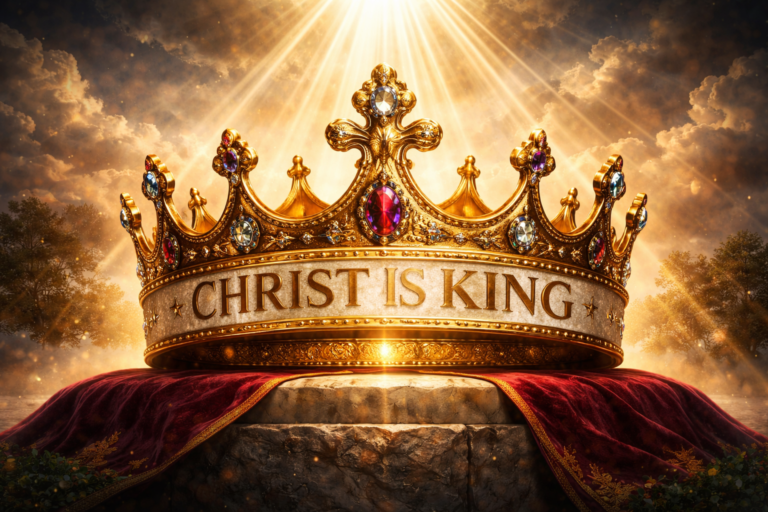
By contrast, the theocratic kingdom hoped for by Christianity is eschatological: an ultimate reality actively brought into history by God. It is not the political completion of human civilization evolving from below, nor is it the institutional result of some church-state model expanded to its extreme. Rather, it is the kingdom personally manifested and established by Jesus Christ at His Second Coming. In this kingdom, the true King is not any earthly regime, religious hierarchy, or theocratic group, but Christ Himself. The reason its order is perfect is not that human beings have finally learned how to stop sinning, but that God Himself judges sin, removes sin, conquers death, and renews all things by His righteousness.
Therefore, when this article says that “sinful humanity cannot establish the theocratic kingdom,” the object of this negation includes not only various secular utopian political ideologies, but also every false theocratic project carried out by sinners under the borrowed name of God. The true kingdom is not a political project completed by humanity on God’s behalf, but the ultimate kingdom personally established by God through the Second Coming of Jesus Christ.
VII. Conclusion
In light of the above analysis, when utopian political ideologies such as socialism and communism have repeatedly been proven by history to be unable truly to realize the equality, freedom, and liberation they promised, Western industrial capitalism does not thereby automatically become the final answer to humanity’s institutional problem. On the contrary, when capitalism gradually degenerates into crony capitalism, the original competitive mechanisms and institutional legitimacy of the market are likewise eroded, leading to the concentration of wealth, collusion between government and corporations, declining social mobility, and the collapse of public trust. It is therefore evident that neither left-wing utopianism nor a degenerated capitalist order is capable of bearing humanity’s ultimate hope.
At a deeper level, the fundamental cause of these institutional predicaments does not lie in the difference between institutional names, nor merely in whether technical design is sufficiently refined. Rather, it lies in the fact that all institutions are constructed and maintained by sinful human beings. As long as the inner life of man remains under the dominion of sin, any institution may be distorted again in history. As long as sin continues to reign at the center of human life, any ideal blueprint may be transformed into a new form of oppression. Institutions may restrain certain evils, but they cannot eradicate evil. Institutions may improve particular injustices, but they cannot transform earthly society into the perfect kingdom.
Therefore, the central conclusion of this article is this: God has already told humanity through Scripture that sinful human beings cannot, by themselves, establish a theocratic kingdom as perfectly righteous, holy, merciful, and peaceful as the one described by Jesus in the Sermon on the Mount. Moreover, the theocratic kingdom spoken of here is not a false theocratic system in which sinners, borrowing the name of God, crudely combine religion and politics. Rather, it is the kingdom established entirely by God Himself through the Second Coming of Jesus Christ. Humanity’s true hope lies not in any earthly utopian system, not in the final repair of any economic model, and not in any historical project of church-state fusion, but in the salvation of God, the renewal of human beings, and God’s final personal fulfillment of His eternal and righteous kingdom.
About The Author








Interesting
Thank you