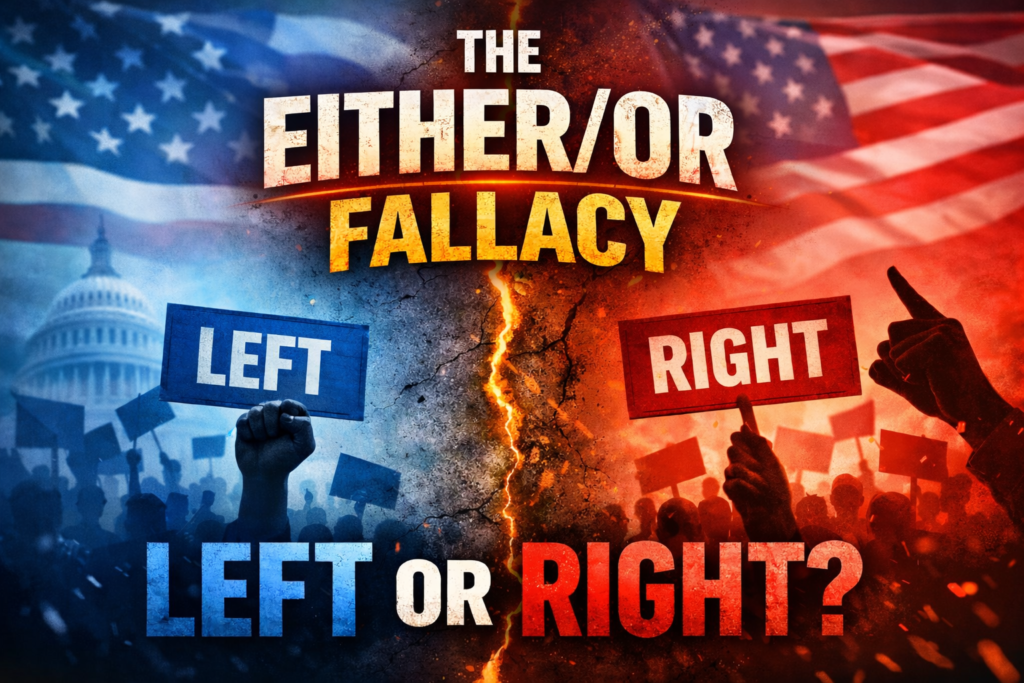
Spend enough time listening to political conversations in America, and a pattern begins to emerge. It doesn’t matter the issue, immigration, healthcare, taxes, education, the discussion almost always narrows into the same rigid framework. You are expected to choose a side.
Either you’re on the Left, or you’re on the Right.
There is very little patience for anything outside those neatly packed boxes. If you agree with one side on a particular issue, you are quickly assumed to belong to that side entirely. If you raise concerns about your “own” side, you are treated as though you’ve defected. The possibility that someone might think independently, evaluating each issue on its own merits, feels almost foreign in the current climate.
What many people don’t realize is that this pressure to choose is not simply cultural. It is rooted in a basic error in reasoning known as the bifurcation or either/or fallacy.
The bifurcation fallacy, sometimes called the false dilemma, occurs when a complex issue is reduced to only two possible options, even though more exist. It forces a decision where no such limitation is necessary. In its simplest form, it sounds like this: Either you belong to this group, or you belong to that one.
At first glance, this kind of thinking feels natural, especially in a political system dominated by two major parties. Elections are framed as a choice between two candidates and their respective affiliations. Media coverage reinforces the divide. Over time, people begin to assume that because there are two dominant parties, there must also be only two valid ways of thinking.
But that assumption does not hold up under closer examination.
The existence of two major parties does not mean there are only two possible positions on every issue. It simply means those are the two most powerful political organizations. The range of thoughtful, reasonable perspectives is far broader than the categories those parties provide.
Even at the founding of the nation, there was a clear warning against this kind of thinking. George Washington strongly opposed the rise of political parties, cautioning in his Farewell Address that the “spirit of party” would divide the nation, inflame passions, and distort judgment. He understood that once people are divided into opposing camps, they begin to think less about what is true and more about which side they belong to. What he warned about has become reality. The two-party system has not only shaped political outcomes, it has shaped how people think, conditioning them to see every issue through an artificial either/or framework.
Yet the pressure to conform to those categories remains strong. You can see it in the way arguments are framed. Someone questions a policy, and the immediate response is not to engage the concern, but to assign them a label. “So you’re with the other side?” The goal is not understanding, but classification.
This is where the bifurcation fallacy does its real damage. It shifts the focus away from truth and toward alignment.
Instead of asking whether an idea is right or wrong, people begin by asking which side it belongs to. Once that determination is made, the conclusion often follows automatically. If it comes from “our side,” it must be defended. If it comes from “their side,” it must be opposed. The actual substance of the idea becomes secondary.
This way of thinking has consequences. It encourages people to defend positions they might otherwise question, simply because abandoning them would feel like handing a victory to the opposition. It creates an environment where loyalty matters more than accuracy, and where consistency is sacrificed in favor of maintaining group identity.
It also makes meaningful conversation nearly impossible. If every disagreement is interpreted as a declaration of allegiance, then honest discussion quickly gives way to suspicion. People stop listening. They start categorizing. And once someone has been placed into a category, everything they say is filtered through that label.
Perhaps most concerning is how this fallacy treats independent thought. Those who refuse to fit into one side or the other are often viewed as inconsistent or unreliable. In reality, they may simply be refusing to accept a false choice.
It is entirely possible to agree with one side on certain issues and disagree with it on others. It is possible to reject both sides on a particular matter. It is even possible to recognize that the entire framework of a debate is flawed. None of these positions are irrational, but all of them are obscured when the conversation is limited to only two options.
Breaking free from this pattern requires a deliberate shift in how we think. It means resisting the instinct to immediately sort ideas into categories based on their source. It means slowing down long enough to evaluate arguments on their own merits. And it means being willing to say, when necessary, that neither of the presented options is sufficient.
While the bifurcation fallacy is often discussed in terms of logic and philosophy, the underlying problem it represents is not new. Scripture repeatedly warns against the kind of shallow, oversimplified thinking that forces complex matters into narrow categories. Jesus Himself rebuked this tendency when He said, “Judge not according to the appearance, but judge righteous judgment” (John 7:24). Righteous judgment requires more than reacting to what is immediately presented, it requires careful evaluation, patience, and a willingness to look beyond surface-level options.
The book of Proverbs reinforces this principle. “He that is first in his own cause seemeth just; but his neighbour cometh and searcheth him” (Proverbs 18:17). In other words, the first argument often sounds convincing—until it is examined more fully. This stands in direct contrast to the either/or mindset, which pressures a person to decide before all sides have been considered. Biblical wisdom calls for a slower, more deliberate approach, one that resists being rushed into conclusions that may not reflect the full truth.
Perhaps the clearest example comes from the way Jesus responded to those who tried to trap Him with forced choices. When asked whether it was lawful to pay taxes to Caesar, the question was designed as a trap, an either/or dilemma with no safe answer. Yet Christ refused the framework entirely, responding, “Render therefore unto Caesar the things which are Caesar’s; and unto God the things that are God’s” (Matthew 22:21). Rather than choosing between two flawed options, He exposed the limitations of the question itself. The truth did not fit within the categories He was given.
For the Christian, this sets a clear pattern. We are not called to think in terms dictated by cultural pressure or political framing, but to “prove all things; hold fast that which is good” (1 Thessalonians 5:21). That command assumes there is more to evaluate than a simple binary choice. It requires discernment, independence, and a commitment to truth. In a world that constantly demands, “Choose a side,” Scripture gives a better answer: examine everything, and refuse any choice that forces you away from what is biblical and true. Not every issue can be reduced to a either/or choice. Not every debate is properly framed. And not every decision requires picking a side.
There is an important implication that must be made clear. Rejecting the either/or fallacy means rejecting the idea that criticism equals betrayal. In American politics, and even in theological circles, there is a constant pressure to defend “your side” at all costs. The moment you raise a concern, you are accused of crossing over. Criticize a conservative position or president, and you are labeled a liberal.
But this kind of thinking is itself rooted in the very fallacy we are exposing.
The ability to critique one’s own side is not a sign of disloyalty, it is a sign of integrity. A person who cannot question those they agree with is not thinking clearly; they are simply aligning themselves with a group. Truth does not belong to a political party, and it does not depend on popular voices within a movement. If something is wrong, it is wrong, even if it comes from those you generally agree with. And if something is right, it is right, even if it comes from those you typically oppose.
For the Christian especially, this must be settled. Our standard is not conservatism, nor liberalism, nor any theological camp, it is the word of God. That means we are free to affirm what is true, reject what is false, and correct what is inconsistent wherever we find it. Doing so does not make a person a liberal, a compromiser, or a Bible rejector. It makes them someone who is unwilling to trade truth for tribal loyalty.
The bifurcation fallacy thrives because it simplifies a complicated world. It offers the illusion of clarity where there is ambiguity and certainty where there should be careful thought. But that simplicity is misleading.
Reality is oftentimes more complex and nuanced. And thoughtful people should be willing to acknowledge that.
Sometimes the most accurate answer is not found on either side of a divided line.
Sometimes, the answer is simply this:
Neither.
About The Author












Amen
Thank you
Great article and profound point. The fallacy of false dilemma is rampant in theology as well as politics. Are you a Calvinist or an Arminian? I’m neither. Do you agree with Ruckman, or not. It depends on the issue. Of course, there are issues for which there are only two valid choices; Jesus said you’re either for Him or against Him, there is no middle ground in this instance.