
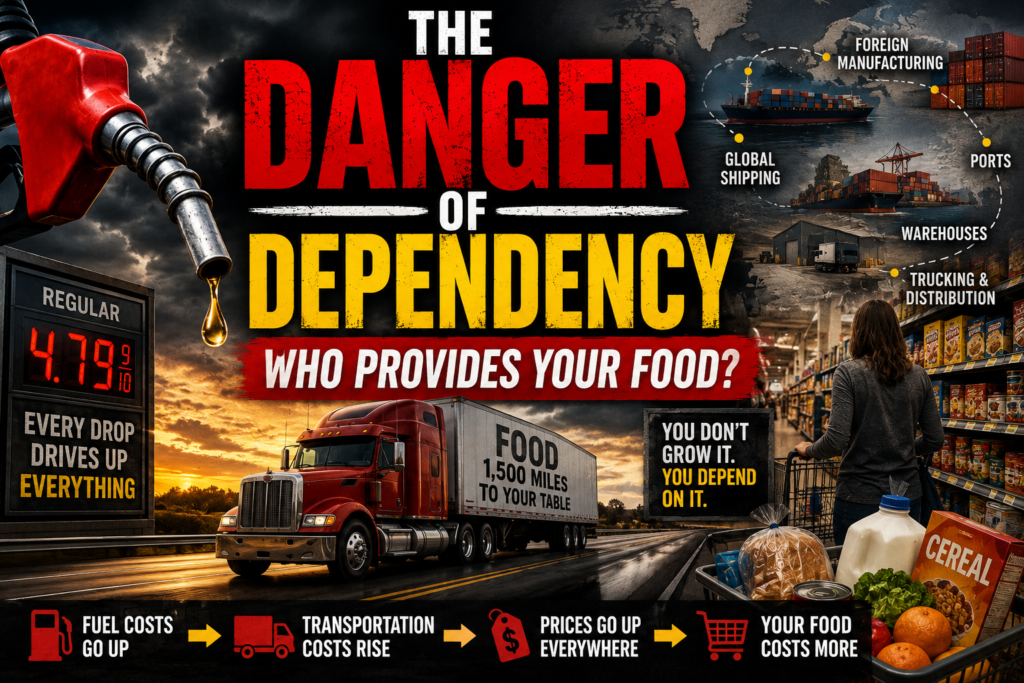
Like most Americans, I find myself grumbling every time I pull up to a gas pump. For months now, we’ve watched fuel prices inflate due to the war in Iran. Analysts tell us futures trading suggests prices may fall in the coming weeks. Perhaps they will. Perhaps they won’t. The point is not whether gasoline drops twenty cents next month or rises another fifty cents by the end of summer. The point is that every time fuel prices spike, Americans are reminded just how dependent we have become.
When gas prices rise, the cost is not limited to filling our vehicles. Every product sitting on a grocery store shelf arrived there on a truck. Every restaurant receives deliveries. Every construction project depends upon transportation. Every business passes increased costs to consumers. When fuel prices rise nearly everything becomes more expensive.
Most people understand this intellectually, but few stop to consider what it reveals about our society.
We live in a system built upon constant movement. Food is grown hundreds or even thousands of miles away. Products are manufactured overseas. Goods travel through ports, warehouses, trucking networks, and distribution centers before ever reaching our homes. We have built our lives upon a supply chain so complex that most people could not explain how it functions. Yet we depend upon it every single day.
The problem is not merely economic. The problem is dependence. Every inconvenience exposes the reality that we have surrendered much of our self-sufficiency in exchange for convenience.
Ultimately, our trust is in the Lord, not in stockpiles of food or off-grid compounds. At the same time, Scripture consistently praises wisdom, stewardship, and diligence. When famine was coming, Joseph stored grain. When judgment was coming, Noah built an ark. When winter was coming, the ant gathered food.
The Bible never presents preparation as a lack of faith. Quite the opposite. Wise stewardship is often an expression of faith. This brings me back to something that would have been completely ordinary to previous generations.
Plant a garden.
I realize that sounds almost too simple.
Yet one of the most practical things a family can do is put a few seeds in the ground and learn to tend to them as they grow. Not because a small garden will solve inflation. But because growing food reconnects us to a way of life that modern society has largely abandoned.
The Bible begins in a garden. The first man was not a consumer. He was a steward.
The modern world has trained us to consume almost everything and produce almost nothing. We consume food, entertainment, news, products, and endless streams of digital content. We have become remarkably efficient at consumption and remarkably inexperienced at production.
Yet Solomon offers a different perspective.
“There is nothing better for a man, than that he should eat and drink, and that he should make his soul enjoy good in his labour. This also I saw, that it was from the hand of God.” (Ecclesiastes 2:24)
Notice the simplicity of that verse.
Eat. Drink. Enjoy the fruit of your labor. Recognize it as a gift from God.
Solomon does not point us toward endless accumulation. He points us toward contentment. There is something profoundly satisfying about enjoying the results of honest labor. Perhaps that is why a homegrown tomato tastes better than one purchased from a store. It is not merely the freshness. It is the knowledge that your labor participated in God’s provision.
Rising gas prices should remind us of something important. Our modern systems are fragile. They depend upon countless moving parts functioning exactly as intended. Most of the time they do. Sometimes they do not. America’s problems will not be solved by gardens alone. But a garden represents something our culture desperately needs to recover. It represents a return to simplicity in an age of dependence.
More to come on this topic.
About The Author













Amen
Thank you