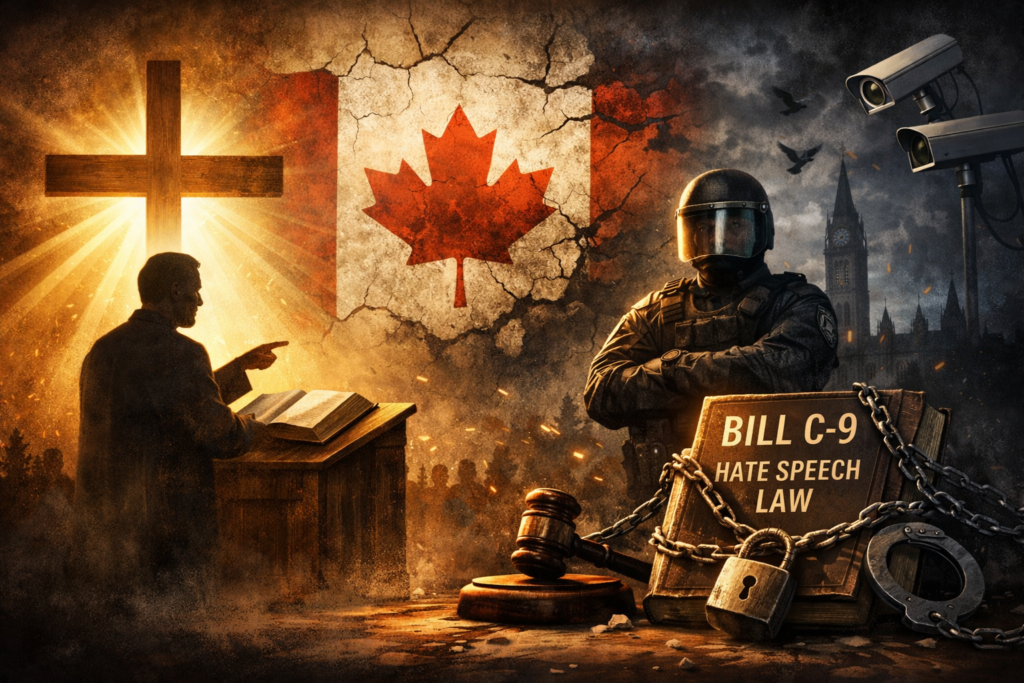
In recent months, Canada has moved to advance new legislation addressing what it defines as “hate.” The speed at which this bill is progressing through Parliament has raised concern among legal and religious observers alike. Proposed legislation such as Bill C-9 expands the legal definition of “hatred,” increases penalties, and lowers the threshold for prosecution—raising serious concerns about how biblical preaching may be interpreted under such laws. This raises an important question: where is the line between protecting society and restricting truth?
While the stated goal is to protect vulnerable groups, the broader effect is far more concerning—especially for those who hold to biblical convictions. For Bible-believing Christians, and particularly Baptists, this is not merely a political issue. It is a spiritual one.
The issue is not merely what the law explicitly says, it is how it can be interpreted and how it may expand over time. Canada’s current statutes include language that appears to protect religious expression, yet they also rely on broad and subjective terms such as “hatred,” often defined as “detestation” or “vilification.” These are not fixed categories, but elastic ones, shaped by courts, culture, and political pressure. What is protected in one generation may be prosecuted in the next. A preacher who simply declares, “Thus saith the Lord,” may find that message increasingly measured not by Scripture, but by the state’s definition of acceptable speech. As legislation evolves and enforcement thresholds are lowered, the concern is not that the law openly forbids biblical preaching today, but that it creates a framework in which such preaching can be reinterpreted as unlawful tomorrow.
At the heart of the concern is authority. Who has the right to determine what is true, what is good, and what may be spoken? Scripture is clear that God alone is the final authority. Yet when governments begin defining moral truth and restricting speech accordingly, they step into a realm that does not belong to them.
This is where the historic Baptist distinctive of separation of church and state becomes critically important.1 Baptists have long held that the church must remain free from government control, not because we seek rebellion, but because we recognize that Christ is the head of the church—not the state. When the government begins regulating what pastors can preach or what Scripture may be declared publicly, it is no longer protecting order, it is usurping divine authority.
Canada’s expanding hate speech framework raises serious questions in this regard. If biblical teachings on sin, whether concerning sexuality, gender, or judgment, are labeled as “harmful” or “hateful,” then faithful preaching could be criminalized. What God calls truth, the state may call hate. And when that line is crossed, the church faces a decision: obey God or comply with man.
Closely tied to this is another foundational Baptist conviction: individual soul liberty. Every person has the God-given right to believe, worship, and speak according to conscience, without coercion from the state. This liberty is not a license to sin, it is the recognition that each soul answers directly to God.2
When governments regulate speech under the banner of “safety,” they inevitably begin to regulate conscience for the sake of their warped consciences. If a man cannot speak what he believes the Bible teaches, then he is no longer free before God—he is subject to human authority in matters of the soul. That is a dangerous place for any society to be. C.S. Lewis said, “…Those who torment us for our own good will torment us without end for they do so with the approval of their own conscience.”3
History has repetitively shown us the dangers of controlled speech. What begins as a protection against “extremism” often becomes a tool to silence dissent. And for Christians, dissent is not optional. The Gospel itself is offensive to the natural man. It confronts sin, calls for repentance, and declares that salvation is found only in Jesus Christ. In a world that increasingly rejects absolute truth, that message will always be labeled as intolerant.
This is where the issue moves from political to prophetic.
The Bible warns of a coming world system under the rule of the Antichrist, a system characterized by centralized authority, enforced conformity, and suppression of truth. While no current law is the full realization of that prophecy, measures like Canada’s hate speech legislation reveal the direction in which the world is moving. They condition societies to accept restrictions on speech, to prioritize unity over truth, and to view dissent as dangerous.
In such an environment, those who hold to biblical convictions will increasingly find themselves marginalized—or worse.
But this should not surprise us. Scripture tells us that darkness hates the light.4 The more boldly truth is declared, the more fiercely it will be opposed. The question is not whether pressure will come—the question is whether the church will stand when it does.
For Baptists, the answer must be clear. We stand on the authority of Scripture. We defend the independence of the church. We uphold the liberty of the soul. And we refuse to surrender the truth, no matter the cost.
Canada’s trajectory should serve as a warning, not just for Canadians, but for believers everywhere. Freedoms once assumed can quickly erode. Rights once protected can be redefined. And when the state takes upon itself the power to determine what may be spoken, it inevitably challenges what God has already declared.
In the end, no law passed by man can override the Word of God. And no system, no matter how powerful, can silence the truth forever.
- Matthew 22:20-22 ↩︎
- Romans 14:12 ↩︎
- C.S. Lewis, God in the Dock: Essays on Theology (Making of Modern Theology) ↩︎
- John 3:19-20, 7:7 ↩︎
About The Author