
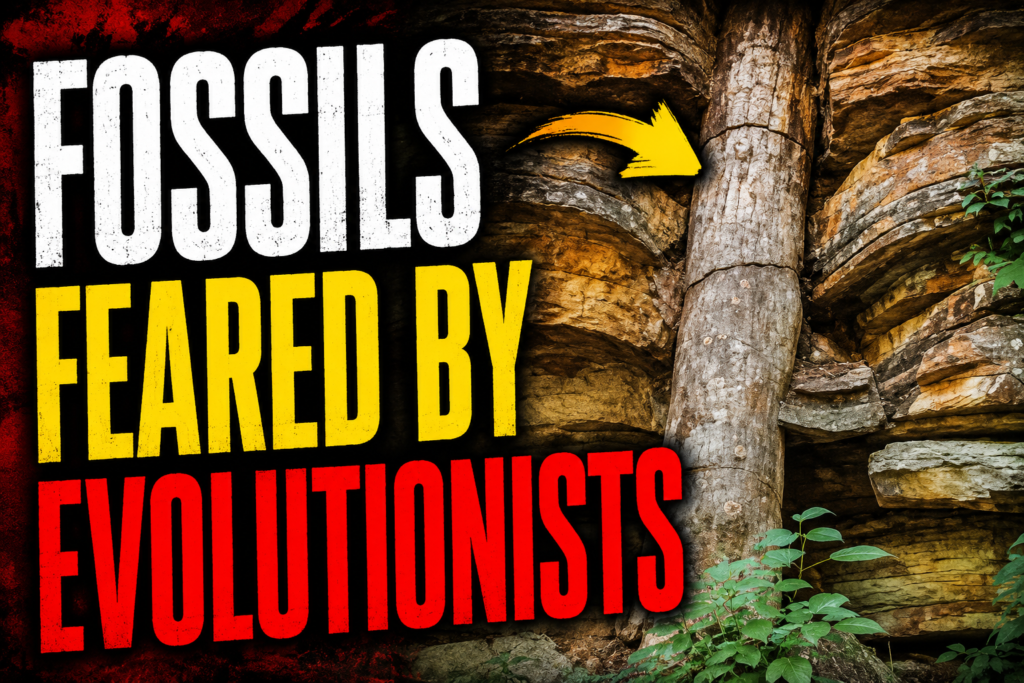
I was happy to see this recent article from the New York Post discussing fossil trees and the Noah’s flood debate. I have spoken about polystrate formations for years, and they are not just limited to tree trunks.1 I majored in apologetics through the Institute for Creation Research, so subjects like this have always been near to my heart. Unfortunately, most Christians have never even heard the term “polystrate fossil,” despite the fact that these formations present serious problems for the standard evolutionary timeline.
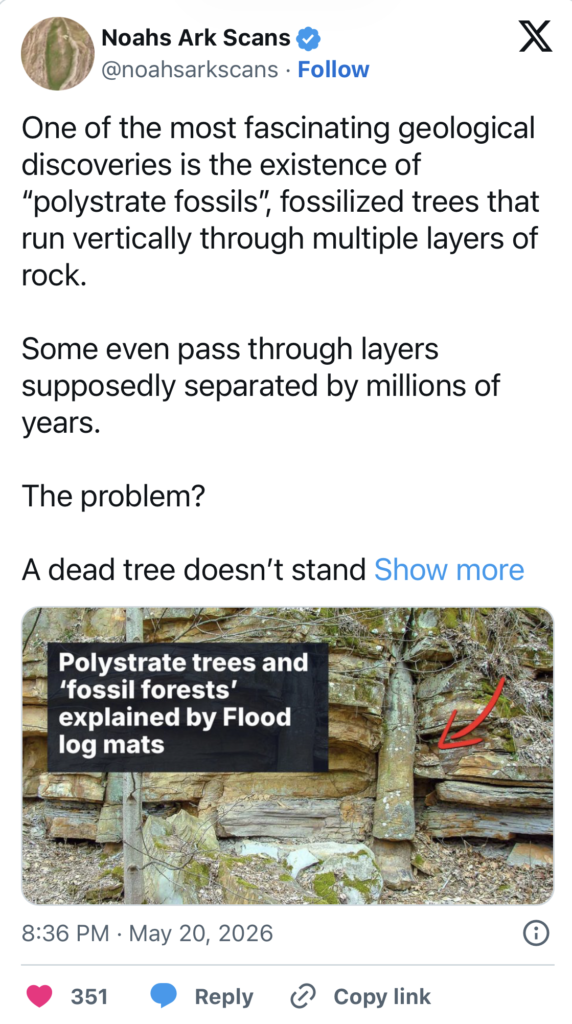
For those unfamiliar, a polystrate fossil is a fossil that extends vertically through multiple layers of sedimentary rock. The most famous examples are upright fossilized trees that supposedly pass through layers claimed to represent millions of years of geological history. The obvious question becomes: how did the tree remain standing while waiting millions of years for the next layer to slowly form around it?
The answer is simple. It did not.
These formations point toward rapid burial through catastrophic geological processes, not slow gradual accumulation over endless ages.
That reality creates a major problem for uniformitarianism, the philosophical foundation underlying much of modern geology. Uniformitarianism is the belief that “the present is the key to the past,” meaning the earth has always changed slowly and gradually at roughly the same pace we observe today. But the Bible never describes the ancient world that way. Scripture describes sudden catastrophe, violent upheaval, fountains of the deep breaking open, and the world perishing beneath divine judgment.
“And the flood was forty days upon the earth; and the waters increased, and bare up the ark, and it was lift up above the earth.” (Genesis 7:17)
The earth itself still bears witness to catastrophe.
Polystrate fossils are not limited to trees either. Entire ecosystems appear rapidly buried. Massive fossil graveyards exist all over the world containing jumbled creatures packed together in violent sediment deposits. Marine fossils are found on mountain tops. Whale fossils have been discovered in deserts. Vast coal seams filled with compressed vegetation stretch across continents. Everywhere we look, the geological record appears scarred by watery destruction.
Secular scientists continually attempt to explain these things through localized catastrophes while rejecting the possibility of a global flood. Ironically, many of the same scientists openly admit that catastrophic events shape geology far faster than previously believed. The eruption of Mount St. Helens dramatically demonstrated this. In a matter of hours and days, landscapes were reshaped, canyons formed, forests buried upright, and sedimentary layering occurred rapidly. Processes once claimed to require vast ages suddenly appeared capable of happening very quickly.
Once you admit catastrophic processes can rapidly shape geology, the door swings wide open to the biblical flood account.
The resistance to Noah’s flood is not merely scientific. It is spiritual.
If Noah’s flood really happened, then mankind is accountable to a holy God who judges sin. The flood is not merely a story about animals entering an ark. It is a historical testimony that God’s patience has limits and His warnings are true. Men despise that message.
Our culture is comfortable discussing climate change, extinction events, asteroids, and apocalyptic scenarios. Hollywood has no problem imagining worldwide destruction. Yet mention divine judgment, and suddenly the world begins mocking. The issue has never been evidence. The issue is rebellion.
“For this they willingly are ignorant of…” (2 Peter 3:5)
Peter warned that in the last days scoffers would deliberately ignore the flood because acknowledging past judgment points toward future judgment.
Jesus Himself connected the days before the second advent to the days of Noah.
“But as the days of Noe were, so shall also the coming of the Son of man be.” (Matthew 24:37)
The similarities are striking. Violence filled the earth in Noah’s day. Corruption consumed society. Men lived as though judgment would never come. They mocked the preacher of righteousness while continuing business as usual until the flood arrived suddenly.
We now live in a generation intoxicated with technological pride. Men believe they can explain away God, redesign morality, rewrite biology, merge with machines, and solve every problem through science and artificial intelligence. Yet for all of modern man’s supposed advancement, he still cannot erase the scars left behind by divine judgment upon the earth itself.
The fossil record does not look peaceful. It looks drowned. The layers of the earth do not whisper slow uniformity. They scream catastrophe. And buried beneath the rocks, sediment, and fossilized graveyards of this planet stands a reminder modern civilization desperately wants to silence: God judges sin.
Hebrews 11:7 says:
“By faith Noah, being warned of God of things not seen as yet, moved with fear, prepared an ark to the saving of his house…”
Notice that phrase: moved with fear.
Modern Christianity often mocks the fear of God as outdated or extreme. Noah would disagree. The fear of God moved him to obedience while the rest of the world laughed itself into destruction. The world still laughs.
The earth beneath our feet still testifies. Buried forests. Fossil graveyards. Marine life atop mountains. Layers of rapid destruction covering continents. The evidence of catastrophe remains visible for any honest observer willing to look. But sinful men suppress truths they do not want to obey.
The real problem has never been a lack of evidence for judgment.
The real problem is that fallen men do not want the Judge.
- http://static.icr.org/i/pdf/technical/The-Whale-Fossil-in-Diatomite-Lompoc-California.pdf ↩︎
About The Author












Interesting
Thank you