
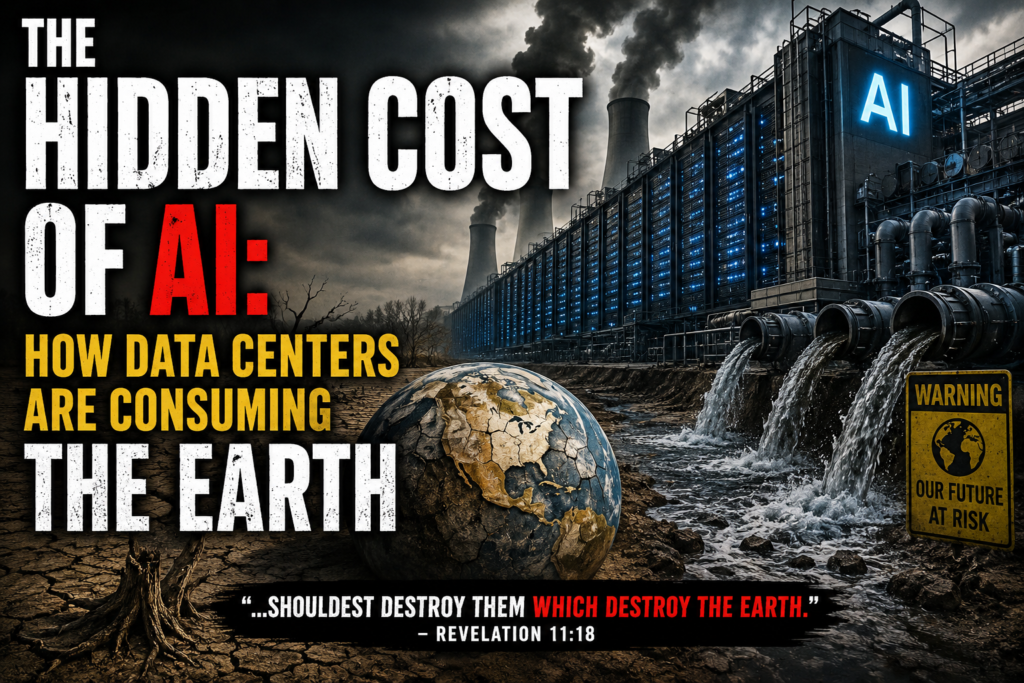
“And the nations were angry, and thy wrath is come… and shouldest destroy them which destroy the earth.” — Revelation 11:18
Most people never think about what powers the digital world around them.
Every AI prompt, every cloud backup, every streaming service, every social media upload, every online bank transaction, all of it is processed through enormous data centers scattered across the globe. And we all use them. Hidden behind the language of “innovation” and “technological advancement” is an infrastructure consuming staggering amounts of land, electricity, and water.
The world is rushing headlong into an AI revolution, but almost nobody is asking what the actual cost will be. And perhaps even fewer are asking whether mankind is once again attempting to build another Tower of Babel.
Recently, officials in Utah approved one of the largest AI data center projects in American history, a massive development spanning over 40,000 acres. Reports indicate the facility could ultimately consume more electricity than the entire state of Utah presently uses. Critics warned the project would also require enormous amounts of water in a region already struggling with drought concerns. Yet despite public backlash and environmental warnings, the project moved forward anyway.1
For years we have been lectured endlessly about carbon footprints, climate emergencies, and conserving resources. Ordinary Americans are told to drive less, use less electricity, conserve water, and surrender more freedoms “for the good of the planet.” Meanwhile, giant corporations are constructing technological fortresses that consume resources on a scale the average citizen can scarcely comprehend. The hypocrisy is breathtaking.
Artificial intelligence is not powered by magic. It is powered by gigantic industrial systems running day and night without interruption. These server farms generate extraordinary heat, requiring massive cooling systems and tremendous electrical output simply to remain operational.
The environmental burden is rapidly becoming impossible to ignore.
Researchers have increasingly warned that modern data centers place enormous strain upon electrical grids, water systems, and local ecosystems. Entire communities are now discovering that these facilities are not being built in some distant industrial wasteland, but beside farms, neighborhoods, creeks, and small towns.
In Wisconsin, residents living near a Meta data center project reported disturbing environmental concerns involving local waterways. One woman described a nearby creek turning “cloudy like milk,” while testing reportedly revealed elevated aluminum levels.2
Ordinary citizens increasingly feel powerless against corporations and governments obsessed with winning the AI race at any cost.
And that brings us back to Babel.
Genesis 11 records one of the most revealing moments in human history:
“And they said, Go to, let us build us a city and a tower, whose top may reach unto heaven…” (Genesis 11:4)
The Tower of Babel was more than architecture. It represented unified human pride. Mankind gathering together in collective rebellion against God, convinced that through centralized power and technological achievement they could build a future independent from the Creator.
Today, the world is once again uniting around centralized technological systems. Massive digital towers now rise across the earth, not brick towers stretching into the clouds, but sprawling data centers consuming entire landscapes in pursuit of artificial intelligence supremacy.
The spirit behind both is strikingly similar.
Humanity increasingly believes it can solve every problem through technology. All that matters is progress.
Faster systems.
Smarter machines.
Larger networks.
Greater control.
But Scripture repeatedly warns what happens when mankind exalts itself in pride.
The modern AI movement is fueled by a near-religious faith in human potential. Some openly speak of transcending humanity itself through artificial intelligence. Others dream of global systems capable of monitoring, predicting, and controlling nearly every aspect of human behavior.
What once sounded like science fiction increasingly resembles reality. And the infrastructure required to support that system is consuming the earth itself.
The irony is sobering: while the original Tower of Babel sought to reach heaven, today’s digital towers are devouring creation below.
Revelation 11:18 contains a warning that God will ultimately judge those “which destroy the earth.” As governments and corporations strip resources, consume landscapes, and expand technological systems with virtually no restraint, the warning here is increasingly relevant to the culture.
This does not mean all technology is evil. AI can be greatly beneficial. Christians do not have to reject innovation outright. Technology can be used for tremendous good. The Gospel itself has spread through technologies previous generations could never have imagined. But an awareness and balance of the cost of these innovations should at least be on our radar.
There is a vast difference between using technology responsibly as a tool and worshipping technological progress as mankind’s savior. That line is rapidly disappearing.
Modern civilization has become intoxicated with convenience, consumption, and control. And like every civilization before it that exalted itself against God, it believes there will be no consequences.
Babel, which arose while Noah was still alive to see mankind’s post-flood rebellion firsthand, continues to mirror the very spirit of our age and the prophetic days yet ahead. “But as the days of Noah were, so shall also the coming of the Son of man be.”3
Mankind no longer simply uses technology as a tool. Increasingly, technology has become an idol, a digital tower of Babel promising salvation through knowledge, connection, automation, and power. Humanity believes that with enough data, enough processing power, and enough centralized control, it can engineer a future independent from God.
Returning to Revelation 11:18, God will ultimately judge those “which destroy the earth.” The verse is not merely about pollution or environmentalism. It is about mankind’s reckless abuse of what God entrusted to him. The earth was given to man for stewardship, but fallen humanity continually transforms stewardship into exploitation.
And like every dispensation before it, arrogant man once again proves that apart from God, he cannot be trusted even with his greatest achievements.
- https://www.theguardian.com/us-news/2026/may/13/utah-approves-datacenter-backlash ↩︎
- https://finance.yahoo.com/economy/policy/articles/wisconsin-woman-says-meta-1b-100000161.html ↩︎
- Matthew 24:37 ↩︎
About The Author















Finally, a excellent explanation of what’s coming.
Once again Agenda 2030
Digital ID
The end goal is to b like China.
Come Lord Jesus Come !
Thank you brother Randy