
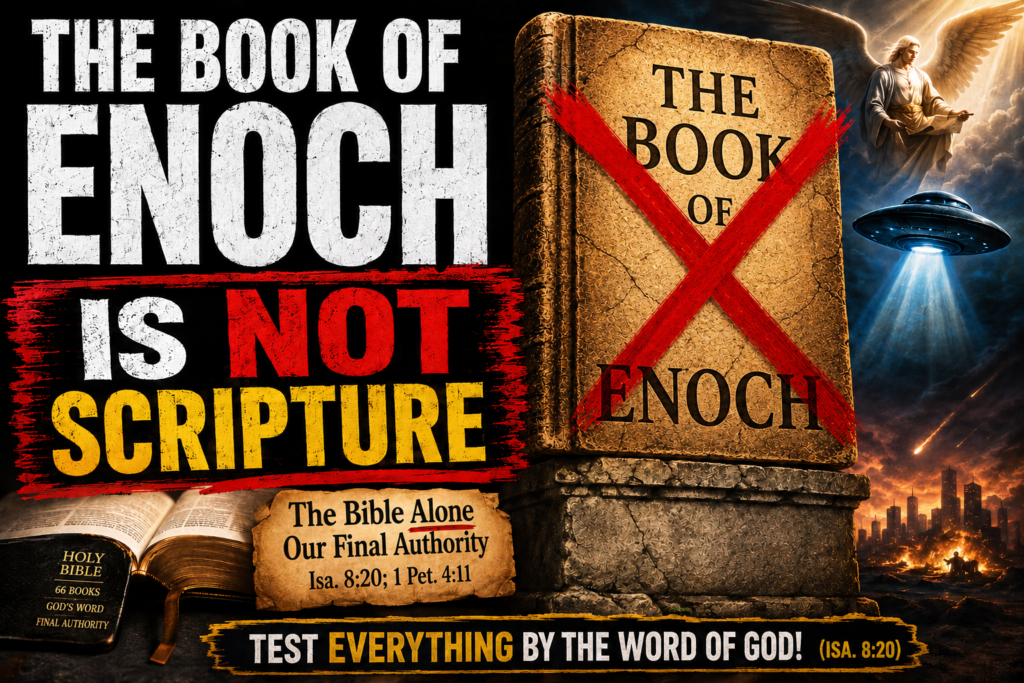
There’s a growing population of believers deceived into thinking the Book of Enoch is inspired Scripture. This belief is founded upon a resurgence of interest in the Ethiopian Bible, Angels, UFO’s, and End Times prophecies.
Unfortunately, the foundation of this conviction is not grounded or rooted in Scripture. As believers, our responsibility is to draw our conclusions from explicit statements and implicit principles of the Bible. The words of God serve as our ultimate standard of authority by which to judge everything. (Isa. 8:20; 1 Pet. 4:11)
God’s revelation clearly defines what Scripture is and what it is not. 53 times the term “Scripture(s)” appears in our KJB – each instance establishes the attributes of God’s words by which we can apply and test the claims of others attempting to convince us that Pseudepigraphical books are equal to the Scriptures that God has preserved in our 66-book English translation.
The Argument
Here is a 10-premise syllogism that demonstrates why the Book of Enoch is simply a Jewish Fable, and not inspired Scripture:
Premise 1: Any text that contradicts the established 66-book canon of Scripture is not inspired by God. (Ps. 12:6, 7)
Premise 2: Any text containing demonstrable historical errors, impossible chronologies, or false prophecies is not inspired by God. (Jn. 17:17)
Premise 3: Any text that misrepresents the holy character of God, the unique identity of Jesus Christ, or the nature of biblical figures is not inspired by God. (Heb. 6:18; Titus 1:2)
Premise 4: The Book of Enoch directly contradicts the Bible on key events, such as claiming angels built the ark and that a demon named “Gâdreêl”, not the serpent, deceived Eve.
Premise 5: The Book of Enoch contains historical impossibilities, including narratives where Enoch interacts with people like Noah long after he was translated.
Premise 6: The Book of Enoch misrepresents God by portraying Him as regretful of the Flood and misrepresents Noah by depicting him as a coward who was told to hide. (Jer. 23:16)
Premise 7: An inspired book would not have been rejected by the ancient Jews, to whom the Old Testament “oracles of God were committed” (Romans 3:2, 9:4).
Premise 8: The Book of Enoch was historically rejected by the Jews and was never included in the Hebrew canon. (Lk. 24:44)
Premise 9: The Holy Spirit does not inspire New Testament authors to quote from uninspired, fraudulent books as divine authority.
Premise 10: The Apostle Jude quoted a single, true prophecy from the man Enoch, which does not serve as an endorsement of the entire fraudulent Book of Enoch written centuries later.
Conclusion: Therefore, the Book of Enoch is a fraudulent, uninspired text and is not the word of God.
About The Author











There’s been a rise in comments regarding this book, glad you wrote this. Strong points to use and easy to follow. The contradictions alone stand witness against its authenticity. Thank you brother!
Amen
Thank you