
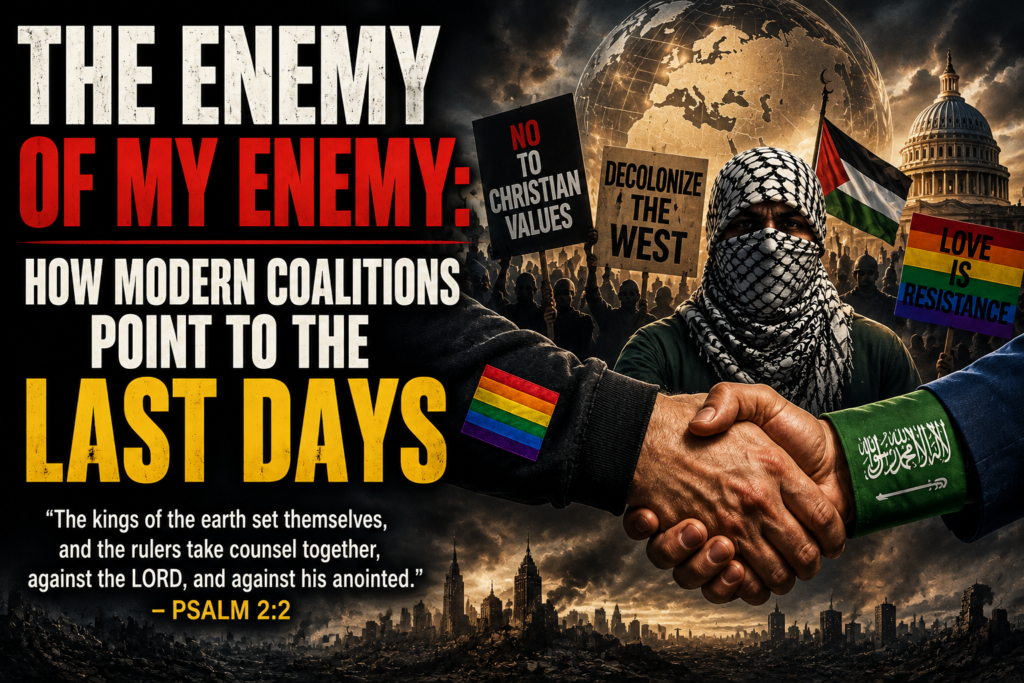
There is no question that strange political and ideological coalitions have formed in the modern West. Many people have noticed that segments of the radical left, LGBTQ+ activism, and Islamic political movements increasingly stand side by side in protests, universities, media campaigns, and anti-Western rhetoric. On the surface, this alliance appears deeply contradictory. Traditional Islam historically condemns homosexuality. Radical progressive ideology often condemns traditional religion altogether. Marxist thought has long viewed religion as an obstacle to social revolution. Yet despite these obvious tensions, cooperation continues.
Why?
The answer is not that these groups suddenly agree on morality, theology, or human nature. In many cases, they clearly do not. The deeper connection is that all three movements often identify a common enemy: historic Christianity, traditional Western values, and the biblical moral framework that once shaped Europe and America.
For centuries, Western civilization was heavily influenced by Christianity. Marriage between a man and a woman, distinctions between male and female, sexual restraint, family structure, patriotism, national identity, and objective moral law were considered normal foundations of society. Even imperfect Western nations generally understood themselves as accountable to transcendent truths rooted in Scripture. Christianity restrained both pagan excess and totalitarian power because it proclaimed that God, not the state, is supreme and separate.
The radical left has long viewed that framework as oppressive. Karl Marx himself saw religion, family structure, and traditional morality as barriers to revolutionary transformation. Modern leftist ideology frequently seeks to dismantle inherited institutions: the family, patriotism, biological distinctions, hierarchy, and Christian moral authority. Traditional Christianity stands directly in the way because it claims eternal truth rather than endlessly evolving social definitions.
Likewise, modern LGBTQ+ activism increasingly functions not merely as a request for tolerance, but as a comprehensive moral revolution. Historic Christian teaching regarding sexuality must be rejected for the movement to fully succeed. Christianity’s insistence upon biblical sexual ethics is therefore treated not merely as disagreement, but as hostility.
Islamic political movements often approach the conflict differently, but the overlap still exists. Many Islamic activists view the Christian West as morally corrupt, imperialistic, decadent, and spiritually bankrupt. While Islam and progressive sexual ideology fundamentally contradict one another morally, both can temporarily cooperate against a civilization they perceive as weakened by Christianity’s historical influence. In activist coalitions, anti-colonial rhetoric, anti-nationalism, anti-Israel sentiment, and hostility toward traditional Western structures often provide common ground.
This creates what many observers see as an unstable but functional alliance. The radical left supplies institutional power through universities, media, corporations, and political activism. LGBTQ+ movements provide emotional and cultural leverage through identity politics and moral pressure campaigns. Islamic activists contribute demographic growth, organized religious conviction, and anti-Western critique. Their internal contradictions are temporarily ignored because their shared opposition to historic Christian civilization outweighs their disagreements.
One of the clearest modern examples of this phenomenon is what some analysts have called “woke Islam.” In a notable analysis from the Hudson Institute titled The Rise of Woke Islamism in the West, the argument is made that segments of Islamic activism in the West have increasingly adopted the language of social justice, intersectionality, anti-colonialism, oppression narratives, and diversity politics in order to integrate themselves into progressive Western coalitions.
This development is deeply significant because “woke Islam” often functions less as a genuine reform of Islam and more as a protective public-relations shield around Islamic activism in the West. By adopting the moral language of modern progressivism, activist Islam gains institutional protection from criticism while avoiding serious internal confrontation with radical elements inside the broader Islamic world. In many cases, the same voices that aggressively condemn Christian traditionalism remain noticeably silent regarding Islamic extremism, sharia authoritarianism, persecution of Christians, or violence committed in the name of Islam.
The result is that “woke Islam” can function as a smokescreen that normalizes or shields more radical currents beneath the surface rather than meaningfully opposing them. The rhetoric changes, but the deeper hostility toward Christian civilization often remains intact. Progressive institutions become willing to tolerate profound contradictions because the larger strategic objective remains the weakening of Christianity and traditional Western moral order.
From a biblical perspective, this should not surprise Christians. Scripture repeatedly shows that movements with deeply opposing beliefs can temporarily unite when Christ and His word becomes the enemy. Psalm 2 declares:
“The kings of the earth set themselves, and the rulers take counsel together, against the LORD, and against his anointed.” — Psalm 2:2
In Luke 23:12, Herod and Pilate became united in the conflict concerning Jesus Christ.
This phenomenon also serves as a striking illustration of how a future one-world religious system could emerge. Modern coalitions demonstrate that deeply contradictory systems can cooperate successfully if they share a common enemy.
Islam and progressive sexual ideology are fundamentally incompatible at the theological level. Radical leftism and traditional religion are likewise contradictory. Yet they increasingly cooperate because they are united not by shared truth, but by shared opposition to biblical Christianity and the authority of the Lord Jesus Christ.
This pattern becomes even more significant when viewed through biblical prophecy. Revelation 13 and Revelation 17 describe a coming global system marked by ecumenicalism, political consolidation, and rebellion against God. The final religious unity of the world may not be built upon theological agreement as much as shared hostility toward exclusive truth claims. There will come a time that Antichrist will turn against the great whore, the Roman Catholic Church, even though they previously shared a common enemy.
The modern West increasingly resembles a civilization trying to survive after rejecting the very worldview that built it. Christianity, despite the failures of sinful men within it, gave the West a moral architecture: the dignity of the individual, the sanctity of life, limitations on state power, the importance of the family, objective morality, forgiveness, and accountability before God. Once those foundations are removed, society does not become neutral. A vacuum forms. Into that vacuum rush competing ideologies seeking dominance.
Yet Scripture warns that societies rejecting God do not move toward enlightenment, but toward confusion. Romans 1 describes civilizations suppressing truth and descending into moral inversion. “Professing themselves to be wise, they became fools” (Romans 1:22). The Apostle Paul warned that the last days would be marked by deception because men “received not the love of the truth” (II Thessalonians 2:10).
The strange alliances forming in the modern West ultimately reveal something profound. Men who cannot unite around truth will often unite around rebellion. And in the end, the world’s growing spiritual coalition is not merely against Western tradition or conservative politics. At its deepest level, it is against the Lord Jesus Christ Himself.
About The Author










Interesting
Thank you
What a profound and true statement: “Men who cannot unite around truth will often unite around rebellion.”
These alliances and compromises truly demonstrate who the god of this world is (2Cor. 4:4)