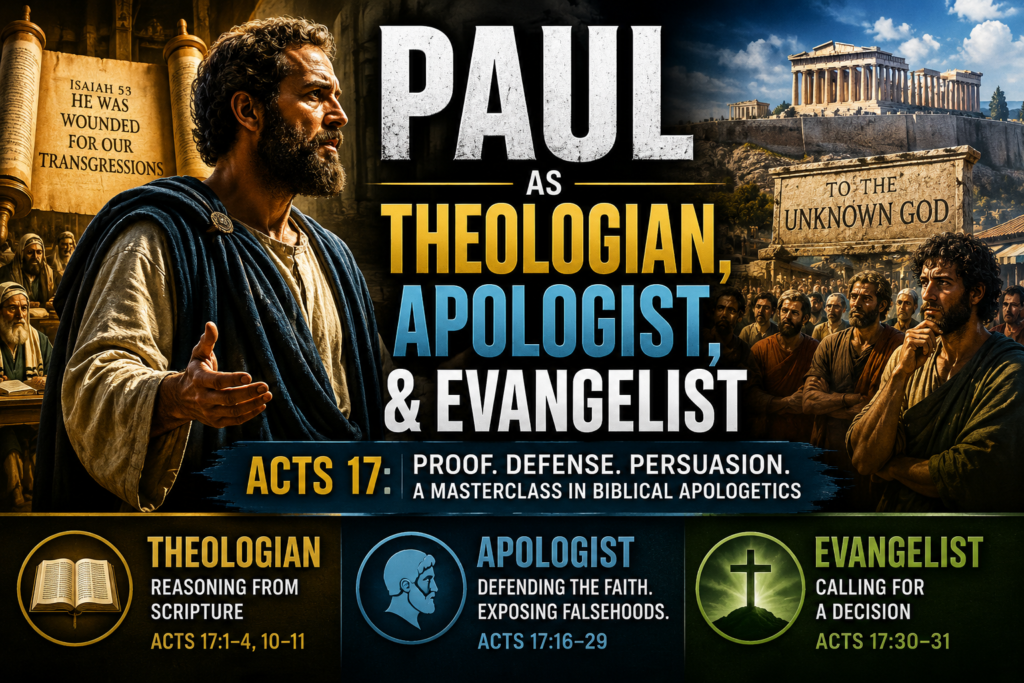
In Acts 17, we do not merely see a man preaching; we see a master steward of the mysteries of God (1 Corinthians 4:1). Paul demonstrates that a mature believer does not handle the word of God deceitfully but seeks the “manifestation of the truth” to every man’s conscience (2 Corinthians 4:1-2). He balances three distinct yet unified disciplines: Theology (Proof), Apologetics (Defense/Offense), and Evangelism (Persuasion).
I. The Theologian: Opening and Alleging (Acts 17:1–4, 10–11)
Apologetic Function: Proof (Theological Affirmation)
In the synagogues of Thessalonica and Berea, Paul operates as a Theological Lawyer. He does not rely on subjective “testimony” alone; he builds a case from the bench of the Bible’s Old Testament counterparts.
- The Discipline of “Opening”: Paul used the Scriptures as the basis of his reasoning. Paul substantiated his claims by providing proof: he didn’t just state a “What” (Jesus is the Christ); he provided the “Why” (The Scriptures required a suffering and rising Messiah).
- The Discipline of “Alleging”: to “allege” means to “set before” as evidence. Paul was “rightly dividing” the word, showing the transition from the Law and the Prophets to the mystery of the Gospel of Grace.
- The Maturity Metric: Paul shows that the mature believer must have mastery of clarity and articulation in presenting the truth. Like the Bereans, he knew where the truth was located in the scriptures he possessed. He was not “lost” in his own opinions because he was anchored in the absolute authority of the word. Paul did not get bogged down in irrelevant illustrations or “strife of words”. The Apostle knew how to communicate volumes with an economy of words.
II. The Apologist: Disputing in the Market (Acts 17:16–29)
Apologetic Function: Defense (Answering Objections) & Offense (Critique of Unbelief)
When Paul entered Athens, his “spirit was stirred in him” upon seeing the city wholly given to idolatry. Here, he exhibits the prowess of a seasoned philosopher, able to critique their unbiblical worldviews through systematic critique:
- Foundation (Arbitrariness): Paul identified the Athenians’ foundation as “ignorance” (v. 23). He exposed that their worldview was arbitrary; they worshiped an “Unknown God.”
- Framework (Inconsistency): Paul used a Transcendental Argument. He pointed out the inconsistency of their system: If we are God’s “offspring” (v. 29) and we are living, rational beings, how can we think the Godhead is like a dead, man-made stone?
- Function (Preconditions): Paul presented God as the First Cause (Cosmological) and the Grand Designer (Teleological). He argued that God is the precondition for “life, and breath, and all things” (v. 25).
- Philosophy vs. Vain Deceit: Paul was “capture-proof” (Colossians 2:8). He understood the Epicureans (materialists) and Stoics (pantheists) well enough to use their own poets as “borrowed capital” against them, proving that the Biblical worldview is the only one that makes sense of human thriving and the Cultural Mandate.
III. The Evangelist: The Summons to the Verdict (Acts 17:30–31)
Apologetic Function: Persuasion (The Call for Commitment)
Paul’s brilliance is that he never leaves the hearer in a “philosophical draw.” No one ever won a soul through arguments. He synthesizes his Theology and Apologetics into a powerful Evangelistic Appeal. This is where the balance is demonstrated in the effective use of apologetics.
- The Demand for Repentance: Paul moves from the “Unknown God” (General Revelation) to the “Man whom he hath ordained” (Special Revelation). He informs the “Academy” and the “Marketplace” that the “times of this ignorance God winked at; but now commandeth all men every where to repent.”
- The Infallible Proof: Paul anchors his persuasion in the Historical Evidence of the Resurrection. He presents the Resurrection not as a religious “story,” but as “assurance” (v. 31), objective, legal proof that a Day of Judgment is coming.
- The Gospel Verdict: Maturity is shown in Paul’s Relational Chops. He maintained his “Ethos” (credibility) and “Logos” (logic) until the very end, leaving the crowd with three possible responses: Mockery, Delay, or Conversion (v. 32-34).
Summary of Paul’s Mature Presentation
| Role | Acts 17 Discipline | Modern Believer Application |
| Theologian | Reasoning from Scripture | Mastery of “addresses” and dispensational clarity. |
| Apologist | Internal critique of worldviews | Using logic and science to expose “vain deceit.” |
| Evangelist | Calling for a decision | Moving from arguments to the Cross and Resurrection. |
The Lesson for Believers: Full spiritual growth is the ability to walk into any “Mars Hill” (the university, the workplace, the street corner), understand the “rudiments of the world” being promoted there, and systematically dismantle them using the Sword of the Spirit and Ministerial Reason. Paul shows us that we don’t just win debates; we win souls by providing a reason for the hope that is in us with “meekness and fear” (1 Peter 3:15).
About The Author