
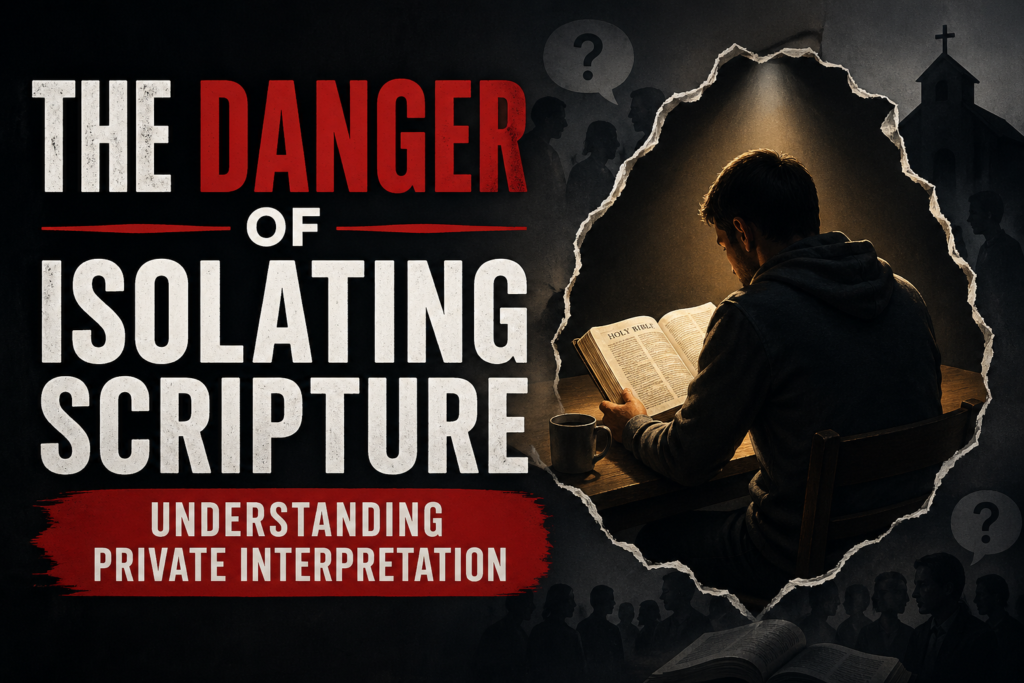
How do we know if we are handling God’s word correctly? In an era filled with countless opinions, shifting theologies, and varying doctrines, the Bible itself provides the fundamental rule for how it must be read and understood.
The chief error in handling Scripture is often doing the exact opposite of the Holy Spirit’s intended method. This error is what the Bible specifically calls “private interpretation.”
The Apostolic Warning: A Primary Boundary
Before diving into complex prophecies, exploring deep doctrines, or attempting to unravel the mysteries of the end times, the Apostle Peter establishes a primary boundary for all biblical study. He writes:
“Knowing this first, that no prophecy of the scripture is of any private interpretation.” (2 Peter 1:20)
Notice the priority here: “Knowing this first.” This isn’t a secondary rule or a mere suggestion; it is the foundational principle for anyone who opens the Bible. This warning is crucial because it tells us that Scripture is not an open canvas for whatever meaning we feel like painting onto it. However, to truly heed this apostolic warning, we must understand exactly what the Bible means by the word “private.”
Defining “Private”: Separation from the Whole
It is a very common mistake in modern Christianity to think that “private interpretation” means “an individual interpreting the Bible for themselves.” Many groups use this verse to claim that only ecclesiastical leaders, scholars, or a specific church hierarchy can tell you what the Bible means. That is absolutely not the biblical definition.
To understand what God means by “private interpretation,” we must use the Holy Spirit’s method: comparing spiritual things with spiritual (1 Corinthians 2:13). We must look at how the Bible itself defines its own terms. When we examine the King James Bible, we find the word “private” or “privately” occurs nine times.
In every single instance, the word is defined not as individual ownership, but as being separated from the whole or a part removed from the group. Scripture consistently uses this term to describe physical or conversational separation from the main body:
- Separation for Specific Instruction: The disciples often came to Jesus “privately” to ask questions. This simply meant they were separated from the multitudes or the pressing crowds (Matthew 24:3, Mark 9:28, Luke 10:23).
- Separation for Action or Location: Jesus or the disciples would depart “privately,” moving physically away from the general public to a solitary place (Mark 6:32, Luke 9:10).
- Separation for Specific Counsel: The Apostle Paul communicated “privately” to those of reputation regarding the gospel he preached. This meant he spoke to them separately from the whole congregation (Galatians 2:2, see also Acts 23:19).
In every biblical example, “private” means isolated or separated from the whole. Therefore, a “private interpretation” is a “separated interpretation.” It is an attempt to understand a prophecy, a verse, or a doctrine in total isolation, severed from the rest of God’s revealed truth.
Context vs. Pretext
The doctrine of private interpretation teaches us that no part of Scripture stands alone. No single verse holds the right to contradict the entirety of the Bible. The sixty-six books of the Bible form one perfectly unified, pure, and inerrant whole. When we violate this rule and isolate a passage, we enter dangerous territory.
There is a vital maxim in biblical study that perfectly summarizes this danger: “A text out of context is a pretext.”
A “pretext” is a false appearance intended to conceal the true purpose of something. It is a justification or a fabricated reason used to hide the real motive. In the realm of biblical doctrine, when a verse is removed from its surrounding context through “private interpretation,” it creates a theological pretext. It gives a false appearance of biblical authority, causing a false teaching to be falsely associated with God’s word.
When someone builds an entire theology on a single, isolated verse while ignoring fifty other verses that clarify the subject, they are guilty of private interpretation. They have separated the part from the whole.
The Cure: The Whole Counsel of God
To avoid error, we must ensure our interpretation of any single verse or prophecy harmonizes perfectly with the whole counsel of God. The Bible is its own best commentary. If an interpretation of one verse makes a contradiction out of another verse, the interpretation is wrong, because God’s Word is perfect and cannot contradict itself.
As believers, our responsibility is to diligently study the word, recognizing that every chapter and verse is part of a larger, divine tapestry. To protect ourselves from private interpretation, we must build consistent study habits:
- Observe the Immediate Context: Always read the surrounding verses, paragraphs, and chapters to grasp the immediate flow of thought.
- Identify the Audience: Pay attention to who is speaking, who is being spoken to, and the specific historical setting.
- Cross-Reference: Always compare the topic with other clear passages in Scripture to ensure perfect doctrinal harmony.
We must never separate the part from the whole. By rejecting isolated, “private” interpretations, we allow the perfect, preserved Word of God to speak for itself, revealing truth exactly as the Holy Spirit intended.
As one preacher aptly stated:
“The correct interpretation is the one that allows God’s word to interpret itself with clear, indisputable scripture witnesses.”
About The Author











Fantastic article, especially how you let the Bible define what it properly means by “private”. This is vital instruction. Thank you!