
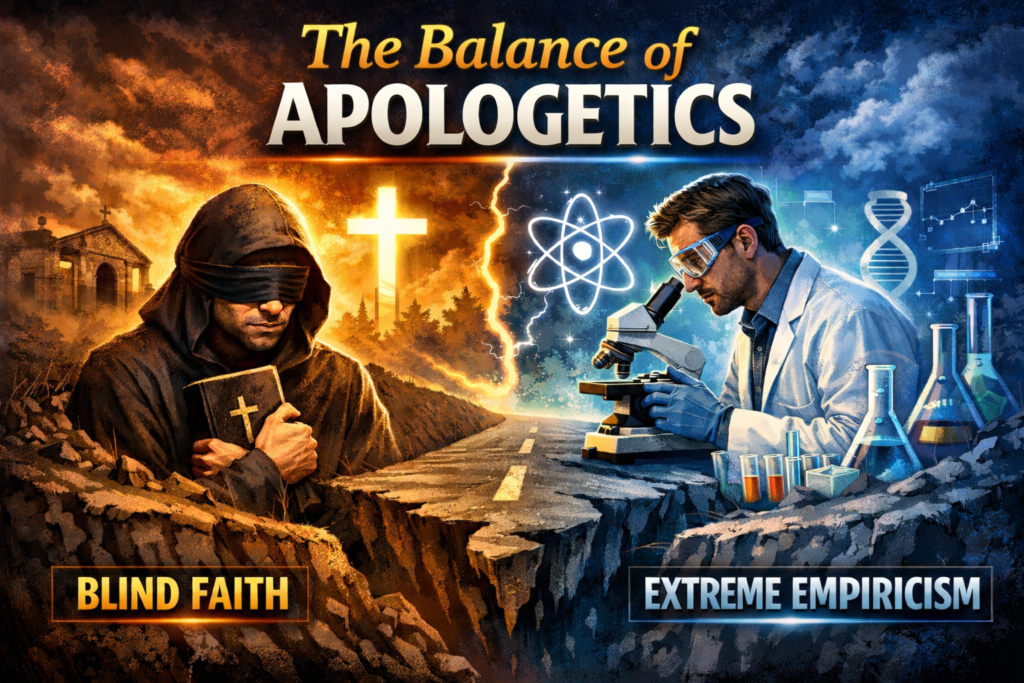
In our Bible-believing world, there is a pervasive and unfortunate trend: a deep-seated disdain for apologetics and the reasoned defense of the faith. Many well-meaning brethren operate under a false dichotomy, assuming that “faith” and “reason” are mutually exclusive enemies. To them, rigorous logical argumentation is often tossed into the trash heap of “over-intellectualism.”
This fear of the intellect creates a culture in which believers are encouraged to leave their minds at the church door, treating logic as a secular invention rather than a reflection of the mind of God. However, Jesus Christ explicitly included the intellect in the greatest commandment, telling us to love the Lord our God with all our heart, soul, and mind (Matthew 22:37). True worship, as Christ stated in John 4:24, requires both “spirit” (the basis of human understanding – 1Cor. 2:11) and “truth” (the objective, universal, invariant logical propositions of God’s reality). True worship cannot be devoid of the intellectual side of our humanity.
The Misunderstood Warning: Colossians 2:8
Much of the fundamentalist fear of intellectualism stems from a failure to carefully read and apply a single verse of Scripture:
“Beware lest any man spoil you through philosophy and vain deceit, after the tradition of men, after the rudiments of the world, and not after Christ.” (Colossians 2:8, KJV)
Believers often make a sweeping generalization, assuming Paul is condemning all philosophy. But Paul is not dismissing philosophy; he is actively warning the Colossians about bad philosophy.
Notice the specific characteristics of the dangerous philosophy Paul attacks:
- Vain Deceit: This is idle, unprofitable, and fruitless thinking. It is an intellectual house of cards built upon a false appearance of truth.
- The Tradition of Men: This elevates human authority and shifting cultural consensus above the absolute, preserved authority of the inerrant word of God.
- The Rudiments of the World: The word “rudiment” historically means the “first principles,” or the early, untrained building blocks of a subject. Paul warns that human, worldly philosophies are kindergarten-level superstition. They are unlearned, man-made attempts to reach the divine that ultimately lead away from the absolute truth found in Christ.
Historically, Paul was combating an eclectic mix of early Gnosticism, Greek philosophy, paganism, and Jewish mysticism. He was not telling Christians to stop thinking. The fact is, everyone does philosophy; it is simply the mechanism we utilize to interpret logical truths. Your worldview will determine what philosophy you practice. The Biblical counter to the fear of “philosophy” is to embrace good philosophy that is rooted entirely in Jesus Christ. When we fail to approach Colossians 2:8 with this careful understanding, we inevitably drift off the narrow path of truth and fall into one of two dangerous ditches.
The First Ditch: Fideism (Blind Faith)
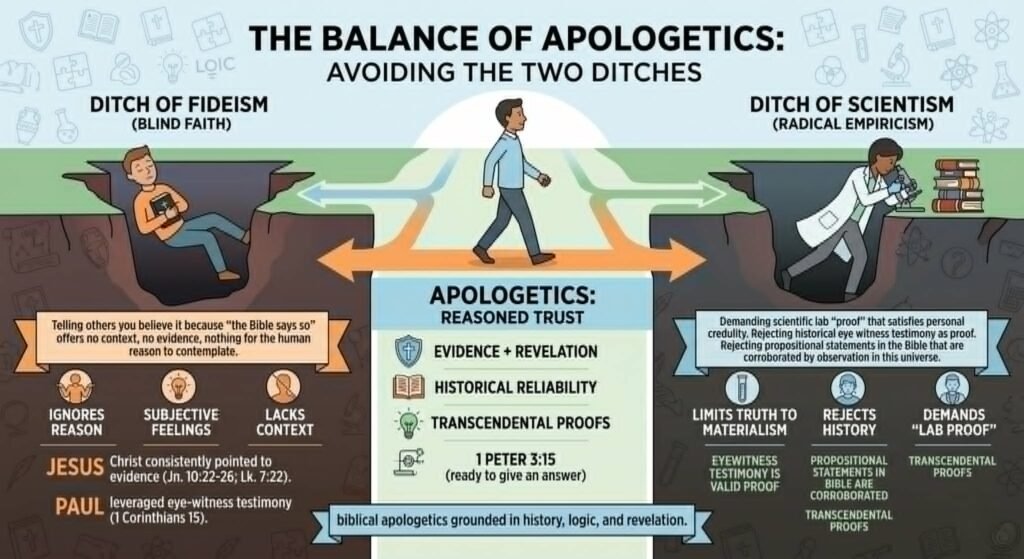
The first ditch is Fideism. This is the belief that faith operates entirely independent of reason and evidence.
- The Danger of “Blind Faith”: Simply telling an unbeliever that you believe something “because the Bible says so,” without offering any foundational context or evidence, provides nothing for their human reason to contemplate.
- The Biblical Counter: The Christian faith is a reasoned step into the light. When questioned by the disciples of John the Baptist, Jesus pointed directly to the empirical evidence of His miracles (Luke 7:22).
- The Apostolic Example: The Apostle Paul did not ask the Corinthian church to take the resurrection on blind, subjective feelings. In 1 Corinthians 15, he leveraged a rigorous historical defense, citing hundreds of living eyewitnesses to establish the physical resurrection of Christ.
The Second Ditch: Scientism (Radical Empiricism)
On the opposite side of the road lies the ditch of Scientism. This is the modern secular demand for scientific, laboratory “proof” to satisfy personal credulity for every truth claim.
- The Limits of the Lab: Scientism errs by restricting all reality to materialism. It arrogantly rejects historical eyewitness testimony as proof, despite eyewitness testimony being the very foundation of our justice system.
- Transcendental Truths: Scientism fails to account for the necessary preconditions of intelligibility. The fundamental laws of formal logic, such as the Law of Identity and the Law of Non-Contradiction, are not physical materials you can observe under a microscope. Yet, these non-material realities are absolutely necessary to even conduct science in the first place.
- Biblical Corroboration: When the Bible makes propositional statements about the order of the cosmos, those statements are consistently corroborated by our observations of this universe (Ps. 19:1).
The Biblical Mandate and The Ultimate Investment
The balance between these two ditches is found in the use of our God-given conscience and rationality. God provides evidence so that man can make a free-will, conscience-driven decision to trust Him. This allows God to judge a man rightly, indict him, and hold him accountable. God is not coercing truth upon a man; rather, He invites us to “reason together” (Isaiah 1:18). We are commanded to “be ready always to give an answer to every man that asketh you a reason of the hope that is in you” (1 Peter 3:15).
This mandate is not just for engaging the lost; it is the absolute foundation for how we disciple the next generation. As managers of our homes and teachers of the word, we cannot afford to outsource the defense of the faith. When a daughter or a young disciple faces the fierce intellectual challenges of a secular culture, simply handing them a curriculum or a book is entirely inadequate. They are watching how we respond. They need to see that the faith holds up under pressure in real time (1 Thes. 1:7; 2 Cor. 3:2-3).
Consider this anonymous quote from a modern apologist:
“What your kids don’t need is another million-dollar Apologist. They need their parents and Church leaders to become master Apologists. Recommending that your kids read books is useless; they won’t read them. They need to hear and see their parents exercising apologetics at a master’s level, seeing apologetics work in the lives of their moms and dads. This is the best defense of the Christian faith you can offer your kids.”Apologetics is the practical, everyday armor of the believer navigating a hostile world. Make the investment. Do not retreat into the ditch of blind faith, and do not be intimidated by the ditch of scientism. Study the word of Truth, master the logical foundations of the faith, and model a reasoned, unshakable trust in the Savior every single day so that those you disciple have a living template to follow.
About The Author







Amen
Thank you
Thanks for this article, very sound and biblical advice offered. This issue with “philosophy” is that traditional practitioners of it (both ancient and modern) presuppose that it can lead to “truth” apart from revelation from God, which is its fundamental error. Logic is not an invention of men, it is the way God thinks (e.g., most of the axioms of logic can be found as principles recorded in Scripture), and Christians today would benefit profoundly from logical thinking, grounded in the presuppositional truth of Scripture. Finally, while I would never use “evidence” in an attempt to prove the existence of God or the truth of Scripture, being able to interact with “evidence” as Bible-believers is essential in our evangelistic and apologetic endeavors.
Amen, brother Steve. It’s important to clarify that “evidence” is rooted in scriptural principle and precept.
Ultimately *all* evidence must be judged according to what the Bible says. The believer should never judge the word of God in light of evidence, but vice versa. This is the pattern Paul demonstrated in Acts 17:1-3. Then the Apostle Paul proceeded to use historical testimony and Creation as an evangelistic appeal to the Athenians later in the chapter.
Bible-believers should learn to do the same.