
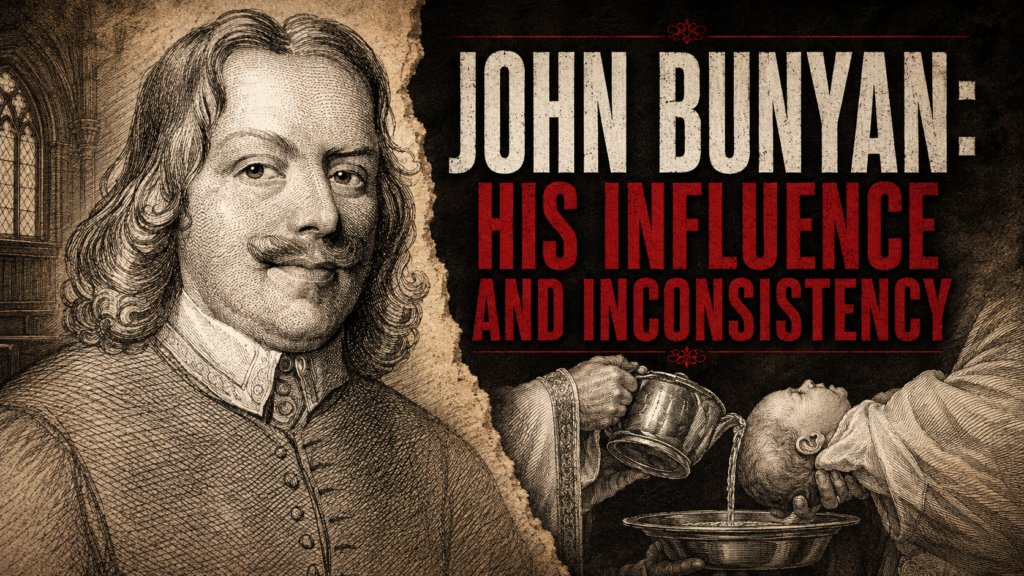
On this day, August 31, 1688, John Bunyan passed away. Most Christians know Bunyan as the author of The Pilgrim’s Progress, but he was more than a writer. He was a preacher, arguably Baptist, and one of the most recognizable Nonconformists in English history. He was willing to go to prison rather than surrender his right to preach the word of God. Yet the same Bunyan who refused to conform to the Church of England was surprisingly willing to bend concerning baptism and communion.
That does not make Bunyan a villain. We do not honor good men by pretending they were perfect, and we do not have to tear them down in order to admit where they were wrong. Bunyan’s courage deserves our admiration, but his position on baptism deserves our attention because the church that bears his name now practices the very infant baptism that he rejected.
Bunyan lived when Nonconformity came with a real price. In 1660, he was arrested for preaching without permission from the Church of England. He was told that he could return home if he would agree to stop preaching, but he refused. What was supposed to be a short imprisonment stretched into approximately twelve years.
His crime was simple: he preached without the approval of the religious establishment.
Today, preachers speak loudly about standing for truth until standing for truth costs them something (See COVID-19). Some will avoid a doctrine to keep a crowd, soften a sermon to protect a paycheck, or change their convictions to gain the approval of a religious institution. Bunyan lost twelve years of freedom because he would not allow the state church to close his Bible and shut his mouth. He was a Nonconformist when Nonconformity wasn’t popular.
His imprisonment also brought suffering upon his family. Bunyan was separated from his wife and children, including his blind daughter Mary. He knew they would suffer because of his absence, and that knowledge weighed heavily upon him. Still, he would not promise to abandon the work God had called him to do. Bunyan understood that the government had no authority to forbid what Christ had commanded.
For that stand, every Baptist should respect him. Christ alone is Head of the church. Bunyan did not need the permission of the Church of England to preach the Bible, and the threat of prison did not change that fact.
Yet Bunyan’s Nonconformity had limits. After his release in 1672, he accepted a license to preach under the Declaration of Indulgence issued by King Charles II. It is difficult to miss the inconsistency. Bunyan had suffered because he rejected the government’s authority to forbid him to preach, but he later accepted a license recognizing the government’s authority to permit him to preach. The king who has no authority to silence the pulpit has no authority to license it either. A preacher does not need Caesar’s permission to obey Christ.
However, Bunyan’s greater inconsistency concerned the baptistry.
In 1673, Bunyan published Differences in Judgment About Water-Baptism, No Bar to Communion. Despite what some may assume, Bunyan was not defending infant baptism. He believed that water baptism was an ordinance for professing believers. He did not believe that an infant who had been sprinkled had received scriptural baptism. His argument was that a Christian who had only been sprinkled as an infant should still be admitted into church membership and allowed to partake of the Lord’s supper without first submitting to believer’s baptism.
This was not merely the opinion of a few overly strict Baptists who opposed Bunyan. It was the stated Baptist position before Bunyan ever published his argument. The First London Baptist Confession of Faith, published in 1644 by seven Particular Baptist churches, declared that those who professed faith “ought to be baptized, and after to partake of the Lord’s Supper.” The order was deliberate: faith, baptism, and then the Lord’s supper. Nearly thirty years before Bunyan published Differences in Judgment About Water-Baptism, No Bar to Communion, the Particular Baptists had already confessed the opposite position.
The Standard Confession of 1660, representing the General Baptists, was just as clear. It declared that baptism was “the orderly way of admission into the visible church of Christ” and that “none ought to be admitted into the visible church of Christ without it.” These were two different branches of English Baptists. The Particular Baptists were Calvinistic, while the General Baptists rejected Calvinism. Yet both agreed that believer’s baptism stood at the entrance of the visible church.
Therefore, Bunyan was not simply offering one equally Baptist option among many. On this point, he was departing from the published order confessed by both major bodies of English Baptists before him, and more importantly, the example of Scripture. Bunyan opened both the church door and the Lord’s table to those whom he himself regarded as unbaptized.
That was the weakness in Bunyan’s position. He said infant sprinkling was not baptism, but he received those who had only been sprinkled as though their lack of baptism created no barrier to church membership. He upheld believer’s baptism in doctrine while weakening it in practice.
The end of that road can be seen in Bunyan’s own church.
The Bunyan Meeting in Bedford claims historical continuity with the congregation Bunyan pastored. Today, it is affiliated with both the Baptist Union of Great Britain and the Congregational Federation, and it baptizes infants. The church associated with one of history’s most famous Baptist preachers now practices the very thing Bunyan rejected.
To be clear, Bunyan never taught infant baptism, and he cannot be held personally responsible for every decision made by that congregation during the centuries after his death. Nevertheless, we would be foolish to ignore the direction in which his position pointed.
Eventually, someone will ask the obvious question: If we receive the infant-sprinkled into membership without baptizing them, why not simply recognize their sprinkling as baptism?
The modern Bunyan Meeting has answered that question.
This is how doctrinal compromise works. It rarely begins with an open denial of truth. It begins with an exception made in the name of charity, unity, or convenience. One generation tolerates the exception. Another generation turns it into settled policy. Eventually, the original doctrine is abandoned, while the church insists that nothing important has changed.
The change did happen though, and it occurred shortly after Bunyan’s death when his successor, Ebenezer Chandler, took over as pastor. In a church letter dated February 23, 1691, Chandler established that he would have the liberty to baptize infants without making it a mandatory practice or a source of debate, officially making the church a mixed/union congregation of both Baptists and Congregationalists
John Bunyan deserves to be remembered as a courageous preacher, a gifted writer, and a man who suffered for the liberty of the pulpit. The Pilgrim’s Progress remains one of the greatest works in Christian literature, and his willingness to suffer rather than stop preaching should convict the soft Christianity of our day. But Bunyan was not infallible.
On the anniversary of Bunyan’s death, Baptists should remember both his courage and his inconsistency. We need his backbone in the pulpit, but we do not need his compromise at the baptistry and the Lord’s table. True Nonconformity is not merely refusing to obey the commandments of men. It is refusing to disobey the commandments of Christ.
Want to Learn More?
If you would like to learn more about dispensationalism and how rightly dividing the word of truth helps you understand the Bible, click HERE to purchase Simply Dispensationalism, a straightforward introduction to dispensational thought and the literal interpretation of Scripture.
For those interested in a more structured study of the Scriptures, click HERE to learn more about Asheville Baptist Institute, our Bible institute dedicated to equipping students with a sound, practical, and Bible-believing education.
About The Author










Amazing article, we do enjoy Pilgrims Progress and watch the movie with our kids several times a year as they enjoy it and we are able to answer questions and lead them in truths not outlined in the story.
Earlier this year I did a three day Baptist History Conference on John Bunyan and the Pilgrim’s Progress. Love it!
Thank you
Excellent