
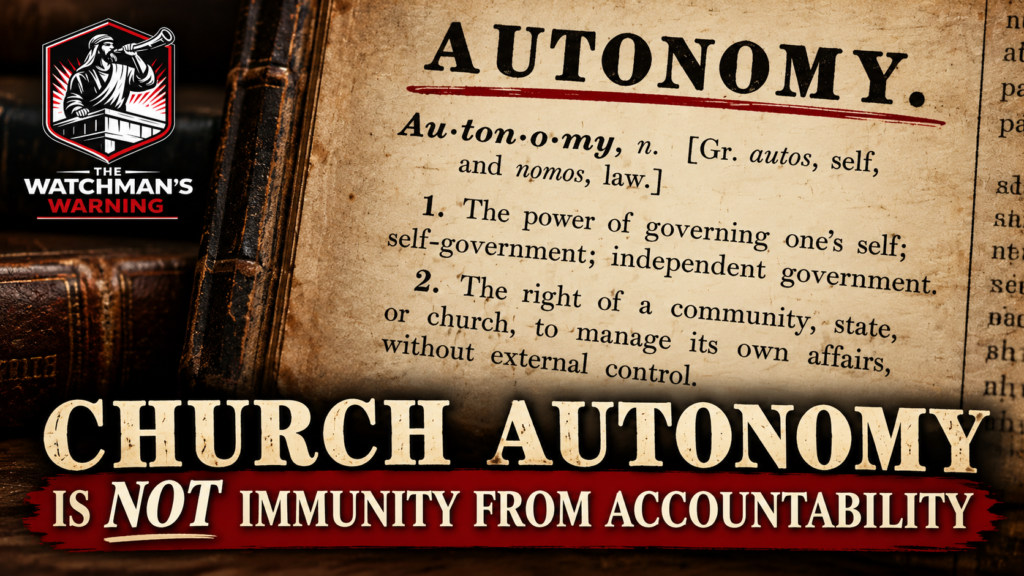
The Baptist distinctive of local church autonomy has never meant that a congregation or its pastor is beyond biblical criticism, correction, or rebuke.
Among the historic Baptist distinctives, few have been more misunderstood and misapplied than the autonomy of the local church. What was intended to preserve the headship of Jesus Christ over His churches has sometimes been twisted into a doctrine of ecclesiastical immunity. Under this mistaken understanding, a pastor may preach false doctrine, a congregation may tolerate open sin, and a church may depart from the plain teachings of Scripture, yet anyone who dares to address these matters is quickly reminded that the offending church is autonomous. We are told that the church answers to God alone and that everyone else should mind their own business and leave the matter to the judgment of God.
This argument may sound spiritual, but it is neither biblical nor historically Baptist. It confuses independence of government with immunity from accountability. Worse still, it takes a doctrine intended to protect the authority of Jesus Christ and employs it to protect men from the authority of His word.
The autonomy of the local church is a biblical principle worth defending, but autonomy is not sovereignty. Jesus Christ alone is sovereign over His church.
The word autonomy refers to self-government. Within Baptist ecclesiology, it describes the right and responsibility of each local congregation to govern its own affairs without the controlling authority of another congregation, denomination, association, bishop, or civil government. Each local church is directly accountable to Jesus Christ, who is its Head. Colossians 1:18 declares, “And he is the head of the body, the church.” Likewise, Ephesians 1:22 identifies Christ as “the head over all things to the church.” The local congregation, as the earthly manifestation of Christ’s heavenly church in a particular place, is responsible for demonstrating its submission to that Head through obedience to the Bible.
This government is exercised under the authority of Scripture, with pastoral oversight provided by biblically qualified elders. Acts 14:23 records the ordination of elders in the churches, while Acts 20:28 commands those elders to oversee the flock over which the Holy Ghost has made them overseers. First Peter 5:3 expressly forbids pastors from acting as “lords over God’s heritage.” Consequently, neither a pastor nor a congregation possesses unlimited authority. The pastor is not the head of the church, and the congregation is not the final authority over the church. Jesus Christ is the Head, and the Scriptures governs both.
An autonomous church is not a church free to do as it pleases. It is a church responsible to govern itself according to the Scriptures.
One of the most common objections to the public correction of a church or pastor is the assertion that Christians ought not to judge one another. However, this objection generally relies upon a selective reading of the Bible. Jesus Christ commanded in John 7:24, “Judge not according to the appearance, but judge righteous judgment.” The prohibition against hypocritical judgment in Matthew 7 does not abolish righteous discernment. Christ’s instruction concerning removing the beam from one’s own eye presupposes that, once corrected, a man may see clearly to address the mote in his brother’s eye.
Paul went further in 1 Corinthians 5, where he rebuked the Corinthian church for tolerating grievous immorality within its membership. Rather than congratulating the congregation for respecting the personal affairs of the offender, Paul demanded action. In verse 12, he asked, “do not ye judge them that are within?” Notice that Paul was writing to a distinct local congregation. He did not regard its local government as a prohibition against apostolic correction. He openly identified its failure, condemned its toleration of sin, and instructed the church concerning the discipline it was responsible to administer. Although Paul’s apostolic authority was unique, his example establishes that a congregation’s local identity does not place its conduct beyond biblical examination.
Scripture does not merely permit the identification of dangerous doctrine — It commands it. Romans 16:17 instructs believers to “mark them which cause divisions and offences contrary to the doctrine which ye have learned; and avoid them.” Titus 3:10 commands, “A man that is an heretick after the first and second admonition reject.” These instructions establish that doctrinal error must not be ignored under the pretense of Christian unity.
Paul instructed Timothy in 1 Timothy 5:20, “Them that sin rebuke before all, that others also may fear.” The surrounding passage concerns accusations against elders and requires sufficient witnesses before an accusation is received. Public rebuke is therefore not a license to circulate rumors or attack pastors over personal disagreements. Nevertheless, when wrongdoing has been established and public correction is warranted, pastoral office does not provide immunity.
Paul himself demonstrated this principle when he confronted Peter in Galatians 2:11–14. Peter’s conduct had compromised the truth of the gospel and influenced others, including Barnabas. Paul therefore withstood him to the face and addressed the matter before them all. If an apostle could be publicly corrected for conduct contrary to the gospel, surely a Baptist pastor cannot appeal to church autonomy as protection against biblical examination.
The Apostle John provides another striking example in 3 John 9-10. Diotrephes loved preeminence, rejected apostolic authority, spoke maliciously against faithful brethren, and cast others out of the church. John did not excuse this conduct because it occurred within another congregation. He announced his intention to confront the matter. The abusive exercise of local authority was not beyond correction.
Neither is the concept of mutual accountability foreign to Baptist history. Though I do not fully affirm most historic confessions and creeds, they are highly beneficial to our understanding of how doctrinal truths were viewed and applied throughout church history. The First London Baptist Confession, in its 1646 edition, acknowledged that distinct congregations were separate bodies while insisting that they should seek the counsel and assistance of one another. Article 47 recognized their common obligation to walk according to the same rule under Christ, their only Head.1
The Second London Baptist Confession of 1689 was even more explicit. Chapter 26, paragraph 14, taught that churches should maintain communion with one another for their mutual edification. Paragraph 15 addressed difficulties involving doctrine, church administration, and even unjust disciplinary proceedings. It affirmed that churches in fellowship could send messengers to consider such controversies and offer advice. Yet it carefully denied those messengers jurisdiction over the congregations or authority to impose their conclusions.
This historical distinction is devastating to the modern misconception of autonomy. Our Baptist forefathers recognized that churches could remain independent in government while being responsible to counsel, admonish, and assist one another. They understood that offering correction and exercising control were two entirely different things.2
The New Testament demonstrates the same principle through the cooperation of local congregations. The churches of Macedonia and Achaia contributed to the relief of impoverished saints in Jerusalem (Romans 15:25–27). Paul encouraged cooperation among congregations in 2 Corinthians 8 and 9. Churches commended ministers, received brethren, and assisted one another in the work of the gospel. Their independence did not require isolation, and their fellowship did not require surrendering their local government.
By the same principle, a congregation may withdraw fellowship, financial support, ministerial endorsement, or cooperative participation when another church departs from sound doctrine or tolerates serious misconduct. No autonomous church possesses the right to demand another congregation’s fellowship. Autonomy protects a church from unauthorized control; it does not entitle that church to the approval, cooperation, or silence of others.
Here is where the distinction must be maintained. One church does not possess the inherent authority to appoint or remove another church’s pastor, dictate its internal policies, or exercise disciplinary jurisdiction over its membership. Those responsibilities belong to the congregation itself under the authority of Christ and Scripture. However, the absence of jurisdiction does not eliminate the responsibility to speak the truth.
A pastor may publicly warn against false teaching without attempting to govern the church in which it is taught. A congregation may withdraw support from an erring ministry without claiming authority over its affairs. Christians may expose established misconduct without attempting to establish a denominational hierarchy. Such actions must be governed by Scripture, sufficient evidence, and a sincere concern for righteousness rather than personal resentment, rivalry, or rumor. Nevertheless, biblical correction does not become ecclesiastical interference merely because the offending party belongs to another congregation.
The Baptist doctrine of autonomy is worth defending precisely because it recognizes that Jesus Christ, rather than an earthly religious hierarchy, is the Head of the church. But when autonomy is invoked to silence legitimate criticism, conceal wrongdoing, or protect doctrinal corruption, the doctrine has been turned against its own foundation.
We must never confuse a church’s right to govern itself with a supposed right to govern itself contrary to Scripture without criticism.
Autonomy means freedom from unauthorized ecclesiastical control, not freedom from biblical accountability.
A church that appeals to the headship of Christ to defend its independence must also submit to the authority of Christ when the Bible exposes its errors. Anything less is not biblical autonomy. It is ecclesiastical arrogance masquerading as Baptist doctrine.
- The First London Confession of Faith (1646), art. 47. See The First London Baptist Confession of Faith ↩︎
- The Second London Baptist Confession of Faith (1677/1689), chap. 26, §§ 14–15. Of the Church ↩︎
For more cultural commentary, Bible studies, and interviews, subscribe to The Watchman’s Warning on YouTube.
To support the Watchman’s Warning, click HERE.
About The Author












Whew !!
Excellent !!
Great article!