
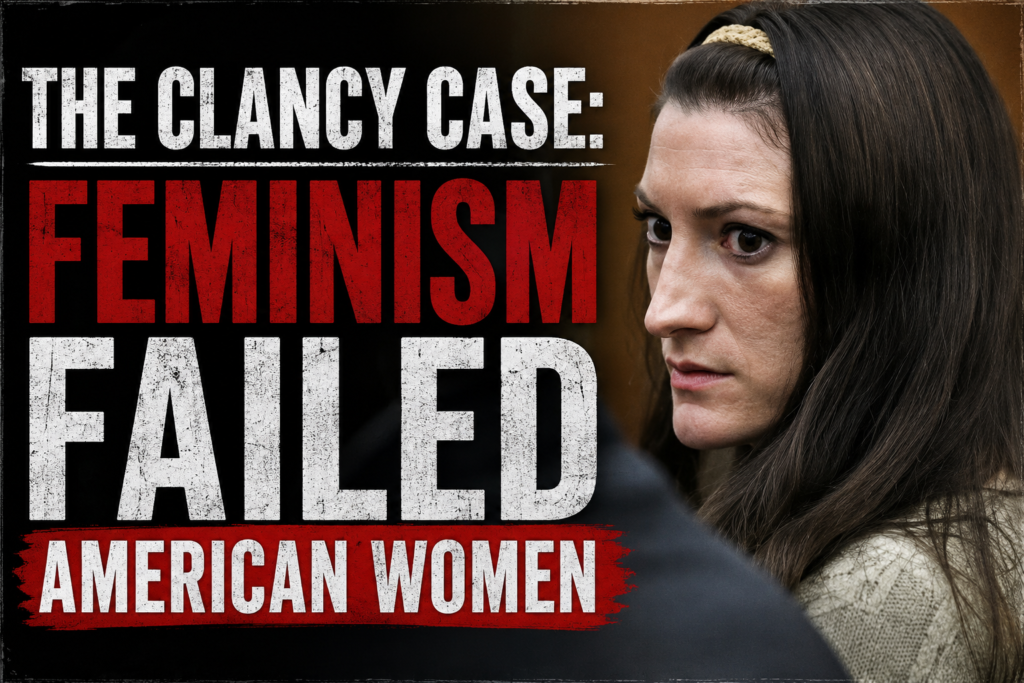
For decades, American women have been told that feminism was their liberation. The liberated woman would be independent. She would control her own body, determine her own destiny, pursue her own career, define her own sexuality, and answer to no man. Above everything else, she would be in control.
Then along comes a case like Lindsay Clancy.
There is no dispute about what Clancy did. On January 24, 2023, she strangled her three children, five-year-old Cora, three-year-old Dawson, and eight-month-old Callan, with exercise bands in the basement of their Massachusetts home. She then attempted to take her own life. Her defense does not deny that she killed them. The question before the jury is whether she was criminally responsible for doing it. Her attorneys argue that she was suffering from postpartum psychosis and could not properly appreciate the wrongfulness of her actions or control her conduct. Prosecutors argue that, although she suffered from mental illness, she knew right from wrong and deliberately killed her children.
I have no intention of diagnosing Lindsay Clancy. That is precisely why we have courts, expert testimony, evidence, and juries. But there is something about the arguments surrounding this trial that exposes a contradiction in modern American womanhood.
Feminism has spent generations demanding that women be regarded as autonomous human beings capable of governing themselves. Women can control their bodies. They can control their sexuality. They can control their careers. They can even control whether their unborn children live or die. The old-fashioned idea that a husband should exercise authority in his family is considered insulting precisely because the modern woman is supposedly perfectly capable of governing herself.
But when a woman does something horrible, suddenly our culture develops an extraordinary vocabulary for explaining her actions through everything surrounding her. Hormones. Trauma. Mental health. Medication. Society. Expectations. Men. Doctors. Circumstances.
That contradiction sits in the middle of the Clancy trial. The woman feminism tells us must be trusted with complete autonomy is now presented by the defense as a woman who could not control herself when she murdered her three children.
The problem goes deeper than the courtroom. Feminism did not simply teach women that they possessed agency. Women do possess agency. They are moral beings created by God who make choices and should answer for those choices. It taught them to use that agency to liberate themselves from the very institutions God created for their good. Liberation from injustice became liberation from husbands, motherhood, children, chastity, submission, domestic responsibility, and ultimately the distinctions of womanhood itself.
That is what makes the Clancy case such a disturbing picture of modern feminism. Here is a mother accused of murdering the three children entrusted to her care, while much of the public discussion centers upon what happened to her. Her mental condition. Her medication. Her doctors. Her postpartum experience. Her pressures. Her suffering.
In fact, feminism’s influence can reach even those we might expect to have developed an immunity to it. A Christian woman brought this trial to my attention, but her focus was not the murder of three children. Instead, she emphasized that Clancy’s husband should have been more involved and appeared distant in photographs. No amount of feminist rhetoric will convince me that, regardless of how poor a husband he may have been, his failures justified her strangling the life out of her babies.
Motherhood has obligations as surely as it has difficulties. The Bible never treats motherhood as merely another avenue for personal fulfillment. Children are an heritage of the Lord. A mother has been entrusted with lives outside of her own. Yet feminism has trained women to view virtually everything through the lens of the woman’s fulfillment and personal identity.
That is the opposite of motherhood.
Motherhood is fundamentally sacrificial. Babies do not care whether their mother is tired. Toddlers do not organize themselves around her career. Motherhood demands that a woman place the needs of another human being ahead of her own.
Feminism made self-fulfillment a virtue and then sent women into an institution built upon self-sacrifice. No wonder modern women are increasingly conflicted about motherhood.
Paul instructed the older women to teach the younger women “to love their husbands, to love their children, To be discreet, chaste, keepers at home” (Titus 2:4–5). He wrote elsewhere, “I will therefore that the younger women marry, bear children, guide the house” (1 Timothy 5:14). Scripture does not apologize for placing obligations upon women. God created women with responsibilities just as He created men with responsibilities.
The same is true of marriage. Feminism taught generations of women that submission was degrading. The thought that a husband should lead his wife became offensive. A woman answering to a husband was oppression, while answering to an employer somehow became independence. Throughout my childhood in the 1990s, sitcoms taught us that men were too stupid to lead a home.
Yet biblical marriage was never designed around two independent people determined to preserve their autonomy. “Wives, submit yourselves unto your own husbands, as unto the Lord” (Ephesians 5:22). The husband is then commanded to love his wife “even as Christ also loved the church, and gave himself for it” (Ephesians 5:25). She owes him submission. He owes her sacrificial love. Both have obligations.
Feminism attacked the woman’s obligation while irresponsible men happily abandoned theirs.
That same philosophy produced the sexual revolution. Women were told that chastity was oppressive and that sexual freedom was empowering. There was only one problem.
God did not redesign the female body to accommodate feminism.
Women still become pregnant. Sexual liberation changed social expectations, but it could not repeal biology.
This brings us back to Clancy, because the real issue exposed by this trial is responsibility.
There is a deadlocked jury in Massachusetts right now, with three female jurors reportedly wearing pink in solidarity with Clancy. The case has exposed a troubling tendency to explain a demonic crime primarily through emotions rather than responsibility. Feminism has taught women to demand autonomy separated from accountability. The jurors must now answer the question at the heart of every criminal trial: is Lindsay Clancy innocent or guilty?
But the rest of us should answer another one.
What kind of woman has feminism produced?
Want to Learn More?
If you would like to learn more about dispensationalism and how rightly dividing the word of truth helps you understand the Bible, click HERE to purchase Simply Dispensationalism, a straightforward introduction to dispensational thought and the literal interpretation of Scripture.
For those interested in a more structured study of the Scriptures, click HERE to learn more about Asheville Baptist Institute, our Bible institute dedicated to equipping students with a sound, practical, and Bible-believing education.
About The Author














Amen
Those sweet children are in heaven .
I Thank God for that !