
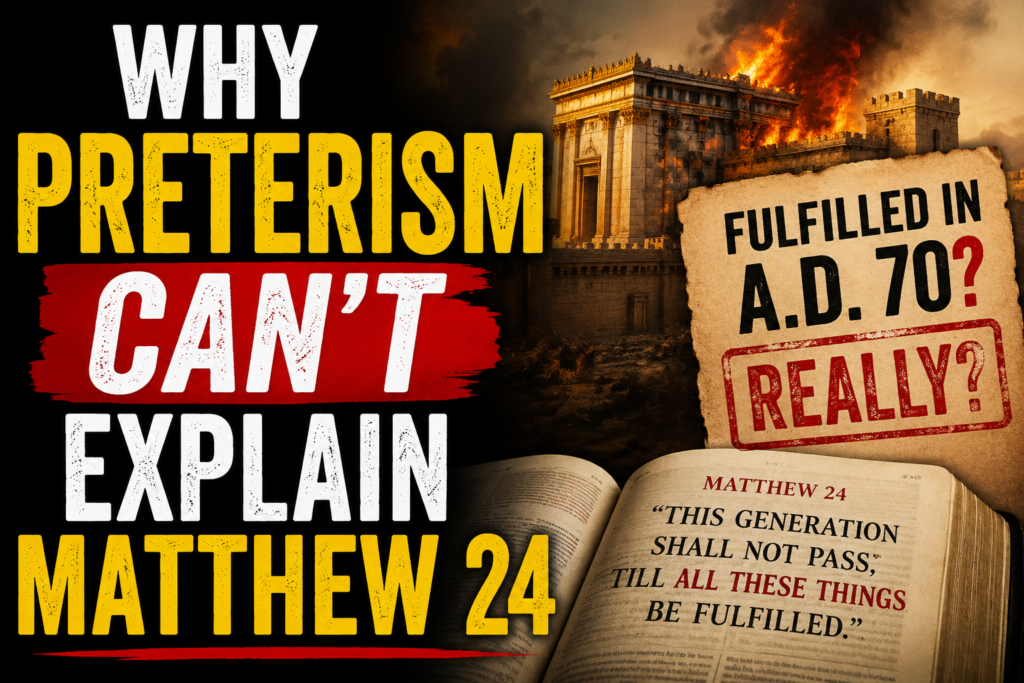
I received several private messages concerning my last article, The Most Embarrassing Verse in the Bible. From those, most addressed preterism. Before going further, it is helpful to define what preterism actually is. The word preterism comes from the Latin word praeter, meaning “past.” Broadly speaking, preterism is the belief that many, or even all, of the prophecies concerning the end times were fulfilled in the first century, particularly in A.D. 70 when the Romans destroyed Jerusalem and the Temple. Partial preterists maintain that some prophecies, such as Christ’s bodily return and the final resurrection, are still future. Full preterists go much further, arguing that virtually every prophecy, including Christ’s Second Coming and the resurrection, has already occurred. Because full preterism denies essential Christian doctrines, it has been rejected as heresy by the majority of Christianity, and definitely by Bible-Believers.
According to partial preterism, Jesus was not describing events that still await fulfillment. Rather, He was predicting the destruction of Jerusalem by the Romans. If that is true, then the phrase, “This generation shall not pass, till all these things be fulfilled,” simply refers to the generation living when Jesus spoke. The problem, however, is that this explanation only works if all, or even most, of the events Jesus described were actually fulfilled in A.D. 70. That is where the preterist interpretation begins to unravel or move into heresy.
The first difficulty is one that Jesus Himself emphasizes. He tells His disciples, “When ye therefore shall see the abomination of desolation, spoken of by Daniel the prophet, stand in the holy place…” (Matthew 24:15). Notice that Jesus deliberately points His audience back to the book of Daniel. He expects His hearers to interpret His words in light of Daniel’s prophecy.
There is no question that Titus desecrated the Temple and brought devastating judgment upon Jerusalem in A.D. 70. The question is whether those events exhausted Daniel’s prophecy and Jesus’ reference to the abomination of desolation. A literal, dispensational reading says no. Daniel 9:27 describes a coming ruler who confirms a covenant with Israel before breaking it midway through the seventieth week. Paul likewise speaks of a future “man of sin” who will sit in the temple of God (2 Thess. 2:3–4). These passages point beyond Titus to a future Antichrist and a future fulfillment.
Jesus then describes a period of suffering unlike anything the world has ever known. “For then shall be great tribulation, such as was not since the beginning of the world to this time, no, nor ever shall be” (Matthew 24:21). Those are remarkable words. No honest student of history would deny the horrors of A.D. 70, but can anyone truly say it was the greatest calamity the world has ever experienced, or that no greater calamity would ever follow? The Holocaust alone claimed the lives of millions of Jews. The two World Wars engulfed the entire globe. The book of Revelation describes judgments so severe that vast portions of the earth’s population perish. Jesus’ description reaches far beyond the destruction of one city. His language anticipates a unique period of judgment that still lies ahead.
The problems only become greater as the discourse continues. Jesus declares that immediately after the tribulation, “the sun shall be darkened, and the moon shall not give her light, and the stars shall fall from heaven” (Matthew 24:29). Were these literal events? If not, what in the passage tells us to abandon the ordinary meaning of language? Preterists generally argue that these are symbolic expressions borrowed from the Old Testament to describe the fall of nations. While it is true that prophetic literature can employ vivid imagery, Jesus does not present these events as poetic metaphors. He presents them as signs that immediately precede His appearing. A literal interpretation allows the text to say exactly what it says without requiring the reader to determine where symbolism begins and literal meaning ends.
The greatest obstacle to preterism, however, is found in the very next verses. Jesus says, “Then shall appear the sign of the Son of man in heaven… and they shall see the Son of man coming in the clouds of heaven with power and great glory” (Matthew 24:30). This is not merely language of judgment. It is language of arrival. It is the visible, glorious appearing of Jesus Christ at the Second Advent. The preterist argues that Christ “came” in judgment through the Roman armies, but that is not what Jesus describes. He does not say the Romans would come. He says the Son of Man would come. Nor does Acts 1 leave room for such a symbolic interpretation. As the disciples watched Jesus ascend bodily into heaven, the angels declared, “This same Jesus… shall so come in like manner as ye have seen him go into heaven.” The One who departed visibly will return visibly.
Nor can the gathering of the elect be comfortably placed into A.D. 70. Jesus says that He “shall send his angels with a great sound of a trumpet, and they shall gather together his elect from the four winds” (Matthew 24:31). Where in history did this occur? When did angels gather God’s people from every corner of the earth? Again, the most natural reading is also the simplest: this event has not yet taken place because it awaits the future return of Christ.
At this point, the real issue becomes apparent. The debate is not merely about one verse. It is about one method of interpretation. Should prophecy be interpreted literally unless the text clearly indicates otherwise, or should it be spiritualized whenever a literal fulfillment presents difficulties? This is why I remain convinced that a literal, dispensational approach provides the clearest understanding of Matthew 24. It allows Israel to remain Israel. It allows the Tribulation to remain future. It distinguishes the Rapture of the Church from the Second Coming of Christ. Most importantly, it allows every prophecy to retain its ordinary meaning until Scripture itself indicates otherwise.
Ironically, preterism is often presented as the solution to the supposed problem of Matthew 24:34, yet it creates far greater interpretive problems than it resolves. It requires the reader to redefine the Great Tribulation, reinterpret the cosmic signs, spiritualize the visible return of Christ, and relocate the gathering of the elect into an event where history records none of those things occurring. The simpler explanation is the better one. Jesus meant what He said.
Jerusalem’s destruction in A.D. 70 was indeed a fulfillment of Christ’s warning concerning the temple, but it was not the fulfillment of everything He described in the Olivet Discourse. The Great Tribulation is still future. The visible return of Christ is still future. His earthly kingdom is still future. That is why the Church continues to look upward with expectation. Our Lord has not failed to keep His promise. He has simply not fulfilled it yet. And just as every prophecy concerning His first coming came to pass exactly as written, so every prophecy concerning His second coming will as well.
About The Author













Amen
Excellent
Thank you