
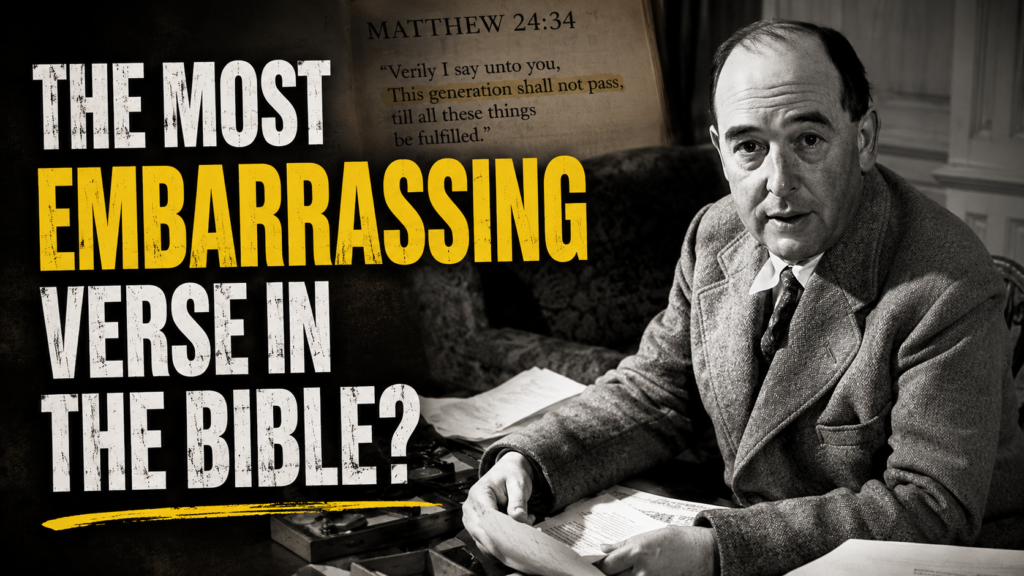
“[Matthew 24:34] is certainly the most embarrassing verse in the Bible.”
Those were the words of C. S. Lewis concerning Matthew 24:34: “Verily I say unto you, This generation shall not pass, till all these things be fulfilled.”
For decades, skeptics have echoed Lewis’s assessment. They argue that Jesus expected to return during the lifetime of His first disciples. Since that generation has long since passed away, they conclude that either the apostles misunderstood Christ or, even worse, Christ Himself was mistaken. If true, Matthew 24 would present a serious challenge to the reliability of Christ’s words.
The problem, however, is not with the text. The problem is with the interpretation.
Lewis’s conclusion rests upon a failure to distinguish between two distinct future events: the Rapture of the Church and the Second Coming of Jesus Christ. Once those events are properly distinguished, the supposed contradiction disappears. In fact, Matthew 24 becomes one of the strongest arguments for a consistent literal, dispensational interpretation of biblical prophecy.
The New Testament teaches that the Church is waiting for the Rapture. This is the “blessed hope” of every believer (Titus 2:13). At the Rapture, Christ comes in the clouds to receive His Church unto Himself (1 Thessalonians 4:16–17). No signs are given that must precede this event. No prophetic countdown is provided. Believers are simply commanded to watch, to be ready, and to live in constant expectation because Christ could come at any moment.
Matthew 24 is describing something altogether different.
The disciples did not ask Jesus about the Rapture. They asked Him, “What shall be the sign of thy coming, and of the end of the world?” (Matthew 24:3). Jesus answered by describing events that will occur during the future Tribulation: false christs, worldwide deception, wars, famines, persecution, the abomination of desolation, unparalleled suffering, cosmic disturbances, and finally His glorious return to earth in power and great glory. These are not signs preceding the Rapture. They are signs preceding the Second Coming.
This distinction is absolutely essential.
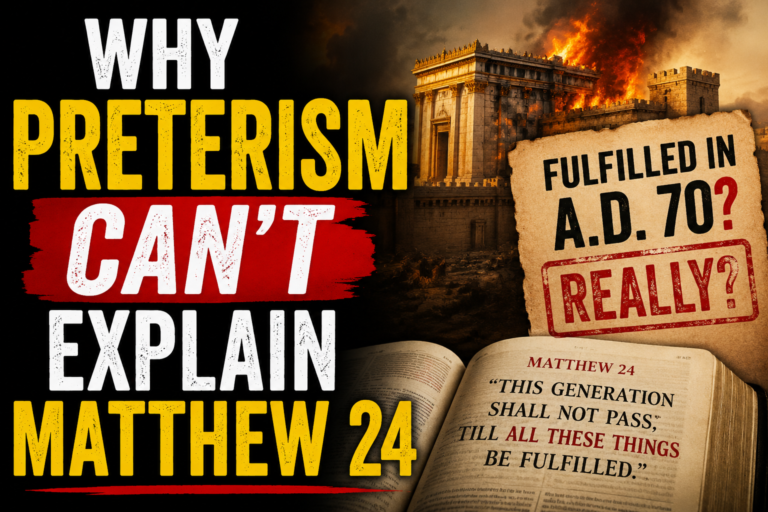
If Matthew 24 concerns the Second Coming rather than the Rapture, then Jesus is not teaching that His return to gather the Church would occur within the apostles’ lifetime. Instead, He is speaking to those who will witness the events of the Tribulation. Immediately before verse 34 He declares, “So likewise ye, when ye shall see all these things, know that it is near, even at the doors.” He then says, “This generation shall not pass, till all these things be fulfilled.”
The phrase “this generation” naturally refers to the generation that sees “all these things.” In other words, the people alive when the Tribulation begins and the prophetic signs unfold will live to see Christ’s visible return. Jesus is not referring to the generation standing before Him on the Mount of Olives. He is referring to the future generation that witnesses the fulfillment of the very events He has just described.
A consistent literal, dispensational interpretation allows every part of the passage to be understood exactly as it is written. The Tribulation is a literal future period. Israel remains central to God’s prophetic program. The judgments are literal. Christ’s return is literal. His kingdom is literal. Because those events are still future, “this generation” must likewise refer to the future generation that experiences them.
Ironically, the very passage critics claim disproves Christianity actually demonstrates the precision of biblical prophecy. The difficulty arises only when the Rapture and the Second Coming are merged into a single event or when Matthew 24 is detached from its prophetic context. Scripture itself never requires either conclusion.
The doctrine of imminency belongs to the Rapture, not the Second Coming. The Church waits for Christ without signs because no revealed event must occur before He comes for His bride. The world, however, will not be without warning before Christ returns in judgment. The Tribulation will unfold exactly as Jesus described it, and the generation that witnesses those events will also witness His glorious appearing.
Far from being the Bible’s most embarrassing verse, Matthew 24:34 stands as another testimony to the consistency and accuracy of God’s word. Christ was not mistaken. The apostles were not confused. The confusion has arisen because too many interpreters have failed to distinguish what God has distinguished. When the Rapture is kept separate from the Second Coming and prophecy is interpreted literally, the so-called problem vanishes, leaving behind not an embarrassment, but another reason to trust every word our Savior spoke.
About The Author












Thank you
Excellent