
Few phrases in Scripture generate more confusion than the expression “the last days.” Some people assume the phrase always refers to the final moments of world history, while others treat it as a vague description of the end times. Yet when we examine the Bible carefully, we discover that the phrase is used in more than one sense.
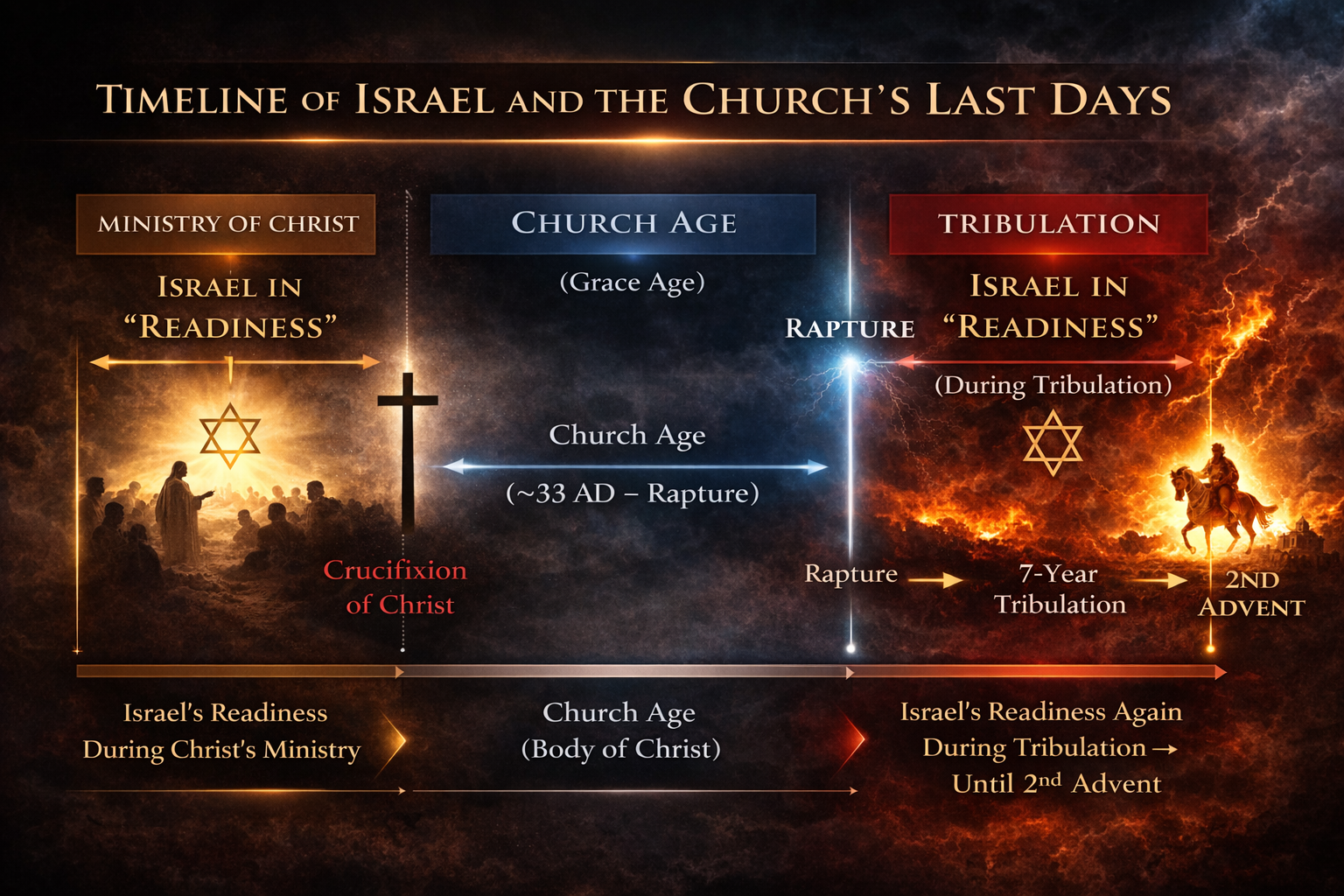
To understand prophecy properly, we must pay attention to who is being addressed and what program of God is in view. Scripture uses the expression “the last days” in at least three distinct ways: in reference to Christ’s revelation, in reference to Israel, and in reference to the Church.
1. The Last Days of Revelation: The Age of Christ
First, the New Testament describes the period beginning with the ministry of Christ as the last days in terms of God’s revelation.
The book of Hebrews opens with these words, “God, who at sundry times and in divers manners spake in time past unto the fathers by the prophets, Hath in these last days spoken unto us by his Son.”
— Hebrews 1:1–2 (KJV)
Here the writer is not speaking about the final generation of human history. Instead, he is explaining that the coming of Christ marked the final stage of God’s redemptive revelation. Throughout the Old Testament, God spoke through prophets and partial revelation. But in the coming of Christ, God spoke through His Son in the fullest and final sense.
From this perspective, the “last days” began with the first advent of Christ. We are living in the final era of God’s revealed plan before the consummation of all things.
2. The Last Days Concerning Israel
The phrase “last days” is also used in the Old Testament in connection with Israel’s future restoration and kingdom blessing.
Jesus spoke of events connected to Israel’s future in His Olivet Discourse in Matthew 24, which is deeply rooted in Old Testament prophecy concerning the nation of Israel. These prophecies look forward to a time when Israel will be restored, exalted, and blessed in the physical Messianic kingdom that will be set up upon this earth.
The prophets describe this period clearly:
“And it shall come to pass in the last days, that the mountain of the Lord’s house shall be established in the top of the mountains . . . and all nations shall flow unto it.”
— Isaiah 2:2 (KJV)
Micah echoes the same prophecy:
“But in the last days it shall come to pass, that the mountain of the house of the Lord shall be established in the top of the mountains.”
— Micah 4:1 (KJV)
These passages describe a future era when Christ reigns and the nations come to Jerusalem. In this sense, the last days refer to the culmination of Israel’s history, when God fulfills His covenant promises to the nation.
The reference point here is Israel’s prophetic program, not the Church.
3. The Last Days of the Church Age
The New Testament also speaks of the last days in connection with the Church. In these passages, the phrase describes the moral and spiritual condition that will characterize the end of the present age.
Paul warned Timothy,
“This know also, that in the last days perilous times shall come.”
— 2 Timothy 3:1 (KJV)
He then lists the characteristics of this period: selfishness, pride, rebellion, and religious hypocrisy. These warnings are echoed elsewhere in the New Testament:
- 1 Timothy 4:1–3 speaks of some departing from the faith.
- 2 Peter 3:3 warns that scoffers will arise in the last days.
- Jude 17–19 describes mockers who follow their own ungodly desires.
These passages describe declension and apostasy within the professing Christian world as the present age draws toward its conclusion.
A Necessary Distinction
Recognizing these different uses of the phrase is essential for understanding biblical prophecy.
C. I. Scofield summarized this well,
“A distinction must be observed between ‘the last days’ when the prediction relates to Israel, and the ‘last days’ when the prediction relates to the church… The ‘last days’ as related to the church began with the advent of Christ… The ‘last days’ as related to Israel are the days of Israel’s exaltation and blessing, and are synonymous with the kingdom-age… They are ‘last’ not with reference to this dispensation, but with reference to the whole of Israel’s history.”
— C. I. Scofield, note on Acts 2:17
Scofield also noted another important distinction: the Bible sometimes speaks of “the last day” (singular), which refers to the resurrection and final judgment (John 6:39–40; 11:24; 12:48). This is different from the phrase “last days” (plural) used in prophetic contexts.
Understanding these distinctions helps prevent confusion when reading prophetic passages. Not every reference to the “last days” is speaking about the exact same event.
- Hebrews 1:2 refers to the final era of God’s revelation beginning with Christ.
- Old Testament prophecies describe the last days of Israel when the kingdom is established.
- New Testament warnings describe the moral decline of the Church age as history approaches its climax.
Each usage must be interpreted within its proper context.
The Bible does not leave us guessing about the nature of the times in which we live. Scripture teaches that we are living in the closing era of God’s redemptive plan, a time marked both by the proclamation of the gospel and by increasing spiritual deception.
For believers, the purpose of studying the last days is not speculation but watchfulness and faithfulness.
As Paul wrote,
“Looking for that blessed hope, and the glorious appearing of the great God and our Saviour Jesus Christ.”
— Titus 2:13 (KJV)
The study of the last days ultimately points us to one great truth: Christ is coming again.
About the Author